• Please note that Audiokarma will be offline briefly for updates early on Monday morning, September 28th.

Antennas and FM audio quality

jhoyt

Incomprehensible space llama
I keep hearing that I can take my tuner's sound quality to an exalted plane by using a super-duper antenna. Here's the issue--I have been using "gimme" dipoles exclusively (because that's all I have), and have always thought I got good sound. And, I live in a metro area where fringe stations are not an issue.

What's the straight story on actual sound quality with different antennae?

Currently using Audio Dynamics T-200 (aka DBX TX-3)
Previously used Kenwood KT-880D, KT-6500

Thanks for the opinions!
 
Register to hide this ad
I think the question is the amount of signal into the tuner. If a dipole gets you a strong signal, for the stations important to you, that may be all you need.
 
True

I think the question is the amount of signal into the tuner. If a dipole gets you a strong signal, for the stations important to you, that may be all you need.
An antenna* doesn't have a sound signature. All it's supposed to do is yank signals out of the air and feed the to the tuner, which is the determining factor in the sound quality. A poor signal will deliver poor sound quality.

A tuner reaches it's maximum "quieting" level at a certain signal strength. Anything more than that is wasted. But, some tuners can be overdriven if the signal strengrth is too high so a monstor antenna is not always your friend.

Since you're in a metro area and, Im assuming, most of your target stations are fairly local, you probably could get by with a "good" antenna.

Use this little tool to see what kind of distances and directions you're talking about and take it from there: http://www.radio-locator.com/
 
Last edited:
All that may be true but . . .

it never ceases to amaze me how many antenna comparisons I read about in which a simple dipole just wins. . .

I keep hearing that I can take my tuner's sound quality to an exalted plane by using a super-duper antenna. Here's the issue--I have been using "gimme" dipoles exclusively (because that's all I have), and have always thought I got good sound. And, I live in a metro area where fringe stations are not an issue.

What's the straight story on actual sound quality with different antennae?

Currently using Audio Dynamics T-200 (aka DBX TX-3)
Previously used Kenwood KT-880D, KT-6500

Thanks for the opinions!
 
Yep. Sometimes that's all it takes.

it never ceases to amaze me how many antenna comparisons I read about in which a simple dipole just wins. . .
Like Goldilocks says, it's not too hot, it's not too cold. It's just right.

I'm in a metro area with toms of stations in all directions and I've been using Rat Shack's version of this little Antennacraft turnstile antenna for years and it fills my dial. It's essentially two folded dipoles mounted at 90 degrees from each other to make it onmnidirectional.

If I were in the sticks or wanted to pick up a weak, distant station, then it would be another story.
 

Attachments

  • Antenna FMSS.gif
    Antenna FMSS.gif
    2.6 KB · Views: 48
You are correct, sir.

This is definitely wrong. Each of my tuners has its own sound. Different sound-stage, etc.
It should have said "An antenna doesn't have a sound signature".

Good catch.

I'll edit and correct that now.
 
Guys,

Reno ain't New Jersey (except maybe culturally.)

An antenna can have TWO functions. First is GAIN - delivering RF power to the tuner. The second function is REJECTION.

FM signals can bounce around a good bit, especially where there are mountains or tall buildings - Reno has both. A reflection of a station's signal off a mountain can arrive just behind the direct signal and confuse the heck out of your tuner. An adjacent or alternate station (or certain multiples of frequency) can also talk-over your signal.

That's why a directional antenna has two main metrics - forward gain and front-to-rear rejection. The little turnstile antenna is omnidirectional - it has neither gain nor rejection and could be a bad choice for most of Reno.

Being in the Reno metropolitian area means that forward gain is not a factor so the best antenna would be one with the greatest front-to-back rejection.

What I'd recommend would then be the APS-9B for about $100. It doesn't have the forward gain of the Winegard for about the same price but it has significantly better rejection. (http://www.antennaperformance.com)

If that's too much $$$ or too long (8.25 feet) then the Radio Shack antenna for $25.

The ribbon dipole is not bad and will probably be better than the turnstyle or j-pole omnidirectional antennae.

A highly directional antenna can improve the sound, especially in high multipath areas with a number of powerful transmitters in the area. You will need to tweak it - the best sound might not come from pointing it directly at the transmitting antenna.
 
For what its worth, I've got about 10 Marantz receivers scattered throughout my house and, at one point in time, almost all of them were using a Terk tower-type antenna. This is the type you have to plug into an electrical outlet.

Over time, I've found that I'm better off and have a lot less trouble with the plain old ordinary cheap dipoles and that's all I'm using now. My home is located about 10 miles from downtown Cleveland.
 
For what its worth, I've got about 10 Marantz receivers scattered throughout my house and, at one point in time, almost all of them were using a Terk tower-type antenna. This is the type you have to plug into an electrical outlet.

Over time, I've found that I'm better off and have a lot less trouble with the plain old ordinary cheap dipoles and that's all I'm using now. My home is located about 10 miles from downtown Cleveland.

I have an Aiwa bookshelf stereo system with a Terk tower antenna, as well as several AM/FM portables with whip antennas and several vintage AM/FM radios with line-cord antennas. I am about 35 miles from downtown Cleveland and get every one of the city's major FM stations just fine, in addition to several stations in outlying areas and at least two NPR stations, one of which is a translator for an NPR station some 60 miles south of here. The only Cleveland station I don't get over the air is the classical station on 104.9, as there is a very strong country station just 0.2 MHz down the dial that obliterates the classical station.

The Terk antenna is good, but the amplifier gain must be adjusted very carefully to prevent overloading the front end of your tuner or receiver. If you are only, say, 10 miles or so from the stations you may not need the amplifier at all. In fact, I have heard that the amplifier in the Terk tower antenna will not only increase the signal strength of the desired station(s), but will also amplify any and all noise the antenna receives, so your reception may be worse with the amplifier on than with it switched off. You are (as you have discovered) better off with plain and simple unamplified dipoles; being in a suburban area you probably have plenty of signal from every station in town. If you still want to use the Terk antenna on any of your receivers, disconnect the wall-wart from the jack on the back of the antenna and forget about it. Without the amplifier your tower antenna will work about as well as any dipole or other unamplified antenna.
 
Hi There,
I have been searching and spending way too much on indoor antennas.
(I live in an apartment)
Recently I acquired a Vintage Fisher SS Receiver in near mint condition. What was surprising to me, it had a UHF "bow tie" antenna from the '60-'70's with the manual and info.
For fun I removed the $100.00 "waste of money" FM antenna from my
Mcintosh 1900. It worked better. Infact it worked better than any of the antenna's in my collection. Which includes an overly expensive dipole and a down right cheap one.
I'll stop by the radio electronic shop and see if I can pick up a few more.
"Good Listening"
nikkofan
 
I have the APS 9B and also the Radio Shack model.One advantage to the RS is that unless you have your heart set on a station at the outer fringe of reception,you can point it at and pick up signals not strong enough on a dipole.But, the rejection is low enough that you can pick up most strong stations without having to turn the antenna.It's a PITA to move your antenna every time you want to see what is happening on another frequency.
 
jhoyt, see.... had you stayed in Brainerd it would have been a lot easier. 107.5, 103.5 and all you need is a dipole. 101.5 is now bad classic rock and you'd need a rooftop antenna, a rotator and a barf bucket.

As everyone said above, a different antenna will help with stations you are having a hard time with now. And to put Whitehall's fine post differently, if two stations are nearby in frequency, the front/back features of a rooftop type antenna can help you find the station you want.

It also depends on your tuner and how wide a swath of bandwidth it allows in. Even with my Antennacraft and a rotator, I still can't get get 90.1 in St Cloud out from behind 90.7 in Pillager unless 90.7 is off air. On my Luxman I can get 90.1 but it sounds like crap.
 
Hey Holst-what are you guys doing in my neighborhood. I'm in Darwin(home of the worlds largest ball of twine, dontcha know), and I am looking for good rock & roll. St. Cloud 103.7, Wilmar, 94.1 and KQRS 92.5 are all different directions for me. I think the Radio Shack turnstile antenna that was mentioned earlier is maybe the best solution. I don't have one but will try to get it.
The turnstile uses a 'trick' in order to get omni-directional horizontal polarization - and it isn't anything I can make myself because it requires a carefully cut 90 degree length of feedline.
 
Holst, you're making me miss Brainerd. Now stop it. Sounds like you need to install a commode diode in line with your antenna. That will filter out all crappy content, such as 101.5.

RIP Froggy.
 
Guys,


What I'd recommend would then be the APS-9B for about $100. It doesn't have the forward gain of the Winegard for about the same price but it has significantly better rejection. (http://www.antennaperformance.com)

I went from the Wingard to an APS13 because of the better rejection figures and slightly higher gain. Was hoping it was enough to tune out a local 300 watt Christian station that's on the same freq as some other distant stations I wanted to get. Not enough. The APS is definitely better than the Wingard, but not by much, the specs are better, but in real world performance, in most cases it's not really noticeable.

The build quality on the Wingard is much better than the APS. In hind sight I probably should have just stuck with the Wingard and saved myself a couple hundred dollars.

Another thing to look at is the beamwidth, the gain patterns usually shown in the specs. The narrower the pattern the more directional the antenna will be.

Haven't used the Rat shack or APS9 antennas
 
I haven't seen in person the APS antennas so Punker X's experience is very useful.

I will say that when I got my new Winegard home, it was missing a couple of elements! I called the store and they didn't have a replacement in stock. A call to the factory got me a new one overnighted! I'd call that excellent customer service.
 
Hey Holst-what are you guys doing in my neighborhood. I'm in Darwin(home of the worlds largest ball of twine, dontcha know), and I am looking for good rock & roll. St. Cloud 103.7, Wilmar, 94.1 and KQRS 92.5 are all different directions for me. I think the Radio Shack turnstile antenna that was mentioned earlier is maybe the best solution. I don't have one but will try to get it.
The turnstile uses a 'trick' in order to get omni-directional horizontal polarization - and it isn't anything I can make myself because it requires a carefully cut 90 degree length of feedline.

Hey, a buddy of mine is now chief engineer at KQRS.

I went from the Wingard to an APS13 because of the better rejection figures and slightly higher gain. Was hoping it was enough to tune out a local 300 watt Christian station that's on the same freq as some other distant stations I wanted to get. Not enough. The APS is definitely better than the Wingard, but not by much, the specs are better, but in real world performance, in most cases it's not really noticeable.

The build quality on the Wingard is much better than the APS. In hind sight I probably should have just stuck with the Wingard and saved myself a couple hundred dollars.

Another thing to look at is the beamwidth, the gain patterns usually shown in the specs. The narrower the pattern the more directional the antenna will be.

Haven't used the Rat shack or APS9 antennas

Good info, I've thought about buying a better antenna, the built quality thing is good to hear.. that and Whitehalls customer service experiance.
 
My experience is that a good antenna will yield better results than a 300 ohm wire dipole up to point. Got your tune in the basement on a dipole; get antenna above ground. The beeter the gain generally the better but you can have a good antenna and b/c of the cable loss have no more signal than with the dipole. The big issue is aiming the antenna for best strength. Swinging a dipole is a bit unweildy. Also, verticles such as whips are not necessarily better and may be worse.

I a in the process of evaluating 2 receivers and am using identical dipoles for evaluation. The unit that was purported to be the better had not synergy with my speakers systems and overall sounded rather poorly. Finally found that it was more sensitive to multipath than the "lesser" unit. I had been rotating the dipole using the wrong tuner. When I used the "better" unit to minimize the multipath, the speaker synergy improved greatly. Sound of the lesser unit did not change at all.
 
I dicked around with dipoles and indoor antennas for decades. What a mistake! I now use an APS13 with a Modafferi modded MR78 and an Antenna Performance Specialties modded TU9900, which has been a revelation. If you want good performance from your tuners and receivers get an outdoor antenna with a rotor and you will not regret it.

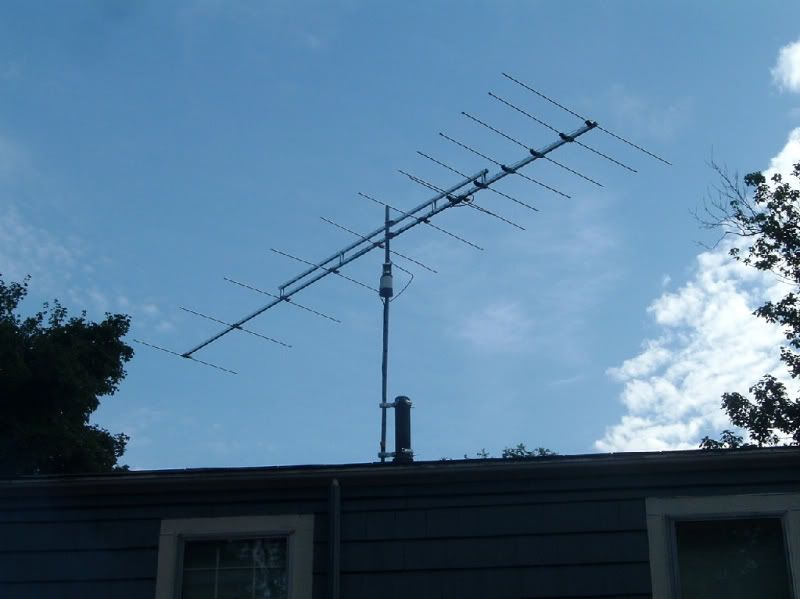
house038.jpg


This is a Picture of the APS13 on my house.
 
Back
Top Bottom