• The move to the new server is done. There are some software and database maintenance updates in process. This has us passing the hat around to help out. We appreciate any donations. Seriously, even a dollar helps. The payment page may be found here - https://www.audiokarma.org/support.html

Flexy rack materials Q's (wood type and rod sizes)

I'm looking to build a flexy-style shelf for my main rig, which isn't all that special, actually. No 200-pound turntable plinths or 100 pound monobloc sets for this guy. It's going to be a five-shelf unit made from four 36" threaded rods and using 16"x24" shelves.

I have a choice of materials, with MDF (painted a neutral color) and birch plywood (with birch veneer tape) for the shelves, and with 1/2" and 5/8" threaded rod appearing to both work.

The challenge is the cost. A 1/2" with MDF is about half the price of a 5/8" with the birch plywood ($66 to $118 with tax, all the hardware, finishing stuff I don't already own and a couple of hockey pucks to sit under it to dampen vibrations... got bored before work, lol).

I guess the questions come down to this:
1) Is 5/8 necessary, or will 1/2 work? I see 3/4 or 5/8 suggested for the 3-post models, but I'd be OK with a 4-post model if it means materials are cheaper.
2) Other than looks and ease of finish, are there advantages to the plywood over MDF to justify an extra money?

Extra credit:
Since I don't have a ton of weight (like a 100-watt Kenwood receiver from the late 90s is the heaviest), and each component will get its own shelf, could I go with thinner plywood even?
 
Register to hide this ad
Part of this plywood/mdf question may be answered by what finish you were planning on using. If paint is where it ends up I would be skipping the birch, but sticking with plywood. I used 3/4 exterior and 1/2" rod. When you see the pic you will figure out why I stuck with the 3/4 http://www.audiokarma.org/forums/attachment.php?attachmentid=441149&d=1373345636.
Anyway, filler doesnt cost much, and I assume you arent paying yourself (except of course with the satisfaction of another DIY job well done).
I'm probably old fashioned, but I am just not a believer as far as mdf making a good shelf, unless, you are willing to glue (construction adhesive) a brace on the bottom of the shelf from right to left. You could probably just use one, about 2/3 of the way towards the back or so. Making moves like that with pine or angle could let you lighten up the thickness besides, however, you would have to recalculate costs if you dont already have such things on hand.
You can use 1/2" rod as long as it isnt too far between the shelves, I would think you could get away with a foot if you had to, but less is better. My bottom shelf is about 14" to the middle one, but its also a whole lot longer with many more chunks of rod than 4, so in your case I would stay at 1' and under. I would also hedge my bet and use fender washers at least on the bottom of the shelves to help things stay stable.
Hope this helps a little.
 
Last edited:
I used 3/4 inch Allthread and 3/4 inch plywood for mine. It is very sturdy.:yes:

See my avatar.

Oops! I changed my avatar!
 
Last edited:
I'd suggest to go to a big-box store like Home Depot and buy two stair treads for the shelves. They come in either 36" -> 48" length and are over 1" thick. If you need or want the full depth of 16", buy a piece of board with the same thickness and glue/screw/nail it onto the back of the stair tread. You could even get three treads and rip one for that purpose or buy four and glue two of them together for a 23" depth.

Stair treads are finished (almost, light sanding needed) and have a rolled edge, perfect for shelves. They are thick enough so that the usual problem of a sagging shelf won't occur. Available in usual Pine or Red Oak

Pine stair tread
 
Build it right and don't try to skimp. You'll soon forget all about the minimal extra cost and have something nice to hold your gear. What would you save by cheaping out; 25-30 bucks maybe?
 
1/2 inch rod is plenty. Its under compression in this situation. The distance between shelves is short enough that it will not "flex". Use washers on both sides and tighten then snug. Fender washers are excellent. They spread the load and add stability.

You can get decent 1/2 construction ply or even 5/8 and 1) sand and paint, 2) fill and sand and stain or 3) "skin" it with a finish grade ply, sand and stain.

For 3. There are thin ply sheets available with a finish grade surface much cheaper than the heavy stuff. Get that, cut it to match the shelf size and glue it to the cheaper construction ply. Do it as shelves, don't try to do the whole sheet to whole sheet. Get a big bottle of glue, soak down a shelf and pile a lot of heavy things on it. (park the car on it). Let the glue ooze out and dry, then clean it up with the saw once dry and add the edge trim. You might be able to do all the shelves as one big stack.

I'd avoid MDF. It has no "flex" and will crack, break, snap if there ever is any twist. Getting the 4 rods evenly snug would be tough to get the MDF loaded without some uneven load.

FWIW, I saw some solid "slab" wood available at the DIY stores I think its pine slab, unfinished. Countertops? Seemed reasonable in price. Laminated, as in many narrow boards glued together. I didn't measure, but they seemed to be the right width. I'm thinking, cut to length an stained, they would look great.
 
Last edited:
I suppose that if one wanted to use mdf safely and the concern was direct pressure or cockedness of the rod through the mdf towards crumbling and breaking that one could make or find something that would act as a ferrule or an insert through the shelf.
If that ferrule had a washer attached on the bottom, then the mdf could just sit there. In other words the ferrule takes the pressure and abrasion and the mdf could just be sitting there and looking pretty.
All things are possible given money, time and material. Would it be worth it? I can't say, maybe so in the right situation which is a combination or preferences, tools available, budget and stubbornness.
 
Thanks, all. I'm going with the plywood and 1/2" rod (found the metal parts about $10 less at the local mom and pop hardware store, so that offsets half the cost of the plywood). The rods and ass. hardware (hehe, I said ass hardware) are in the living room and I'm going to get the wood tomorrow. All I need now are two 2x4' sections, a roll of edge veneer, and a can of light stain to wrap this up.

I figure if I don't like the 1/2", I can go buy the 5/8, bore out the holes slightly, and use the 1/2" hardware for something else, like making another rack for lighter duty like a spice rack.
 
Again, thanks for all the help, everyone... All done!


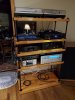
1/2" rods seem to work just fine with the 3/4" plywood. Went with four shelves because I just stacked most of my sources on the bottom. Hardest part was learning how to work with veneer edging and not tearing up the thin birch veneer on the plywood. All I blew was $80, plus I have leftover hardware and two shelves in the sun room. :banana:

Yes, my gear isn't exactly top tier stuff, so not too heavy... Fisher MT-6330 turntable with stock cart, CNC phono preamp (that alone made a drastic improvement on quality when I got that done up! Again, my thanks to the DIY crew here), Kenwood AR-404 receiver (I need to learn how to bypass the phono preamp so I can still use the input), Auvio HD tuner run through TOSLINK to the Teac CDW-D200 CD recorder (better DAC), and a cheap Realistic SCT-90 I grabbed to play the few tapes I own.

For the eighth time, I believe, thank you, all!
--Bob
 
Last edited:
That's a great looking job:yes: 1/2" rods and 3/4" ply are plenty strong enough especially with 4 rods. Glad to see you didn't cut corners and made yourself a nice looking and sturdy rack:thmbsp:.
 
I know this is an old thread but I am curious what did you use for the "feet"? Did you cover the bottom of the all thread where it meets the floor?
Thanks!
 
I know this is an old thread but I am curious what did you use for the "feet"? Did you cover the bottom of the all thread where it meets the floor?
Thanks!

I didn't cover the feet on mine; the end of the rod isn't sharp so I'm ok. Maybe some of those furniture slider things would be good? I have some for other pieces of furniture and that's what I'd try first. The plastic ones, not the felt ones.
 
I know this is an old thread but I am curious what did you use for the "feet"? Did you cover the bottom of the all thread where it meets the floor?
Thanks!

I like the idea the OP stated about the hockey pucks. Sounds like a really solid base.
 
I used birch butcher block countertops from Menards. 1-1/2" x 25" x 48". They were pre sanded. 2 or 3 years ago, sale for $50. I made a double wide flexy.
You could saw in half.

You can find thread-on flat bottom swivel feet for bottom. I used surface mount fully locking wheels.

Or add a shallow counterbore in your hockey pucks, so rods don't slip off.

Black Oxide finish rods and hardware can be found, on line. Along with cloth filled rubber washers that hold up to compression. I found brass acorn nuts for topping rods.
20211127_091658.jpg
 
Last edited:
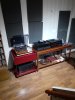
Made the shelves out of (2) 1" mdf and the sandbox is a picture-frame type stacked in 1" mdf layers, 8" tall/deep. Filled with fine sand and topped with 1 1/2" butcher block pedestal. 3/4 rod with S.S. nuts and washers lined with neoprene and acorn nuts for both rod ends. Solid as a rock and perhaps a bit overkill i think. Nothing affects that needle but I probably could have achieved the same result with just 3" of sand. I originally intended on a high stack with 6 shelves and after cutting them all up and gluing the layers, I decided that their height would interfere with the sound stage, so I just built the turntable/amp stand. I'll restart building a mating piece to replace the sideboard that the other equipment is on. BTW, I used Aleenes soft glue for the layer glue ups. It doesn'tTTsandbox.jpg form a hard glue line like titebond and others but remains soft helping to further absorb resonances.
 
I'd suggest to go to a big-box store like Home Depot and buy two stair treads for the shelves. They come in either 36" -> 48" length and are over 1" thick. If you need or want the full depth of 16", buy a piece of board with the same thickness and glue/screw/nail it onto the back of the stair tread. You could even get three treads and rip one for that purpose or buy four and glue two of them together for a 23" depth.

Stair treads are finished (almost, light sanding needed) and have a rolled edge, perfect for shelves. They are thick enough so that the usual problem of a sagging shelf won't occur. Available in usual Pine or Red Oak

Pine stair tread

Since I don't really have carpentry skills, is the stair tread idea something I could do with basic skills? I have a circular saw and would cut to size, then glue and clamp back to back to get 23" width for the shelf, but how would I secure it? Kreg pocket Jig? Face screw on the underside?
 
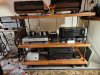
This is one I finished early this year. Going to expand it sideways over the speaker. The wood is 1.5" birch butcher blocks. The hardware is 3/4" all thread, nuts, and washers.

The carpentry included: Circular saw to width and length desired.
Drill 4 pilot holes.
Drill 7/8" through hole.

I did that with a circ saw, a battery drill, and a plug in drill, all cheap.

The "foot" is scrap that uses a Forstner bit that chewed a 2 inch counterbore in the bottom of the foot so that the nut on the bottom was recessed into the hole and didn't hit the floor. The bottom shelf and the "feet" are bolted together that way. There are many felt sticky pads under the bottom.

Finish is stain and gloss poly, and satin black spray paint on the hardware. Some touchup was needed after assembly to the black.

Edit: The wood thickness and hardware size is overkill, even for the 50 lb receiver.


C.jpg F.jpg
 
Back
Top Bottom