• The move to the new server is done. There are some software and database maintenance updates in process. This has us passing the hat around to help out. We appreciate any donations. Seriously, even a dollar helps. The payment page may be found here - https://www.audiokarma.org/support.html

Sony Receiver Evolution

Whitehall

Super Member
Banned
I find facinating the product evolution of the early Sony stereo receivers.

The first was the STR-6060FW developed circa 1965. It was aimed at the McIntosh niche and was a knockout of restrainted, classy styling and best-in-class engineering. No gimmicks or doodads - just performance with class. 45 wpc.

It was replaced by a larger frame with the same capacitor-coupled output at 65 wpc - the STR-6120 about 1968. Two years later the STR-6200F came out with unchanged styling and output power but with some of the new FETs and a direct output connection.

Now that Sony's brand name was established in the US market and the buyer demographics seemed to be moving younger, the STR-7065 came to market at the same power but with a slightly smaller frame and a bit more glitz and sparkle. The market was no longer lawyers and dentists but more college students. Integrated circuits started to appear in low voltage signal and RF applications such as the phono amp and the MPX.

Freshed with a STR-7065A model with unknown but probably minor internal changes, it was completed restyled about 1977 into the STR-6800 model. Styling became much more heavy handed (IMHO) and the output power modules appeared to replace discrete output transistors. A similar looking version replaced it as the STR-V7 with a big jump in power.

Here's the STR-6060FW (top left), the STR-6200F (bottom left), STR-7065 (top right) and STR-6800 (bottom left).
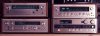
Four Sonys Best.jpg


Here are the older Sonys at night:

Older Sonys in Dark.jpg
And the newer ones:

Newer Sonys in Dark.jpg

The 6060 had the goofy flap over the minor controls and the bakelite knobs on the levers. A big omission was the center tuning meter. The knobs were smooth, solid metal.

The STR-6200F pioneered the knurled knobs for better grip - still solid metal - and had both RF meters. This is to my eye the best design in the batch.

The STR-7065 had more bling - more shiny surfaces - but plastic secondary knobs. One useful innovation was the pendant lamp on the tuning indicator.

The STR-6800 had the necessary controls but just lacks design integration to my eye.

Of them all, the STR-6200F is my beloved one. The sound is solid and authoritative and the design is matches. This is my favorite piece of all my gear.

And, no, I am NOT a collector. I'll keep the older two because I have household and office uses for them but will be letting the others go to good homes now that I have my photos.

Please see the Vintage Knob for specifications and official photos as well as insightful commentary.
 
Register to hide this ad
Nice history on Sony. I would add the STR-7800SD had a toroidal transformer and 125 wpc. The Sony STR-V7 also has a toroidal. I don't recall seeing output modules in the V7.
 
There is a lot more detail we can add. The 7800 was the TOTL model but was not available in all markets nor for long.

After the V7 came the STR-VX series which seem rather hoohum.

The STR-GX10ES in 1988 is the next "good" receiver I know about.

I might add that the recievers in my original post all had 5 gang tuners except for the 7065 which was four.

I'd love to get some input from Axel, Brian, Glenn and others.

BTW, the first photo had a much better color balance in Photoshop - wonder what happened?
 
Looks-wise, were I into receivers, the Japan-only STR-6000 is the one I'd take: understated black looks version of the 6060/F.

The 6800SD is a little cramped and busy - the transposed ES-II design slant only takes proper shape on the bigger 7800SD.
The 70xx series never clicked for me - somewhat "passe partout" and I much prefer the original smooth knobs.
The V7 is one mighty beast which looks always better in the flesh - understated shiny-ness, the opposite of Marantz' brassy-ness :g
The GX10ES is the best of all -technically- but black 1988 looks really argh my senses.

Looks-wise, I think I'd hesitate between the STR-V7 (sans metal sides and in wood enclosure) and the japanese STR-6000...
Sound-wise, the GX10ES -no doubt- but I'd have to find a way to hide it completely !

btw, often forgotten is the STC-7000 "pre-ceiver".
 
Sometimes it seems that the world is divided into two camps - smooth knobs vs. knurled.

I'm a knurly guy myself.

Why would the GX10ES be so much better sounding? I'd like to see a schematic or do a listening test before I endorse that view. Of course, it is a step below the TA-E80ES/N80ES separates. What would be the matching tuner? ST-550ES?
 
I recently acquired a mint 6060FW in its original cherry wood case. (Thanks EddyR again!) When we opened it up to see its internals and clean the switches, it was the first time it had been looked inside.

I love the design and appearace of this piece! Says '60s to me. The "goofy flap" is part of its charm and of the era, as are the bakelite knobs that feel a bit rubbery after 40-plus years. Just a clean, clear design.

And the sound! I have mine mated to a pair of JBL L-88 Nova (2-way from the same era) and the sound is so detailed. Fantastic phono section. Incredible build quality. Didn't it cost $700 new in 1965--68? Huge money for audio. It sounds better than my Marantz 2270 -- which sounds mushy in comparison.

Clearly the Sony engineers were in charge and had the cost accountants and marketing/sales guys tied up somewhere to build a piece like the 6060FW. I think they still held sway with the 6200F and 7065, too. Those two have a distinct Sony look that makes the brand -- would like to have either one of those.

I've had a STR 5800 and 6800SD, and have commented before on how the control layout had to have been done by a drunk/drugged committee -- toggles, push buttons, knobs -- oh my! The EXT ADPT (External Adaptor) and three speaker output of the 6800 make up for it not having pre/main separation in my book. Nice strong sound out of each. Sold the 5800 to a friend who still uses it. The 6800 is my son's main unit.

The V-X series just doesn't grab me for some reason. Looks like the Sony marketing and sales guys said, "Make it look like the rest of the market -- except for JVC -- those guys have read too much Buck Rogers!" Overall sort of boring.
 
I have two 6060f, two 6800, and one 7065. The 6060f wins for sound, the 6800 annoys me with its sudden jump in sound when the volume control is turned at low volume and my heart goes for the bling of the 7065. they all sound pleasing to my ear and I am thankful to AK for introducing them to me. I am going to get another 7065;a wondrous sight in the dark of night.
 
Missing from the mix is the 6065 that I think was the totl after the withdrawal of the 6200. I have 3 6060s, a 6065, 6045 and 6120. I'm in the process of doing a subjective comparison between the 6120 and 6060. The 6120 defined the control layout for Sony through the 70x5 series including the rather interesting function control that the 6060 shows the beginnings of. At some time I hope Axel can timeline Sony production as the is the 60x0 series other than the 6060 and I'm still trying to figure out when and where they fit.

For me I vote for the smooth feel of the round knobs of the 6060 and 6120 over the knurled knobs of later units. They are turned from solid aluminum billets.

The 6060, 6120 and 6200 were up against the McIntosh 1700, 1900, Marantz 18 and 19. We are talking of the best of the best at the time. Yes, there was Sherwood that had IMHO surpassed Scott when SS developed and Fisher with its 600T and 500T receivers but both the Sherwood and Fisher were somewhat lower on the scale. The Marantz units were not a transition from tube to ss in sound while the 1700 was a hybrid with a sound charactor not too dissimilar to the earlier hydrid 1500 while the 1900 was a break with thed past sonically. The 6060 and 6120 seem like the Mc units be in 2 different periods sonically. The 6060 ties back towards to the best of the tube era while the 6120 looks forward.

For me the units post 60x5 (well 6065) seem to have too many markers of a change of design goal from developing a top tier receiver to compete against the best of the best to units to capture more of the market downstream controled by Pioneer, Marantz, etc. That said I might at some time be interested in adding a 6800 or V7 to the stack.

I would have a tough time dispoosing of any of the 4 models I have but could surrender the 6045 in favor of the Philips 796 and the 6065 in favor of the Philips 797 as I currently find the Philips to outperform each of these Sonys. I've not compared either to the 6060 and 6120 which would be a fairer comparison but will do so after compaing the 6060 to the 6120.
 
Thanks for the history lesson. I'm a newbie to the Sony vintage club.

I've only ever owned a 6060FW (actually two of them) so I can't comment on how they compare to the others you list but I will say that I was completely floored by the sound output of the 6060FW when I first lit it up.

At the moment it is powering a pair of AR 10pi's with my Yammie YPD8 TT and Toshiba PCX-40 tape deck and the sound is gorgeous. Very musical, no edginess and tons of toe tapping pace and rhythm.

As an added bonus the 6060FW has an awesome headphone output. It sounds as good as my Sugden Headmaster.
 
Thanks for the history lesson. I'm a newbie to the Sony vintage club.

I've only ever owned a 6060FW (actually two of them) so I can't comment on how they compare to the others you list but I will say that I was completely floored by the sound output of the 6060FW when I first lit it up.

At the moment it is powering a pair of AR 10pi's with my Yammie YPD8 TT and Toshiba PCX-40 tape deck and the sound is gorgeous. Very musical, no edginess and tons of toe tapping pace and rhythm.

As an added bonus the 6060FW has an awesome headphone output. It sounds as good as my Sugden Headmaster.

Hello Pneumonic, you should write a review.
 
Nice thread Joe,
My spec sheet for the 6800SD states a 4 gang tuner.
Still excellent sensitivity.Im with Reggaenaut on
the Very steep gain in Volume in the first 4-5 klicks!
I think the 7800SD did sport a 5 gang tuner,
By the way,theres one on the bay right now~
Mark.
 
Beginning to sound like we are hoarding 6060s in expectation of a drought or as an investment.

There is not separate headphone amp in the 6060 but the jack is on the amp output padded with 470 ohm resistors. I use a set of Kloss ESP9b that require connecting to the speaker outputs. The 6060 through the 9s is amazing; easily as good as the 9s being driven with the tube Sherwood I used prior to subbing in the 6060 as the bedroom unit.
 
Beginning to sound like we are hoarding 6060s in expectation of a drought or as an investment.

There is not separate headphone amp in the 6060 but the jack is on the amp output padded with 470 ohm resistors. I use a set of Kloss ESP9b that require connecting to the speaker outputs. The 6060 through the 9s is amazing; easily as good as the 9s being driven with the tube Sherwood I used prior to subbing in the 6060 as the bedroom unit.

A second one is imperative:the 6060 is 40 years old.
 
re the 6800 I stand corrected - the 7065 and 6800 then have four gang tuners. I understand the V7/V6/V5 returned to five gangs - am I correct? TIC seems to agree on the"Rick's Receiver Rack" section.

Anyone have a schematic of the STR-GX10ES in pdf? Love to take a look at it.
 
Missing from the mix is the 6065 that I think was the totl after the withdrawal of the 6200. I have 3 6060s, a 6065, 6045 and 6120. I'm in the process of doing a subjective comparison between the 6120 and 6060. The 6120 defined the control layout for Sony through the 70x5 series including the rather interesting function control that the 6060 shows the beginnings of. At some time I hope Axel can timeline Sony production as the is the 60x0 series other than the 6060 and I'm still trying to figure out when and where they fit.

For me I vote for the smooth feel of the round knobs of the 6060 and 6120 over the knurled knobs of later units. They are turned from solid aluminum billets.

The 6060, 6120 and 6200 were up against the McIntosh 1700, 1900, Marantz 18 and 19. We are talking of the best of the best at the time. Yes, there was Sherwood that had IMHO surpassed Scott when SS developed and Fisher with its 600T and 500T receivers but both the Sherwood and Fisher were somewhat lower on the scale. The Marantz units were not a transition from tube to ss in sound while the 1700 was a hybrid with a sound charactor not too dissimilar to the earlier hydrid 1500 while the 1900 was a break with thed past sonically. The 6060 and 6120 seem like the Mc units be in 2 different periods sonically. The 6060 ties back towards to the best of the tube era while the 6120 looks forward.

For me the units post 60x5 (well 6065) seem to have too many markers of a change of design goal from developing a top tier receiver to compete against the best of the best to units to capture more of the market downstream controled by Pioneer, Marantz, etc. That said I might at some time be interested in adding a 6800 or V7 to the stack.

I would have a tough time dispoosing of any of the 4 models I have but could surrender the 6045 in favor of the Philips 796 and the 6065 in favor of the Philips 797 as I currently find the Philips to outperform each of these Sonys. I've not compared either to the 6060 and 6120 which would be a fairer comparison but will do so after compaing the 6060 to the 6120.

I had a Mac 1700 and sold it after I got my first 6060.
 
The V5, V6, and V7 have 5-gang tuners, toroidal power supplies, discrete amplifier sections, and good looks.

I have the STR-V5. Besides wattage output(being 85wpc), it is everything the V7 is.
 
Where does the STR-110 fit in the Sony lineup? I could perhaps buy this setup...

936c868113a0298614488f94945bb-orig.jpg


There are some specs on this page (down at almost bottom of the page):
http://www.hifi-studio.de/hifi-klassiker/sony.htm
 
Sony had at least 2 lineup back then. The 1 we mostly discuss here and a 2nd for the mass-merchandisers. Other companies likewise did this. Technics and Panasonic, Superscope's Marantz and Superscope lines. Even McIntosh tried it though the 2nd lineup was not for the mass-merchandisers but for dealers not wanting or qualifying for McIntosh dealerships. This was the Stereotech line. That experiment backfired as many Mc dealers threatened to pull the plug if the line went to a competitor.

The Sony lineup comes closest to the Marantz/Superscope lineups in terms of quality of the 2nd line. The Sony units of their 2nd line were price point engineered and did not copy from the 1st line and a 4046A (think that was the model) was not built and did not spec to a 6045 a 6045 owner could easily enjoy the 6046A.

Not sure when or where the 110 would have fit in the 2nd line and today they do not seem to go for much. From what I've seen as asking prices for some of the 2nd line units, a person can buy a lot more receiver of a brand not on the radar that is 1st line. It come down to a question of if the marque is all that important.
 
Back
Top Bottom