

You are using an out of date browser. It may not display this or other websites correctly.
You should upgrade or use an alternative browser.
You should upgrade or use an alternative browser.
Zilch's AK Design Collaborative - Econowave Speaker
- Thread starter Zilch
- Start date

An Evaluation of the Biggest E-Wave (so far)...
Finally got time to hook up a real amp (the Carvin F600) to the "Little Reds".
THESE THINGS SOUND ABSOLUTELY IN - CREDIBLE !!!!!
I don't really know of a PA speaker that I've ever heard, at any price that sounded significantly better than this- and I've heard big EAW setups, Meyersounds, JBLs with 2" drivers and Crown DSP systems, and many more... these things just are RIGHT, on the presentation of music. It sounds literally like you're standing in front of a stage of a live band playing with a small PA system "enhancing" them. From a CD!!
The real kicker? Who would expect a couple of PA speakers sitting 20 feet apart in a parking lot, to IMAGE? WHOA. It's like 180-degree wrap-around sound on tracks with lots of ambient info.
The only thing I can attribute this to, is that this speaker has a rare combination of amplitude and group-delay flatness, vs. frequency. Things just happen at the right level and at the right time. And it sounds good no matter what direction, or how far from or close to the speakers that you choose to listen. Even behind the speakers- they STILL sound natural and well-balanced!
No, it won't play 130dB... but man, it's louder than you think. I had no problem drowning out a freight train, from tracks about one block away. Didn't even realize it was there, until it blew its horn! I don't care who you are, that's pretty loud! NO strain... NO discernable distortion... NO change in response with volume level changes.
These things are almost TOO good. Now I'm going to get comments "so, when are you going to upgrade the REST of the AWA speakers?"... I can see it coming... :sigh:
Regards,
Gordon.
Finally got time to hook up a real amp (the Carvin F600) to the "Little Reds".
THESE THINGS SOUND ABSOLUTELY IN - CREDIBLE !!!!!
I don't really know of a PA speaker that I've ever heard, at any price that sounded significantly better than this- and I've heard big EAW setups, Meyersounds, JBLs with 2" drivers and Crown DSP systems, and many more... these things just are RIGHT, on the presentation of music. It sounds literally like you're standing in front of a stage of a live band playing with a small PA system "enhancing" them. From a CD!!
The real kicker? Who would expect a couple of PA speakers sitting 20 feet apart in a parking lot, to IMAGE? WHOA. It's like 180-degree wrap-around sound on tracks with lots of ambient info.
The only thing I can attribute this to, is that this speaker has a rare combination of amplitude and group-delay flatness, vs. frequency. Things just happen at the right level and at the right time. And it sounds good no matter what direction, or how far from or close to the speakers that you choose to listen. Even behind the speakers- they STILL sound natural and well-balanced!
No, it won't play 130dB... but man, it's louder than you think.
I had no problem drowning out a freight train, from tracks about one block away. Didn't even realize it was there, until it blew its horn! I don't care who you are, that's pretty loud! NO strain... NO discernable distortion... NO change in response with volume level changes. These things are almost TOO good. Now I'm going to get comments "so, when are you going to upgrade the REST of the AWA speakers?"... I can see it coming... :sigh:
Regards,
Gordon.

geiman
E Wave appellation #49
Next New E'wave attempt!
I have a new base for an E'wave top end.
Here's how the story goes:
Back in the 50's my dad built a 5cuft bass reflex cabinets and installed a JBL-D-123 full range driver. He used a Regency integrated amp, and Thorens turntable with a Pickering cart. and ESL arm. Then Stereo hit and he built a second cabinet and switched to a stereo Eico integrated amp and matching tuner.
As the years went on, the electronics used to drive them improved, H/K 200 solid state and so forth.
The speakers remained the same except a high pass was added for a Phillips dome tweeter. Also later RR/Traffic Switch JBL tweets, like 075-077s replaced the Phillips.
They were in my brother's possession later and he asked me if I wanted them and yes, I have them now.
The first thing I did was scratch build a set of JBL- N-2400 crossover clones and they work great.
The tweets are very directional so the only thing to do is to take them out of the circuit and add the E'wave top to the system.
Picks to follow and BTW suggestions and recommendations are always accepted.
I already have the ZilchLab boards built to Hi Eff specs and the Pyle 612 waveguides and Selenium 220 drivers.
The original configuration of the cabinets was as a console with a matching equipment cabinet in between them. So I'm thinking of mounting the waveguides on 1 in. black granite plates and setting them on top of the speaker cabinet. The crossover would mount as part of this assembly maybe with a plexiglas cover.
I have a new base for an E'wave top end.
Here's how the story goes:
Back in the 50's my dad built a 5cuft bass reflex cabinets and installed a JBL-D-123 full range driver. He used a Regency integrated amp, and Thorens turntable with a Pickering cart. and ESL arm. Then Stereo hit and he built a second cabinet and switched to a stereo Eico integrated amp and matching tuner.
As the years went on, the electronics used to drive them improved, H/K 200 solid state and so forth.
The speakers remained the same except a high pass was added for a Phillips dome tweeter. Also later RR/Traffic Switch JBL tweets, like 075-077s replaced the Phillips.
They were in my brother's possession later and he asked me if I wanted them and yes, I have them now.
The first thing I did was scratch build a set of JBL- N-2400 crossover clones and they work great.
The tweets are very directional so the only thing to do is to take them out of the circuit and add the E'wave top to the system.
Picks to follow and BTW suggestions and recommendations are always accepted.
I already have the ZilchLab boards built to Hi Eff specs and the Pyle 612 waveguides and Selenium 220 drivers.
The original configuration of the cabinets was as a console with a matching equipment cabinet in between them. So I'm thinking of mounting the waveguides on 1 in. black granite plates and setting them on top of the speaker cabinet. The crossover would mount as part of this assembly maybe with a plexiglas cover.
Last edited:

Russellc
Addicted Member
Hi,
I'm preparing a 'rev up' project after seeing the Wired page and a e few e-mail with Zilch (thanks again). But before I take out the drill and sawzall I need some advice on these 'Klipsch' Energy 22 circa 1980 boxes.


How do I get in ?
I Remember Energy 22 when they came out. Pretty highly regarded at the time. Didnt have anything to do with Klipsch though....
Russellc

We've discussed D-123s a couple of times here and over on LHF, and though everybody seems to have some, nobody's come up with a good application for them.I have a new base for an E'wave top end.
Here's how the story goes:
Back in the 50's my dad built a 5cuft bass reflex cabinets and installed a JBL-D-123 full range driver.
My own guess is that they'd make decent compact mid/high boxes with E'Wave, for combination with supplemental subs, but your project may provide new insight on how they might best be used. There's sure plenty of them out there. :yes:
Those're beggin' for a LED color organ inside.I Remember Energy 22 when they came out. Pretty highly regarded at the time. Didnt have anything to do with Klipsch though....
[Us hippies never die....
 ]
]
Last edited:

Wayne Parham
Active Member
Polar measurements (with video showing off-axis nulls)
Recently I started a little project, and like all of my loudspeakers, I designed it to provide uniform coverage over a 90°x40° pattern. As most of you know, the loudspeaker has to be capable of providing good response at various places, which is not an altogether easy task. To test its performance, you have to move the microphone and measure off-axis as well as straight in front of the speaker.
I have found it isn't too hard to obtain uniform horizontal coverage. That's largely a function of the horn used, which must provide constant directivity along the horizontal plane. The only thing in addition to that are the crossover points, which must be done where the sound sources have matching coverage. In the case of a direct radiating midwoofer and a horn tweeter, the frequency where they match is determined by the size of the woofer and the angular coverage of the tweeter. When using a 90° horn, the woofer matches directivity at the frequency where wavelength is approximately equal to diameter. There is a pretty wide margin here though, I've found that as long as you're within about a third octave, the pattern is still very uniform.
It is harder to get the vertical pattern right. This is because of path length distances between the listener and the woofer and tweeter. Movement along the vertical axis causes the path length differences to change. Once you near 1/2λ, nulls form.
I did a little video that shows these nulls, hoping that would give a clearer picture of what to expect. Some people are already very familiar with this, so it's not news to them. But many people struggle with the concept of vertical nulls, what they are, and how to find them. Hopefully, this video will be helpful, because it shows one of the things I do during development, and it also shows a speaker that I think is a good example as far as vertical coverage is concerned. It has a tall forward lobe that is useful at most any listening distance.
)
When I move the microphone to the bottom edge of the speaker, you'll see a notch form in the response curve. That is the lower null. Later, I move the microphone to a position beyond the top edge of the speaker. Watch the response curve as I move the microphone, you'll see it remains flat until I reach the upper null, where a dip again forms.
You might also notice that when I moved the microphone to show the lower null, I moved it just a smidge too far - just past the deepest part of the null. But you can still clearly see the upper and lower nulls, and the smoothness of response in between. Pay attention to the response curve as I move the microphone, you'll see it stays nice and smooth all the way between nulls, over a wide vertical range.
Recently I started a little project, and like all of my loudspeakers, I designed it to provide uniform coverage over a 90°x40° pattern. As most of you know, the loudspeaker has to be capable of providing good response at various places, which is not an altogether easy task. To test its performance, you have to move the microphone and measure off-axis as well as straight in front of the speaker.
- three Pi upgrade (using the TD12S woofer)
I have found it isn't too hard to obtain uniform horizontal coverage. That's largely a function of the horn used, which must provide constant directivity along the horizontal plane. The only thing in addition to that are the crossover points, which must be done where the sound sources have matching coverage. In the case of a direct radiating midwoofer and a horn tweeter, the frequency where they match is determined by the size of the woofer and the angular coverage of the tweeter. When using a 90° horn, the woofer matches directivity at the frequency where wavelength is approximately equal to diameter. There is a pretty wide margin here though, I've found that as long as you're within about a third octave, the pattern is still very uniform.
It is harder to get the vertical pattern right. This is because of path length distances between the listener and the woofer and tweeter. Movement along the vertical axis causes the path length differences to change. Once you near 1/2λ, nulls form.
I did a little video that shows these nulls, hoping that would give a clearer picture of what to expect. Some people are already very familiar with this, so it's not news to them. But many people struggle with the concept of vertical nulls, what they are, and how to find them. Hopefully, this video will be helpful, because it shows one of the things I do during development, and it also shows a speaker that I think is a good example as far as vertical coverage is concerned. It has a tall forward lobe that is useful at most any listening distance.
- Vertical Nulls (video)
)When I move the microphone to the bottom edge of the speaker, you'll see a notch form in the response curve. That is the lower null. Later, I move the microphone to a position beyond the top edge of the speaker. Watch the response curve as I move the microphone, you'll see it remains flat until I reach the upper null, where a dip again forms.
You might also notice that when I moved the microphone to show the lower null, I moved it just a smidge too far - just past the deepest part of the null. But you can still clearly see the upper and lower nulls, and the smoothness of response in between. Pay attention to the response curve as I move the microphone, you'll see it stays nice and smooth all the way between nulls, over a wide vertical range.

skywave-rider
Slumming in Akihabara
Excellent demo, Wayne. Thanks.
The nulls sure are easy to see.
From a distance, looking at your laptop in the video, response looks very flat at the forward axis; wonder where those woofers begin to roll off in that cabinet at the bottom end of the spectrum?
I see the AE woofer flange is not countersunk. I like that idea because it's easy and IIRC you showed symmetry in vertical nulls above and below the point between woofer and tweeter mounted that way.
EDIT: Sorry I got excited and jumped the gun on the woofer response question. I'll wait for the nearfield and anechoic readings......
The nulls sure are easy to see.
From a distance, looking at your laptop in the video, response looks very flat at the forward axis; wonder where those woofers begin to roll off in that cabinet at the bottom end of the spectrum?
I see the AE woofer flange is not countersunk. I like that idea because it's easy and IIRC you showed symmetry in vertical nulls above and below the point between woofer and tweeter mounted that way.
EDIT: Sorry I got excited and jumped the gun on the woofer response question. I'll wait for the nearfield and anechoic readings......
Last edited:

Spectrum77
Super Member
Highly educational tutorial. Thanks.
Thanks for the video! It's impressive you went straight through that whole video without having to stop and make edits. And I feel a little smarter after having watched it. 
Are your Pi4 speakers in the background angled upward on the stands? I couldn't tell very well.
Are your Pi4 speakers in the background angled upward on the stands? I couldn't tell very well.

Duffinator
Spin The Black Circle

jackgiff
Well-Known Member
Do they have my name on them?
Duffinator, I can't get over to the Bay area that soon, but maybe someone will store them for me for a couple months. I have drivers for them, and REALLY need another project. Let me see what I can do to take them off your hands.
Still no takers on my free ADC speaker cabinets, perfect for eWave project. These are very high quality cabinets.
Look here and post 6290 in this thread.
Duffinator, I can't get over to the Bay area that soon, but maybe someone will store them for me for a couple months. I have drivers for them, and REALLY need another project. Let me see what I can do to take them off your hands.
Duffinator
Spin The Black Circle
Consider them yours. The plan was for either pickup here in the valley or at ZilchLab. Member Bhamm is planning a trip to ZilchLab in the next few weeks and can drop them off. That is if Zilch has any room for them, maybe there's room in Area 51.Duffinator, I can't get over to the Bay area that soon, but maybe someone will store them for me for a couple months. I have drivers for them, and REALLY need another project. Let me see what I can do to take them off your hands.
Or if you are coming to the valley I can hold them for you.Send me a PM with your email address and I'll send you better photos. They are in excellent condition and very well made. :yes:
Wayne Parham
Active Member
Thanks guys.
I've added a little more information on ART, if any of you want to do something like this with your E-Waves. The PT-F95HF is similar in many respects to the horn I use, but different enough that your crossover would have to be a little different for the nulls to be in the right places. I see some of you have done this sort of thing already, but for those that haven't, maybe this is helpful. You guys use a lot of different woofers and configurations, some of which are undoubtedly more optimized than others.
The WTPro measures the T/S specs of the woofer and then can measure the impedance of the woofer in the box too. I have to do that to get the ZMA file for the ICD. One of the other cool things it does is to do a BoxPlot style bass response simulation, but with the added accuracy that it is using actual measurements of the woofer in the box. This is what it says:
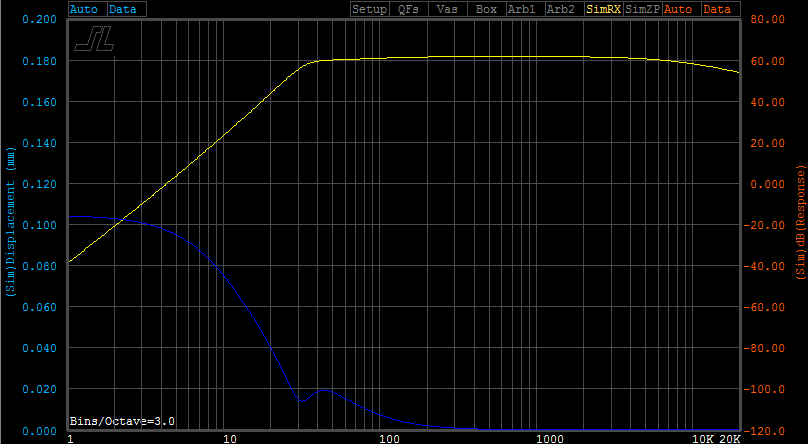
I expect anechoic will show a little more rolloff below 200Hz because of collapsing directivity as the baffle starts to transition to halfspace. I don't ever use BSC because in room, the power response tends to dominate. Actually, room modes dominate but you know what I mean. In room there's a lot more going on than just collapsing directivity from the baffle transition. I see BSC as more of a way to voice a speaker than anything else. Still, anechoically, I expect some extra rolloff from collapsing directivity due to baffle dimensions.
Those cabinets were actually built by Fred Thompson and donated to me. I knew I was going to try out the TD12 woofers and Fred had a pair of cabinets, so I used them. He had a real cool colored false baffle, a neat look that was popular with Pi guys about five years ago.
I like the looks of routed flush drivers. The extra 3/8" or so forward or back won't make much difference in a ~1kHz crossover point. You don't have to redesign anything in a speaker like this if your drivers are routed flush. The nulls shift like maybe 2°, and unlike the round horn guys, we have plenty of vertical space between nulls to work with.
Yep, those are four Pi speakers on 18" stands, angled up slightly. The nulls form slightly lower on that model, roughly 30° down to the lower null and 20° upward to the upper null. The stand angle splits the difference and puts the center of the forward lobe right in front. Not that it's needed, but then again, it doesn't hurt to put the zero line where the listeners are.
What you maybe couldn't see is I have subs too, and they're blended with the midwoofers in the four Pi's so they smooth floor bounce as well as other room modes.
I've added a little more information on ART, if any of you want to do something like this with your E-Waves. The PT-F95HF is similar in many respects to the horn I use, but different enough that your crossover would have to be a little different for the nulls to be in the right places. I see some of you have done this sort of thing already, but for those that haven't, maybe this is helpful. You guys use a lot of different woofers and configurations, some of which are undoubtedly more optimized than others.
From a distance, looking at your laptop in the video, response looks very flat at the forward axis; wonder where those woofers begin to roll off in that cabinet at the bottom end of the spectrum?
The WTPro measures the T/S specs of the woofer and then can measure the impedance of the woofer in the box too. I have to do that to get the ZMA file for the ICD. One of the other cool things it does is to do a BoxPlot style bass response simulation, but with the added accuracy that it is using actual measurements of the woofer in the box. This is what it says:
I expect anechoic will show a little more rolloff below 200Hz because of collapsing directivity as the baffle starts to transition to halfspace. I don't ever use BSC because in room, the power response tends to dominate. Actually, room modes dominate but you know what I mean. In room there's a lot more going on than just collapsing directivity from the baffle transition. I see BSC as more of a way to voice a speaker than anything else. Still, anechoically, I expect some extra rolloff from collapsing directivity due to baffle dimensions.
I see the AE woofer flange is not countersunk. I like that idea because it's easy and IIRC you showed symmetry in vertical nulls above and below the point between woofer and tweeter mounted that way.
Those cabinets were actually built by Fred Thompson and donated to me. I knew I was going to try out the TD12 woofers and Fred had a pair of cabinets, so I used them. He had a real cool colored false baffle, a neat look that was popular with Pi guys about five years ago.
I like the looks of routed flush drivers. The extra 3/8" or so forward or back won't make much difference in a ~1kHz crossover point. You don't have to redesign anything in a speaker like this if your drivers are routed flush. The nulls shift like maybe 2°, and unlike the round horn guys, we have plenty of vertical space between nulls to work with.
Are your Pi4 speakers in the background angled upward on the stands?
Yep, those are four Pi speakers on 18" stands, angled up slightly. The nulls form slightly lower on that model, roughly 30° down to the lower null and 20° upward to the upper null. The stand angle splits the difference and puts the center of the forward lobe right in front. Not that it's needed, but then again, it doesn't hurt to put the zero line where the listeners are.
What you maybe couldn't see is I have subs too, and they're blended with the midwoofers in the four Pi's so they smooth floor bounce as well as other room modes.
Last edited:
jackgiff
Well-Known Member
Consider them yours. The plan was for either pickup here in the valley or at ZilchLab. Member Bhamm is planning a trip to ZilchLab in the next few weeks and can drop them off. That is if Zilch has any room for them, maybe there's room in Area 51.
Send me a PM with your email address and I'll send you better photos. They are in excellent condition and very well made. :yes:
Hey that is great. I have several pairs of drivers here which will fit, and not having to build from scratch is surely much easier than doing it all. I have already PM'ed the Zilchster to see if he would have room to hold them for me for a bit, but after seeing ZilchLab, he might have to put them in his bedroom. If you wouldn't mind holding them for awhile, that could also work. They look like a perfect pair for EconoWaves. I have already made room for another pair of keepers by giving away a pair of Trusonic two ways to a friend here in Prescott.
I have PM'ed you with my e-mail address. It will be good to get a better look at them.
Thanks, they will become another (the 7th) pair of EconoWaves built by yours truly. Love them things.
Excellent demo, Wayne, and thank you.While doing this project, I decided to make a short video and I thought you might find it useful here. Some of you already know this stuff, but I think some might benefit from it.
I'm on dialup, so it took me a while to download the video, 8 hours. :tongue:
I catch the lower null at 3:23, and with a screen shot of that frame, a ruler, and a scientific calculator, we can compute the angle from whatever reference we choose. I'd probably use the midpoint between the drivers, or the tweeter axis, rather than the woofer. Similarly, from there to the upper null, and we have defined the forward vertical lobe.... :thmbsp:

HatchetJack
Chillin' The Most
8 hours ? Zilch you gotta get high speed. Dial up is like riding a donkey in
the Kentucky Derby.
the Kentucky Derby.
Wayne Parham
Active Member
I'd probably use the midpoint between the drivers, or the tweeter axis, rather than the woofer.
Yes, the true acoustic center, the center of the forward lobe, is somewhere between woofer and tweeter in that model. The physical center of the loudspeaker is just an arbitrary point acoustically, but it is one that is visually associated to be the central axis.
Personally, I'm not averse to using either method to define the center for measurement/discussion, like I said in the video. I'm more concerned with making sure the forward lobe is useful, that the nulls are widely spaced enough the listener can't possibly be in one. But I do agree that the center of the forward lobe is in between the woofer and tweeter in that model (as it should be).
With the right driver spacing and crossover, it is possible to achieve a fairly tall forward lobe, over 40° centered out in front of the speaker with nulls widely spaced above and below the speaker, even at relatively close range, just a few feet back.
Looking at this video, I think people can see why they might be concerned about a narrow null angle. If you have a speaker like that, it can be difficult to setup properly because orientation becomes so critical. Worse than that, if the user doesn't realize the ramifications, they're likely to setup the speakers where listeners may be sitting in a bad spot.
Russellc
Addicted Member
We've discussed D-123s a couple of times here and over on LHF, and though everybody seems to have some, nobody's come up with a good application for them.
My own guess is that they'd make decent compact mid/high boxes with E'Wave, for combination with supplemental subs, but your project may provide new insight on how they might best be used. There's sure plenty of them out there. :yes:
Those're beggin' for a LED color organ inside.
[Us hippies never die....
Color organ eh? Let me look in the attic.
Russellc
geiman
E Wave appellation #49
Color organ eh? Let me look in the attic.
Russellc
I prefer the overhead projector, water, vegetable oil and food color, and clear glass dish to get my colors. LOL
Roll one for me, Russellc!
To stay on topic, the E'wave will be built as a modular unit, not in a box but exposed and naked, pretty with a granite or glass base, stainless steel fittings and clear plexiglas covering the Zilchlab cards.