• The move to the new server is done. There are some software and database maintenance updates in process. This has us passing the hat around to help out. We appreciate any donations. Seriously, even a dollar helps. The payment page may be found here - https://www.audiokarma.org/support.html

Zilch's AK Design Collaborative - Econowave Speaker

Right now I'm listening to the JBL 6"/ Kef B110/ AR3sub 3-way rig using the stock Ewave low sensitivity crossover. There's nothing obviously wrong with this combination and The Trinity Sessions is sounding wonderful as usual. After I work out the mic cable deal I'll measure and fiddle some more. It would be great if the compensation and crossover of the stock crossover works for these.
I got it close with 2414H using a series notch, but not so good as with the JBL filter, which I was able to tweak within +/- 1.5 dB. You can vary the attenuation up and down a bit by changing the 0.68 uF within the range of 0.47 - 1.0 uF....

attachment.php
 

Attachments

  • PT-B99HF 2414H 2 Filters.jpg
    PT-B99HF 2414H 2 Filters.jpg
    58.7 KB · Views: 305
Last edited:
Gettin' closer.

FedEx just delivered the Dayton woofers. He was much later today than usual, so I just got one of them mounted, along with a QSC waveguide. The DE250 is not mounted to the waveguide, because it's studs are about a quarter of an inch too short to reach through the long plastic mounting ears of the QSC waveguide. I have had them for several days, and never thought to check. Anyway, tomorrow a visit to True Value Hardware is in order to get proper length studs, and screws to mount the woofers.

Tomorrow is also supposed to be the day that the last of my veneer supplies order is delivered, and the veneer whicih is already here can be utilized. Now, do we veneer or get them singing first ? They might sound better if they look nice. :dunno:
 

Attachments

  • CabWPartsMntd.jpg
    CabWPartsMntd.jpg
    92.7 KB · Views: 131
That looks great Jack. I have not been up on ALL the post about the QSC but does it go lower than the JBL WG? Why use the QSC instead of the WG we've been using?

Those stands or legs look cool to. Do you have pix of their construction? Cheers.
 
Man, it JUST fits!

Looks like the ports could go in front, if desired, also.

Would the woofer fit in through the waveguide cutout?

I presume you've buried some T-nuts for woofer mounting there?

[I think they better sing, first.... ;) ]
 
Last edited:
Looks promising.
Jack, I think 25mm long bolts work IIRC.

FedEx just delivered the Dayton woofers. He was much later today than usual, so I just got one of them mounted, along with a QSC waveguide. The DE250 is not mounted to the waveguide, because it's studs are about a quarter of an inch too short to reach through the long plastic mounting ears of the QSC waveguide. I have had them for several days, and never thought to check. Anyway, tomorrow a visit to True Value Hardware is in order to get proper length studs, and screws to mount the woofers.

Tomorrow is also supposed to be the day that the last of my veneer supplies order is delivered, and the veneer whicih is already here can be utilized. Now, do we veneer or get them singing first ? They might sound better if they look nice. :dunno:
 
I got it close with 2414H using a series notch, but not so good as with the JBL filter, which I was able to tweak within +/- 1.5 dB. You can vary the attenuation up and down a bit by changing the 0.68 uF within the range of 0.47 - 1.0 uF....

attachment.php

Thanks for posting that. I could live with either of those, actually. It looks like the JBL crossover has a slightly downward trending characteristic wit ha bit more energy in the 'presence region' than the Ewave example.

It's surprising to me that the raw response is strongest at 2khz. There are probably reasons having to do with distortion and possibly power handling why it's not usable that low. It's a shame, because there are a lot of woofers that will provide strong bottom octave and play up to 1500 hz or so.

Couple of questions:

1) when you say vary the attenuation by changing the .68uf do you mean the broadband level of the tweeter is changed by altering the value of the input capacitor, or are you referring to the slope (steepness of angle) of the compensation?

2) when you say tweaking the JBL crossover are you referring to small changes to the values of the components in the original schematic to optimize the response?

In any case I'm pleased with the performance of this small waveguide and tiny driver. A compact (very shallow) package with good response down to 2500 hz should have a lot of applications in monitor-sized speakers. Not that that appears to be the priority in this forum, where 2 cu ft seems to be the minimum size considered ;-)

When I switched to the Ewave crossover from the stock JBL circuit I had to turn the lpad down quite a bit, indicating that the stock JBL AC16 circuit provides significant attenuation of drive voltage without 'wasting' a lot of power in resistive attenuation. That's probably why the AC16 system is rated and measures like a 16 Ohm despite the 2414H being an 8 Ohm driver.
 
Couple of questions:

1) when you say vary the attenuation by changing the .68uf do you mean the broadband level of the tweeter is changed by altering the value of the input capacitor, or are you referring to the slope (steepness of angle) of the compensation?
The broadband level. That cap is the HF comp, 6 dB/octave beginning at some frequency above 20 kHz. How high it starts establishes the attenuation. I was not successful in supplementing that with an L-pad anywhere but ahead of the entire filter.

2) when you say tweaking the JBL crossover are you referring to small changes to the values of the components in the original schematic to optimize the response?
Yes, and if you compare it to the earlier posted curve, you'll be able to see the differences. Those adjustments may only be applicable to the particular sample I'm using, however; it'd probably require 10 or so of them to confirm that they are an improvement.

Go with the published schematic. JBL engineering clearly has more and better resources at work in this, and they also know the production variables. I'm not even mounted on a baffle.... :dunno:
 
attachment.php


With the same lowpass filter:

attachment.php

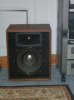
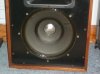
What's behind the GRILLE, Zilchster? ;)
 

Attachments

  • DQ10 OLA NF.jpg
    DQ10 OLA NF.jpg
    57.8 KB · Views: 245
  • DQ-10.jpg
    DQ-10.jpg
    77.9 KB · Views: 246
Last edited:
Really, foam stuffed vs 'glass?
I showed in my Advent thread that fiberglass damping reduces the Advent's boominess. This is one of the Wired Magazine OLAs, with the stock foam still in place.

The DQ-10 is stock with fiberglass. It also has an interesting triple-chamber construction inside; I'll see if Ken Kantor knows or can figure out what that's about the next time he comes by.

In any case, we see that the the DQ-10 is better damped, and the low frequency extension is similar -- they both have usable bass down to ~30 Hz. With its shallow profile, the DQ-10 low frequency box is suitably deployed as a sub. Don't pass them up, even if the high-frequency superstructure is trashed.... :thmbsp:

Edit: Here's OLA with stock foam (red) versus fiberglass (violet) erroneously dubbed "NLA" in the legend, actually a chamfered OLA, as measured over a year ago:

attachment.php
 
Last edited:
That looks great Jack. I have not been up on ALL the post about the QSC but does it go lower than the JBL WG? Why use the QSC instead of the WG we've been using?

Those stands or legs look cool to. Do you have pix of their construction? Cheers.

The existing waveguides all have thread mounting for the compression drivers, while the QSC uses a two bolt mounting. This opens up the use of many different compression drivers. JBL makes a bolt on, but it sells for about $100. There are probably other one inch throat waveguides that use bolt on mounting, but the QSC is being used in a couple other places, plus it is touted to have some "Geddes influences", so I decided to use it. I don't know how low it will go, but the B&C DE250 drivers are recommended to crossover at 1.6 KHz, which seems to fit the EconoWave principals.

A better picture of the legs is shown in post 7070, on page 472.

Man, it JUST fits!

Looks like the ports could go in front, if desired, also.

Would the woofer fit in through the waveguide cutout?

I presume you've buried some T-nuts for woofer mounting there?

[I think they better sing, first.... ;) ]

I am going to try some embedded inserts, rather than T-nuts, since I want the front baffle to be veneered. I will use 8 per woofer, since I don't know how good they will hold.

The woofer will fit in through the waveguide cutout, so the baffles could be glued on, and not show the external mounting screws. That is certainly going to be considered.

I received the Veneer flattener solution (Super Soft 2) today, so four pieces are being pressed. By tomorrow, they should be ready to use, so maybe veneering and testing can take place at the same time. Test # one, veneer # two, swap, then test #2, veneer # 1. That might work out OK.
 
I am going to try some embedded inserts, rather than T-nuts, since I want the front baffle to be veneered. I will use 8 per woofer, since I don't know how good they will hold.

The woofer will fit in through the waveguide cutout, so the baffles could be glued on, and not show the external mounting screws. That is certainly going to be considered.
O.K., here's what I'm thinking:

Flush mount the waveguide and do a roundover on the woofer opening, full 3/4" if possible, including the waveguide flange in that area. Just have the waveguide mounted when you do it to accomplish this.

I suppose that would be possible with imbedded T-nuts, as well, if they were sunk in far enough. With a 10" woofer mounted on an adapter ring glued to the inside, there'd be no interference issue, as that would mount to the ring, not the baffle itself....
 
O.K., here's what I'm thinking:

Flush mount the waveguide and do a roundover on the woofer opening, full 3/4" if possible, including the waveguide flange in that area. Just have the waveguide mounted when you do it to accomplish this.

I suppose that would be possible with imbedded T-nuts, as well, if they were sunk in far enough. With a 10" woofer mounted on an adapter ring glued to the inside, there'd be no interference issue, as that would mount to the ring, not the baffle itself....

But I don't know how to veneer a 3/4 inch roundover in a circle. A straight line roundover would be a piece of cake, but a circular one? Not sure I am ready to tackle one of those at this point. I have some Carpathian Elm burl veneer, which should look stunning on these cabinets.

That would probably look nice if the baffle was painted black, but black baffles that are exposed don't light my fire. Wood is preferred. If things work out so that is the best way, maybe someone can refer me to the proper black paint so the baffle matches the waveguide.

My thoughts are that we need to check and see how much time alignment may be necessary first before deciding about all that. If the waveguide needs to be moved out around a tenth inch or so, it would be possible to make a filler behind the waveguide, even with the cabinet edges, and the waveguide flush mounted. Then a grille could be made to cover just the woofer. That might look nice, as well. Or if the woofer needs to come forward a tenth inch or so, the rear of the baffle could be routed to accomplish this.

Testing during the early stages should tell us which way to go.
 
...I am going to try some embedded inserts, rather than T-nuts, since I want the front baffle to be veneered. I will use 8 per woofer, since I don't know how good they will hold...The woofer will fit in through the waveguide cutout...
I used quite a few of the threaded inserts doing all my ewave conversions. If you overtighten the flush mount variety they can cause MDF to delaminate (pull apart like sheets of paper). I found that if I used the shouldered variety that did not occur. Using all eight holes in the bolt circle should minimize the chances for that. I attached a photo of the Madrids I did with the shouldered type. I found using the 25/32" long ones (3/4" MDF baffle) left a protruding nub that made starting the screws for back mounting the driver easier.

92105A018
Zinc-Alloy Knife-Thread Insert for Wood Hex Drive, W/Flange, 10-32 Internal Thrd, 25/32" L

http://www.mcmaster.com/#catalog/115/3237/=3nvyl4

Altec Santanas 002.jpg

Altec Santanas 006.jpg
 
I used quite a few of the threaded inserts doing all my ewave conversions. If you overtighten the flush mount variety they can cause MDF to delaminate (pull apart like sheets of paper). I found that if I used the shouldered variety that did not occur. Using all eight holes in the bolt circle should minimize the chances for that. I attached a photo of the Madrids I did with the shouldered type. I found using the 25/32" long ones (3/4" MDF baffle) left a protruding nub that made starting the screws for back mounting the driver easier.

92105A018
Zinc-Alloy Knife-Thread Insert for Wood Hex Drive, W/Flange, 10-32 Internal Thrd, 25/32" L

Thanks for the good words about the threaded inserts I will be using in my next project. I bought the slotted types shown In the McMaster-Carr kink, although they look to have deeper external threads than the ones shown in the McM-C illustrations. They should hold OK, but this is the first time I have tried them, so I will be careful with them till they prove their worth. I need to get a proper drill bit to use them, so they will be mounted tomorrow. Seems like everything is tomorrow around here.

And thanks for the link to McMaster-Carr. I never thought about looking in their catalog. Cheaper than my local True Value, as well.
 
attachment.php


Agreed, which is why I suggest they sing first.... :thmbsp:

You beat me to it. I've been trolling for a pair of partial DQ10s to ewave ever since I noticed how nice and high on the cab the woofer sits.

Sacred cows make the tastiest burgers...
 
Back
Top Bottom