• The move to the new server is done. There are some software and database maintenance updates in process. This has us passing the hat around to help out. We appreciate any donations. Seriously, even a dollar helps. The payment page may be found here - https://www.audiokarma.org/support.html

Zilch's AK Design Collaborative - Econowave Speaker

I started to ask this before then deleted it.... trying again.. .

Given these cabinets.... 1) pair Original Advent - Walnut veneer and bullnose, masonite ring driver (need refoam). 2) pair Utility NLA - vinyl clad, NLA driver (newly refoamed).

The Utility NLAs are actually already eWave'd .... But I like the walnut OLA cabinets and want to eWave them. Would there be any advantage in using the NLA driver in the OLA cabinet? Are the cab volumes the same? Is one driver better than the other? I read somewhere that the NLA driver would fit the OLA but not vice-versa.

Thanks.
 
Last edited:
That's all correct.

Best answer since you have the stuff -- try it yourself and let us know what you conclude.... :thmbsp:
 
That's all correct.

Best answer since you have the stuff -- try it yourself and let us know what you conclude.... :thmbsp:

LOL, why did I know that was going to be one of the responses. :D

I might just do that, would mean waiting until I get foams in.... In the mean time is there any consensus regarding the woofers? One might think that since Advent changed the woofer for the NLA that they did it for better sound quality, lower smoother bass, etc., but we all know that's not always the case.
 
There are some measurements in my Advent thread.

I have four types, including round- and square-magnet NLAs, and DQ-10 as well as OLA Masonites, and no clue as to how different they sound.... :tongue:
 
Last edited:
Thanks Zilch, Found your Advent thread and some other Advent ewave threads as well. I think I got enough out of them to suggest either woofer in the OLA cab would perform about the same. So I'll probably go ahead and refoam the masonite ring drivers and go from there. My concern was that if the masonite ring drivers provided lesser SQ I didn't want to invest the (although minimal) money and time into the them if they were going to be inferior to drivers I already have available.
 
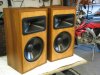
I finished these up about 3 weeks ago. They are the "standard" kit except the cabs are reused RS units running sealed.The more I listen the better I like them. While they are much smoother than the L100t's that are serving as stands for these, they are still a little harsh, for lack of a better term, for my ears. Since I view them as a work in progress this is not meant as criticism. In my view they have a better overall sound than the JBL's or the 901's that they sit in between.

The best part is that I put them together. Had to learn new skills as I have never done much woodworking, soldering, reading schematics, etc. Heck I had to learn something new to post this pic, at least I hope it's here.

Thanks to all who have contributed to this thread, especially Zilch who must be a teacher at heart. He doesn't always just give you the answer, but makes you learn more by digging for it a little. Gotta admit that much of it is still above my head yet.


IMG_0051.jpg
 
I finished these up about 3 weeks ago. They are the "standard" kit except the cabs are reused RS units running sealed.The more I listen the better I like them. While they are much smoother than the L100t's that are serving as stands for these, they are still a little harsh, for lack of a better term, for my ears.

Very nice job, Mmaxed. You commented that they still sound a little harsh. Can you expound a little more on that? What exactly are you hearing, and on what type of music? Is the harshness in the upper end or the mids, etc? I guess you are using the Selenium driver? I've read that before but not very often. Some have moved up to the B&C DE250 to help smooth things out.

Thanks for posting your project. :thmbsp:
 
From the AudioKinesis website, I copied the following regarding the elimination of an L-pad on the Rhythm Prisms.

On the rear of the speaker is a single external resistor in a terminal cup, and this resistor acts as a tilt control for the compression driver. It is bypassing a certain resistor in the crossover. By changing the value of this resistor, the compression driver's output can be tilted up or down, which does a better job of adjusting for room acoustic conditions than an L-pad's shelving characteristic, and this single external resistor is much higher quality than all but very expensive custom L-pads.

Would this be a viable option to the use of L-pads in the Ewave? I'm guessing no, since they are designed to meet certain econo goals. :D
 
The B&C DE250 is bolt-on and thus, without a throat adapter (a bad approach) not compatible with the original Ewavegude. I'm working with the Celestion CDX1-1731 here presently that Duke suggested earlier in this thread. It's cheaper than DE250, as well:

http://professional.celestion.com/pro/pdf/CDX1-1731.pdf

Another option is the neodymium-magnet Selenium D2500Ti, which uses the same diaphragm as D220Ti, but which Gordon tells us is somewhat smoother sounding. D220Ti can probably be smoothed with Aquaplas damping, but nobody's figured out how to do that here yet.... ;)


Would this be a viable option to the use of L-pads in the Ewave? I'm guessing no, since they are designed to meet certain econo goals. :D
What Duke does with that is alter the power response. It's not the attenuation that an L-pad accomplishes to balance lows and highs.

Jack and I have shown how to do that in eWave by varying the value of C3, after Wayne Parham....
 
Last edited:
Hey, I'm "official" now. Hope that is a good thing.

Yes, roymail, I am using the Selenium D220Ti. I'm not sure harsh is the right word. I have a constant ringing in my ears from too much noise in my younger years and still enjoy my music fairly loud sometimes. Speakers that are harsh or bright send my ears over the edge quickly. The Selenium is a little rough or maybe strident in the upper mids and highs to me. Much less so that the tweets in the JBL's but still there. My ears like smoooooth.

My next step will be to stuff the wave guides with the foam that has been talked about here. Maybe try the charged cross over and/or move up to the B&C. Like most of my mod projects (mostly involving things with engines) these may be a work in progress for a long time. Or they may move to the garage or to the kid and be replaced with a "deluxe" version of some fashion. Kinda seems like I'm becoming an E'Wave addict!?!
 
Hey, I'm "official" now. Hope that is a good thing.
It's mostly our way of acknowledging your participation and contribution to the collaborative effort here. Everybody who builds EconoWaves brings their unique perspective and creative approach to the concept, and we appreciate your sharing what very much belongs to you with us in the interest of expanding the project scope. :yes:

Kinda seems like I'm becoming an E'Wave addict!?!
WAY fun, of course!

[It happens.... ;) ]
 
Last edited:
RCF Maybe Woofers

I have a pair of what I think are RCF 12" woofers. I measured them in WT2 using added mass for VAS. Apart from what size box it will work in and efficiency, does this data imply whether or not they will play high enough for an EWave 2way? Or do I need to put them on a baffle and make a FR/distortion measurement to get that?

When I get home I will post a pic in case anyone can ID them.


Vas test completed: Wed Nov 24 17:42:09 2010
Drive level 100.00% [3181.82 uA]
Shunts: Not Used
;------------------------------------------------------------------
Re = 6.1531 ohms
Fs = 49.7533 Hz
Zmax = 123.1965 ohms
Qes = 0.4335
Qms = 8.2460
Qts = 0.4118
Le = 0.5860 mH (at 1 kHz)
Diam = 261.6200 mm ( 10.3000 in )
Sd =53756.5909 mm^2( 83.3229 in^2)
Vas = 58.2888 L ( 2.0585 ft^3)
BL = 17.8823 N/A
Mms = 72.0674 g
Cms = 141.9898 uM/N
Kms = 7042.7578 N/M
Rms = 2.7321 R mechanical
Efficiency = 1.5560 %
Sensitivity= 93.9381 dB @1W/1m
Sensitivity= 95.0781 dB @2.83Vrms/1m
Krm = 129.163E-03 ohms Freq dependent resistance
Erm = 386.883E-03 Rem=Krm*(2*pi*f)^Erm
Kxm = 297.127E-03 Henries Freq dependent reactance
Exm = 335.537E-03 Xem=Kxm*(2*pi*f)^Exm, Lem=Kxm*(2*pi*f)^(Exm-1)
;------------------------------------------------------------------
; A test mass should be used that produces a decent resonance change
; without significantly altering the drivers suspension zero point.
; An Fs/Fsa ratio of 1.125 to 1.250 should be sufficient. Horizontally
; mounted drivers avoid suspension sag but require a sticky test mass
;------------------------------------------------------------------
Fs = 49.7533 Hz Mms = 72.0674 g Free air resonance
Fsa= 39.8981 Hz Mms+Ma=112.0674 g Modified resonance
Fs/Fsa = 1.2470
Ideal Test Mass = 40.5379 g (for 25% shift)
Test Mass used = 40.0000 g
Missed ideal by = -0.5379 g (too light)
Nickels used = 8.0000
Nickels desired = 8.1076
 

Attachments

  • rcf woof 1.jpg
    rcf woof 1.jpg
    59 KB · Views: 39
Last edited:
They are relatively high efficiency (>90 dB), and the 50 Hz Fs tells me they'll likely make it to 1.5 kHz nicely, though you'll have to confirm that with FR and distortion measurements. They'll likely need subs or "0.5" augmentation if built into rational-size systems. EBP > 100 says ported alignment; using that parameter set, UniBox or WinISD will tell you what.... :thmbsp:
 
Awesome, thanks, Zilch!
Later I'll post a pic in case anybody has a positive ID.
They are heavily built.

Happy Thanksgiving everybody!
 
Back
Top Bottom