• Please note that there are a few updates and clarifications made in the Audiokarma Rules, mostly relating to advertising and the addition of the new "Paying it Forward" & "Giving back" forums in the AudioKarma Audio Marketplace section.

Common Transistor Case Styles

EchoWars

Hiding in Honduras
Sponsor
Starting this post so I can have a reference to point to when someone asks about 'what can I use to replace this transistor?' When such a question is asked, it is important to note the case style of the original, and that is the point of this thread...to assist in the identification of the part in question.

Note that technically, the case style also indicates the lead layout (CBE, BCE, etc, etc...) Manufacturers flaunt these conventions as it suits them, so do NOT rely on this pic for lead identification. And of course, nothing here is to any kind of scale...

Note about TO-220's. There are a lot of new designs where the traditional metal mounting tab (which is at the same potential as the collector, and in need of electrical isolation in most cases where it contacts a heatsink) is encased in plastic. These plastic-tabbed TO-220's are also called TO-220D's or TO-220F's, and of course do not require electrical insulation of the mounting tab. The only time these cannot be used as a viable substitute for a metal tab TO-220 is in situations where the tab is actually used to conduct current instead of the center collector lead (Sansui does this often on much of their older gear).

It would be nice if this were a sticky...
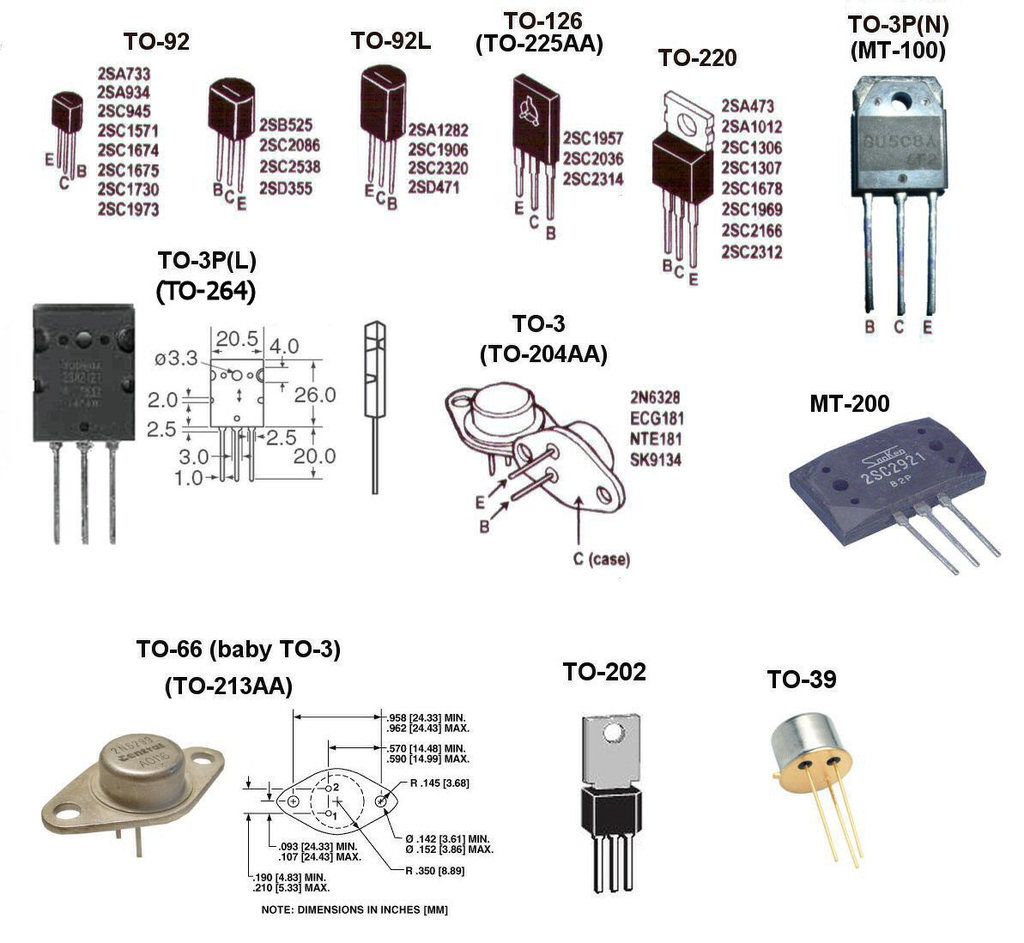
transistortypes_zpsl5pwl7i7.jpg~original
 
Last edited:
Register to hide this ad
That's extremely helpful. Easy to get confused about case styles. I'm getting a little older and do forget things.
I've seen that top part before but can't remember where. Thinking it was ham or cb repair books.

Thanks for the effort EW.
 
Thanks for this, Glenn.

In terms of substituting transistors, I try to match case styles, maximum current, maximum voltage, maximum power and bandwidth. I find that bandwidth is the characteristic most often ignored, with resultant oscillations.

Also, you might include the package style of the infamous leaksistor 2SC458, the one that looks like a Monopoly house split down the middle with legs. As well, you might add the TO-1 package used for scads of germanium devices and a few early silicons and the near twin of the TO-39, the TO-5.

The old Sony STR-7065 used those strange "similar to TO-66" devices. Then there were those bizarre little RF transistors that looked like miniature Tums with three legs sticking out like Sputnik.

Hail to those big round germanium transistors used as class-A autoformer-coupled output devices in early solid-state car radios.

:thmbsp:

Fred
 
One interesting style that might be added is the Hitachi 2SB700 used in the Yamaha CR-2040 (kind of like a TO-220 with ears on the sides rather than the top) and the big plastic Sankens. Why I mention this is because there is a current production Sanken that will sub for the Hitachis, and the mounting holes line up. BTDT, just don't recall the Sanken pair's numbers of the top of my head.
 
I tried to get all the most common ones...

AFAIK, the 2SC458 is considered a TO-92 'mod'. If it has it's own package name, I don't know what it is.

3996222.jpg


As far as the 2SB700, you must mean the 'batwing' devices.

Batwing_Power_Transistor_zpsmspnioyt.jpg


If you've found a readily available substitute, I'd like to know what it is.
 
Last edited:
OK, the Sanken sub for the Hitachi 2SB700 is a 2SA1215 and the sub for the 2SD736 is a 2SC2921. The mounting holes in the big plastic Sankens match the bat wing Hitachi mounting holes. Subbed them in a CR-2040 and they work like a charm. As with all subs I did both sides, just remember to order the silicone insulators as the bat wing micas are barely enough to cover the metal back plate of the Sankens. I can make up a list of successful subs that I have used and post it here if that would help.
 
Great reference, Glenn! This one's a print-out-and-keeper, for sure! :yes::thmbsp:

Merrylander, that list of successrul substitutions would also be a useful reference.

And lastly, agree that this one should be made a sticky! :yes:
 
OK, the Sanken sub for the Hitachi 2SB700 is a 2SA1215 and the sub for the 2SD736 is a 2SC2921. The mounting holes in the big plastic Sankens match the bat wing Hitachi mounting holes. Subbed them in a CR-2040 and they work like a charm. As with all subs I did both sides, just remember to order the silicone insulators as the bat wing micas are barely enough to cover the metal back plate of the Sankens. I can make up a list of successful subs that I have used and post it here if that would help.
Hmmm...the 2SB700 must not be the same as the B616 I posted (these were a popular style for mid-powered amps, like the Kenwood KA-3500 and a few Pioneer amps as well). Anyway, I had a Sanken in the MT-200 case, and compared it to the B616 batwing. No way that Sanken is going to fit where the B616 came out.

index.php


Edit...found a pic of the B700. Very oddball case...a very large version of the batwing. I can see where the Sanken might work for it, but certainly not for the more common package that the B616 and D586A use.

2SB700_zpssy7gy4ld.jpg~original
 

Attachments

  • Comparo.jpg
    Comparo.jpg
    22.7 KB · Views: 714
Last edited:
Great reference- I'm going to print it out and put it on my wall, as I'm forever having to look this stuff up.

Question about the plastic isolated TO-220s- are they as good thermally as a regular metal TO-220 with mica and grease? The parts are rarely at the limits of dissipation, but if they were, the plastic ones might not be a good sub.
 
I have a Marantz 19. Does anyone know the equivalent transistors for 334-1004, 334-1005, and 334-1044? I found some substitutes; 334-1007 = NTE234, and 334-1014 = NTE123AP.

Thanks.
 
Great reference- I'm going to print it out and put it on my wall, as I'm forever having to look this stuff up.

Question about the plastic isolated TO-220s- are they as good thermally as a regular metal TO-220 with mica and grease? The parts are rarely at the limits of dissipation, but if they were, the plastic ones might not be a good sub.
Just saw this. IME, no, the plastic encapsulated devices are not nearly as robust as the metal tabbed ones, so certainly that would have to be a design consideration, or something for the repair tech to think about before subbing a plastic device for a metal tabbed one. Seems the metal tabs are getting damn rare.
Awesome work Glenn! but the pictures are gone :( .
Put back the ones I could find. Ought to be mostly there now.
 
Last edited:
Similar to that Hitachi 2SB700 case are the Toshiba 2SC2565 with "extended" plastic package (the mounting holes measure 24.4mm for both) and these are present in a few vintage Kenwood receivers. Still don't know these package codes.

25be95c658.jpg
 
Last edited:
woww! this is very cool! Thanks for sharing this.

casino online ที่ดีที่สุดในเอเชีย เล่นเกมส์คาสิโนบนเว็บไซด์อันดับหนึ่ง สมัครฟรี Casino
 
Similar to that Hitachi 2SB700 case are the Toshiba 2SC2565 with "extended" plastic package (the mounting holes measure 24.4mm for both) and these are present in a few vintage Kenwood receivers. Still don't know these package codes.

25be95c658.jpg

This is the Toshiba proprietary package - however the hole centres are at 24.4mm so it is compatible with MT200 package style transistors.

http://www.datasheetspdf.com/PDF/2SC2565/605382/1
 
Last edited:
Back
Top Bottom