• The move to the new server is done. There are some software and database maintenance updates in process. This has us passing the hat around to help out. We appreciate any donations. Seriously, even a dollar helps. The payment page may be found here - https://www.audiokarma.org/support.html

Help, these capacitors are too big

rjohn

Active Member
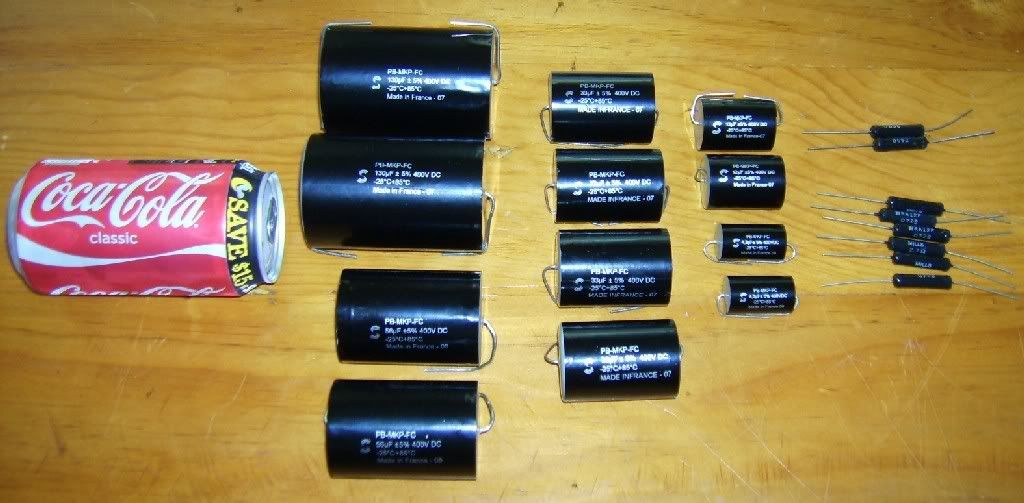
After reading all the posts I thought it would be a good idea to have my speakers recapped. I have a friend who is a computer technician and willing to do it for me . He wrote down the values of the existing capacitors and I went to Parts Express and ordered those exact same values in Dayton and Solen brands on recommendations found here in AK. They came today and they are huge. They are at least 20 times bigger than the old ones. There is no way I can use them. What did I do wrong? How do you tell the size when ordering?
Thanks for any help
 
Register to hide this ad
Those Boutique caps are huge and mostly a waste of money. Non polar electrolytics would have been cheaper and smaller.
 
IThose Boutique caps are huge and mostly a waste of money. Non polar electrolytics would have been cheaper and smaller.

I agree, mostly. For the woofer section of crossovers, the cheaper and much smaller Dayton caps are fine.

PE has a liberal return policy, btw.
 
The sizes are specified in the catalog.

Let your tech have a look at the situation. There are ways to have them fit.

I would not use non-polar electrolytics in a crossover if there were reasonable size and price poly alternatives available....
 
After reading all the posts I thought it would be a good idea to have my speakers recapped. I have a friend who is a computer technician and willing to do it for me . He wrote down the values of the existing capacitors and I went to Parts Express and ordered those exact same values in Dayton and Solen brands on recommendations found here in AK. They came today and they are huge. They are at least 20 times bigger than the old ones. There is no way I can use them. What did I do wrong? How do you tell the size when ordering?
Thanks for any help

I can only assume that if these caps are way bigger, then the originals in the speaker were the smaller electrolytic type. If you find that they don't fit the circuit board properly you can always solder a lead on to the caps, fasten the cap down somewhere else on the board or even on the speaker cabinet and solder the new leads into place. This will not hurt the performance. If you can tell the difference in sound with a couple of inches of lead wire compared to a direct solder from the cap itself, then I'd say your ears are made of gold.
I wouldn't replace the ones you bought, chances are they are higher quality and it will only make the speaker sound better. Be careful though, electrolytic caps are designed to have a bit of rolloff at the top frequencies which may sometimes sound more pleasing. The ones you bought are flatter in response and may make your speaker sound more bright then original. Trust your ears and go with what sounds better to you. I have replaced electrolytic caps in a speaker before (with better ones) only to put the original electrolytic caps back in. I liked the "coloured rolled off sound better"
Don't be afraid to experiment.
 
Caps too big?

After reading all the posts I thought it would be a good idea to have my speakers recapped. I have a friend who is a computer technician and willing to do it for me . He wrote down the values of the existing capacitors and I went to Parts Express and ordered those exact same values in Dayton and Solen brands on recommendations found here in AK. They came today and they are huge. They are at least 20 times bigger than the old ones. There is no way I can use them. What did I do wrong? How do you tell the size when ordering?
Thanks for any help

PE has a hard print catalog which lists the size of their caps. If you don't have one, you can also visit their website and key in the uF values you want and brands like Solen, Dayton, etc and also get the sizes that way. Electrolytics are smaller, but are generally rated a lower voltage and will have a limited lifetime just as the originals did.
 
50 or 100 v np electrolytics will work just fine. The 100 v will be compatible with amps in the up to 200 wpc class. I would not second guess the designer. Get whatever makes you happy and is not a big pain to install. The difference in sound is somewhere between negligible and nonexistant.
 
They will work, just give it a try

We had the same thing recapping some Rectilinear speakers, the new Dayton caps were huge.

Here is the recent post:

We replaced the two stock caps in each speaker with Dayton poly caps in sizes 2.2 and 60 uF.

The 60 uF poly cap was huge, more than 10 times as big as the stock cap. it would not fit in the same spot as the existing cap.

Bob and I figured there was no easy way to glue it to something (without moving a lot of stuff in the crossover and making it a bigger project), so we just cut the stock caps out leaving as much old wire as possible, and soldered the new caps (without trimming any wire from the new caps) to the old wire and now the two caps are floating on top of the crossover. We glued the big cap to the small cap (with goop) and taped them together with electrical tape and now the two caps bundled together are held in position by the 4 wires of the caps connected to the appropriate terminals in the crossover.

Did not look pretty, but the big cap was stable. And man, these things sound fantastic.​

These speakers now sound better than ever with these giant Dayton caps.

Cheers, Snade
 
I don't think ANY caps I've worked with were as big as the Solen 130uF caps I had to use on my Polk SDA SRS II's. They were a challenge to say the least to get them to work but it was not bad. Just look at the layout and mess around with the fitting. If worse comes to worse, you can "remote" mount them close by with short leads. I had to lengthen the leads on a couple of mine and I used the copper ground lead out of some 18/2 home wiring. I only had to use a couple of inches here and there. Here are some pics of the before and after along with the physical sizes of what I had to work with. It CAN be done and it IS beneficial. That was a little over $200 worth of parts and was well worth it for the differences. Plus, I didn't have a lot in the speakers, anyway.

I did have to go back and move the "piggybacked" caps on the low pass side because they hit the passive radiator just barely. :D It was a 15 minute fix.

The crossovers themselves...
005.jpg


High pass stock
004.jpg


High pass with Solen caps/Mills resistors
005-1.jpg


Low pass stock
024.jpg


Low pass with the BIG Solen caps
028.jpg
 
Mills 12 watt. I ordered all my parts from PartsConnexion (in Canada). They had everything in stock whereas Parts Express only carries parts of the Solen caps and Mills resistors. They had a few of the caps but none of the resistors. I think they were a little cheaper, too. I've spend about $400 total with these guys so far and they've been nothing short of spectacular on any questions I had. Plus, recently I had a lead on a Solen 5uF cap just snap off when it was unfolded. They sent me one for just the price of the cap ($5)...no freight. Highly recommended.
 
I know Parts Express has two voltage values in the Dayton polys.
the 250v are a lot smaller than the 400V. So check what voltage you ordered.
Also if space is really a problem you can use regular electrolytic and use a 0.10uf bypass cap parallel to it. At times it works just as well.
 
"Well it balances on your head
Just like a mattress on a bottle of wine
Your brand new leopard skin pillbox crossover..."

Apologies to Bob Dylan.
 
Caps too Big?

Here are some pics of a high-end job I worked on a while back. It was a Swiss made Ensemble Reference I speaker. The first pic shows the original xover board mounted to the base of the speaker. The second shows the original caps I replaced in front of the new ones. The biggie is a 1200V Mundorf Silver/Oil cap that was the key, series cap for the Scanspeak tweeter.
The last pic shows how I got the Mundorf and largest Hovland cap installed. I fabricated wooden blocks and glued them to the sides of the cabinet and then wire tied the caps to them and, as others have instructed, ran wires from each cap down and connected them to the PC board.

IMHO, AVGUYTX went over the top a bit with his Polk woofer crossover. Generally, woofer caps are wired in parallel and thus I don't consider them critical components in need of replacement with MPPF types. If replaced, I use NPE types which cost about 1/10 the price and take up about 1/10th the space. I could be wrong here about the parallel wiring assumption since I am not intimately familiar with that specific XO. But hey, each to his own.

I've worked on Polks also. They are very clever and somewhat unique, in that they mount crossover components to removable parts such as rear connector plates and drivers. The challenge is upgrading these XO's and getting them to fit back into the cabinet!
 

Attachments

  • als original xover.jpg
    als original xover.jpg
    164 KB · Views: 48
  • DSC00928.jpg
    DSC00928.jpg
    83.1 KB · Views: 47
  • Moritz xover pic 05-015.jpg
    Moritz xover pic 05-015.jpg
    75.1 KB · Views: 55
Here is a picture of the last crossovers I re-capped, a pair of Klipsch KG4. As the PCB was small and mounted on the rear of the binding post cup, and as I didn't want to go to the time or expense of mounting the board elsewhere, I had to make a small change.

The values are 33mF, 8mF, and 3mF. I opted to go with a NPE for the 33mF so that it would fit on the board. I also had to piggyback two 4mF to reach 8mF so they would fit on the board. Dayton 1% were used for the mid and tweeter sections, standard Dayton NPE were used for the bass section. If I had used larger caps, I wouldn't have been able to fit the cup back into the cabinet.

Total cost? Less than $20.
 

Attachments

  • kg4caps1.jpg
    kg4caps1.jpg
    116.8 KB · Views: 55
IMHO, AVGUYTX went over the top a bit with his Polk woofer crossover. Generally, woofer caps are wired in parallel and thus I don't consider them critical components in need of replacement with MPPF types. If replaced, I use NPE types which cost about 1/10 the price and take up about 1/10th the space. I could be wrong here about the parallel wiring assumption since I am not intimately familiar with that specific XO. But hey, each to his own.

I've worked on Polks also. They are very clever and somewhat unique, in that they mount crossover components to removable parts such as rear connector plates and drivers. The challenge is upgrading these XO's and getting them to fit back into the cabinet!

Yeah, I may have but they are worth it to me since they are my main speakers for 2-channel listening. :D I know that the main "audible" caps are what's on the top end but the low end was definitely cleaned up by using the better caps. On the other speakers I've done, the low pass caps weren't ever as large...physically or numerical value. Those SRS II's used (2) 130uf, (2) 56uF and (4) 33uF caps (the larger ones, anyway). The crossovers I just rebuilt for my best friends SDA 2.3's were half the cost of mine and the parts were much smaller. Just a different design. Man, they sound good, too. I bought them for his 40th birthday (which is tomorrow) and am leaving here in awhile to go to Arkansas for the weekend to "deliver" them.
 
Back
Top Bottom