

You are using an out of date browser. It may not display this or other websites correctly.
You should upgrade or use an alternative browser.
You should upgrade or use an alternative browser.
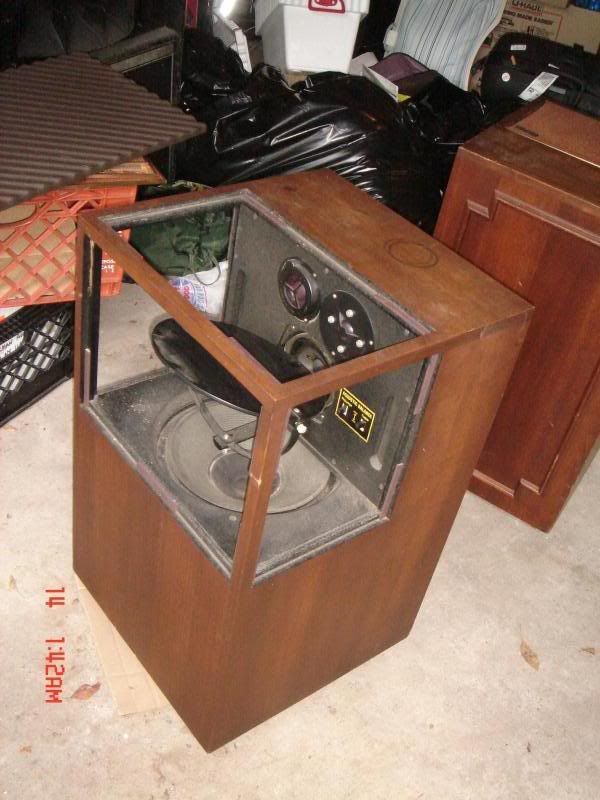
Name that Wharfedale!
- Thread starter pmsummer
- Start date
Register to hide this ad

Rolf Zetterberg
Well-Known Member
I have seen many Wharfedales in my days,but never a variable direct/reflecting one(if you don't count their columns in the 60's and their corner beasts with upward facing drivers).Very unusual,to say the least.Like kfa888 writes,it makes yóu wonder if it could be another manufacturer.The drivers look like Wharfedale,possibly with a small reservation for the mid.Does the badge look like original?

pmsummer
simul justus et peccator
Apparently, it has Wharfedale badges on the grill covers.
Link to more pics. Notice the molding on the backside (front?).
Link to more pics. Notice the molding on the backside (front?).

pmsummer
simul justus et peccator
The mid does not look Wharfedale but the rest of the drivers do. Never seen a reflecting Wharfedale design before, interesting.
I saw something like these in the early seventies... and they were a British speaker, too.
If you look closely at the mid-driver, it looks like the baffle has been pre-routered to fit two DIFFERENT mids.

Fred
I was thinking "Burt"... we already have an Ernie... :scratch2:

Scott

It wouldn't surprise me if those are actual Wharfedales. Gilbert Briggs had several early designs that used deflectors, and a whole bunch that fired tweeters up and out. So when omnis became the rage, he might have tried that. Now the lovely molding actually makes me think that the speaker might be meant to be placed with the molding side out and the drivers facing the wall, firing into the deflector and up, or off the deflector and thence off the wall. I can't see the point of a deflector between the listener and the speaker, nor the point of all that fancy woodword unless its meant to be used backwards.

dshoaf
That high voltage buzz
I remember working on a set of Wharfedale speakers that used a direct-reflecting design. They looked surprisingly similar to a the Quad 57 'static cabinets but the tweeter and midrange were mounted into the top and facing in reverse up and toward the wall. The woofer then fired forward in the middle of the cabinet, which was covered by a mesh grill with fabric covering it.
I do remember them sounding surprisingly good for their age - sometime in the late 50s, early 60s. This was about 1974 when they came through the shop, too.
Based on that experience, I'd buy the idea that this is a similar approach using a square box. Never saw that model, though.
Cheers,
David
I do remember them sounding surprisingly good for their age - sometime in the late 50s, early 60s. This was about 1974 when they came through the shop, too.
Based on that experience, I'd buy the idea that this is a similar approach using a square box. Never saw that model, though.
Cheers,
David
The speaker I think you are refering to was Brigg's favorite of the mono era, so it would have been mid to late 50s. It was actually a planar speaker, with two woofers on a panel and apparently sounded best at 45 degrees to the wall and somewhat out from it. It was not thought domestically acceptable to have two of them in a normal room -- they were big and not so handsome(looked like enormous Quad ESL 57/Dahlquist DQ 10s) and took up a lot of room if placed correctly. So they didn't make it into the stereo era.
I saw one in very dire shape at the dump years ago.
I saw one in very dire shape at the dump years ago.

Brian
An Old Geezer
Suspect the mid is also a Wharfedale. I think with the reflector bracket it would have been difficult for someone to route a new cut for a replacement. An interesting design and probably worth cleaning up and trying. In the early-mid '70s reflector/directed systems were being tried by several companies so suspect from around then. Also, the tweeter looks to be from the W70E (fried egg with plastic cover) so it would also support that period.
Rolf Zetterberg
Well-Known Member
I think Nat is on the right track.Probably meant to face the wall.
Which leads me to the question:is the Wharfedale badge on the grill cover meant to be read with the lodspeaker turned this way?
The two oblong holes-are they actually holes or...?
The yellow Acoustic Balance" label says "midrange" and "treble",but what's in the middle?Can't read it on my screen.
(SFB/3 is the name of the large panel speaker.GA Briggs own description here:http://members.myactv.net/~je245/obriggs.htm)
Which leads me to the question:is the Wharfedale badge on the grill cover meant to be read with the lodspeaker turned this way?
The two oblong holes-are they actually holes or...?
The yellow Acoustic Balance" label says "midrange" and "treble",but what's in the middle?Can't read it on my screen.
(SFB/3 is the name of the large panel speaker.GA Briggs own description here:http://members.myactv.net/~je245/obriggs.htm)
Wharfedale W80A
This is a 100% Wharfedale speaker introduced in 1972 at the same time the W60E and W70E were current models. It was also called the "variflex Speaker System" because it used a 10" hard surfaced "Variplanular " reflector which controlled mid and high frequency dispersion.
The woofer was the same as used in the W60E except it faced upward. Acoustic suspension with a neoprene rubber suspension and a 9-1/2 lb. magnet structure.
The 4-1/2" midrange was the same as used in the W60E &W70E.
The two tweeters were defined as "3" domed sub-treble" and "1" domed ultra-sonic". The latter is the same tweeter used in the W60E & W70E. Both tweeters were mylar domed.
The walnut wood side with the molding was always the front of the speaker; in other words the midrange and tweeters always faced to the rear. Very good diagrams were supplied showing typical positioning of the 10" reflector for different room configurations and speaker placement.
these speakers had a list of $300 each and shipping weight of 85 lbs. each.
I guess you would call these omni directional with controllable directivity. They could be very impressive sounding and G. A. Briggs response to Bose and Ohm and others. Briggs always considered directional effects a very undesireable element in speaker design. :thmbsp:
Dave :tresbon:
This is a 100% Wharfedale speaker introduced in 1972 at the same time the W60E and W70E were current models. It was also called the "variflex Speaker System" because it used a 10" hard surfaced "Variplanular " reflector which controlled mid and high frequency dispersion.
The woofer was the same as used in the W60E except it faced upward. Acoustic suspension with a neoprene rubber suspension and a 9-1/2 lb. magnet structure.
The 4-1/2" midrange was the same as used in the W60E &W70E.
The two tweeters were defined as "3" domed sub-treble" and "1" domed ultra-sonic". The latter is the same tweeter used in the W60E & W70E. Both tweeters were mylar domed.
The walnut wood side with the molding was always the front of the speaker; in other words the midrange and tweeters always faced to the rear. Very good diagrams were supplied showing typical positioning of the 10" reflector for different room configurations and speaker placement.
these speakers had a list of $300 each and shipping weight of 85 lbs. each.
I guess you would call these omni directional with controllable directivity. They could be very impressive sounding and G. A. Briggs response to Bose and Ohm and others. Briggs always considered directional effects a very undesireable element in speaker design. :thmbsp:
Dave :tresbon:
What a fascinating thread! Thanks to Rolf and Tafsound for all the background info and the specifics about this model. I have an enthusiasm for Gilbert Briggs as a writer and as a manufacturer -- if you read any of his books (some of which were brought back into print by Old Colony/AudioXpress (nee Audio Amateur)), its startling how little has changed since 1955 or so, and how astute and balanced yet open to new ideas he was. There are probably more interestingly peculiar, yet effective, designs out of Wharfedale than any other designer/manufacturer. And he was a very fine writer, too.
Wharfedale badge faces wall
I think Nat is on the right track.Probably meant to face the wall.
Which leads me to the question:is the Wharfedale badge on the grill cover meant to be read with the lodspeaker turned this way?
The two oblong holes-are they actually holes or...?
The yellow Acoustic Balance" label says "midrange" and "treble",but what's in the middle?Can't read it on my screen.
(SFB/3 is the name of the large panel speaker.GA Briggs own description here:http://members.myactv.net/~je245/obriggs.htm)[/
The quotation is taken from a book called "Loudspeakers" first published by G. A Briggs in May 1948. The quotation is from the fifth edition, October 1958, Chapter 17 "Baffles"
G. A. Briggs and Peter Walker were great friends. When Briggs heard the Quad Electrostatic in 1956 he recognized it's virtues but felt the same could be accomplished using high quality moving coil drivers on a flat sand filled baffle. Enter the Wharfedale SFB/3
What a fascinating thread! Thanks to Rolf and Tafsound for all the background info and the specifics about this model. I have an enthusiasm for Gilbert Briggs as a writer and as a manufacturer -- if you read any of his books (some of which were brought back into print by Old Colony/AudioXpress (nee Audio Amateur)), its startling how little has changed since 1955 or so, and how astute and balanced yet open to new ideas he was. There are probably more interestingly peculiar, yet effective, designs out of Wharfedale than any other designer/manufacturer. And he was a very fine writer, too.
G. A. Briggs was way ahead of his time. The man covers everything in audio and writes with a wonderful sense of humor and wit. I'm giving my age away but my first "Hi-Fi" was a Miracord changer with a GE VR-11 cartridge, my first kit, an EICO 12 watt tube amp and a Wharfedale Super 8 fullrange in a 3-1/2 cu. ft. bass reflex. It would wipe out all the neighbors Magnavox or Capehart or Zenith consoles. I was a 10th grader and mighty proud of my accomplishment. That same 8" Wharfedale is still one of the best ever once you refoam it. I believe Wharfedale was the very first to use foam suspension. By the end of 1957 they were producing 800 speakers / week using foam suspension. Briggs did not have a source for foam but used the foam covering from ladies coat hangers for his experimental work. Prior to foam he used wool flannel cloth but found foam to have superior damping qualities. He eventually found the coat hanger manufacturers and their source for the foam. What he didn't know was how the foam turned gooey or crumbly in 10-15 years.
Dave :thmbsp:
Similar threads

- Replies
- 275
- Views
- 74K

- Replies
- 55
- Views
- 2K


