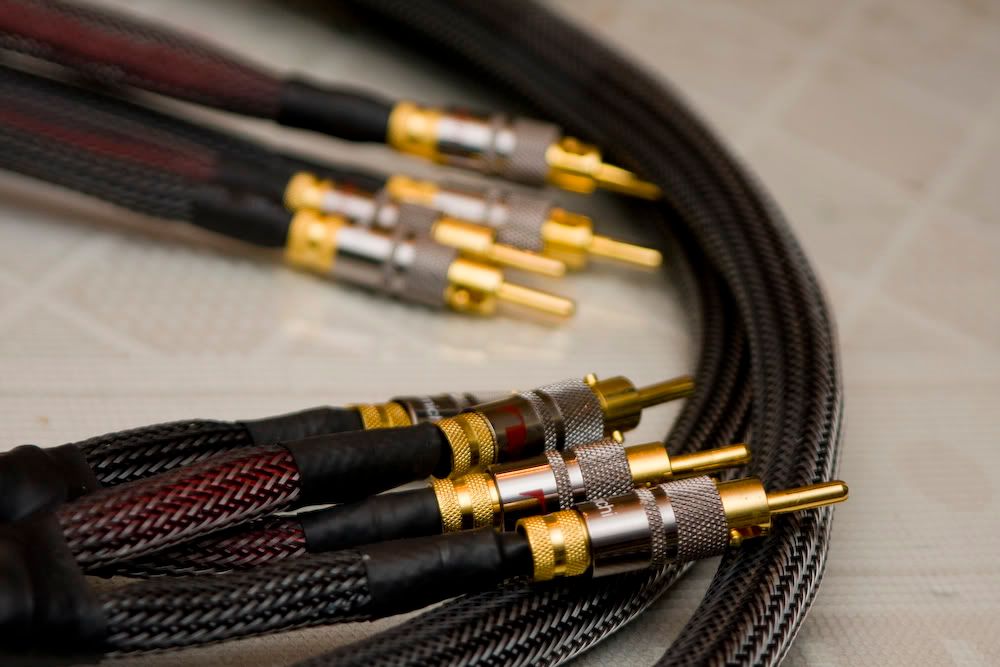
My DIY speaker cable ..................
Parts
Belden RJ45 CAT-5e Crossover Cable - Ebay
WBT 0800 Silver Solder 4% Silver - Parts Express
Techflex 1/2" Expandable Sleeving - Parts Express
Heat Shrink - Home Depot or Lowe's
Nakamichi banana Plug -Ebay
Scotch Super Vinyl Electrical Tape (Red and Black)- Home Depot
Tools
Knife - Auto parts ,Home Depot ,Lowe's etc
Heat Gun (air) - Lowe's ,Parts Express etc
Linemans Pliers - Home Depot ,Sears ,Auto Parts etc
note : never cut CAT-5e with Wire Stripper,the best choice is with knife and Heat Gun.
Links Reference
http://www.audioholics.com/reviews/cables/diy-speaker-cable-faceoff
http://www.avforums.com/forums/home-cinema-diy/954188-diy-cat5e-speaker-cable.html
http://www.platenspeler.com/diy/cabling/uk_4play_1.html
=====================================================================================
http://translate.google.com/transla...com/pcpfiles/doc_altavoces/cables/cables.html
............The electrons are pushed to the outside of the driver.
The delays in changing the magnetic field pushes the charges outside the conductor. This reduces the effective area of the conductor to a small part.
You can avoid a very simple way: with cables that have more surface and to maintain constant current density. This leads to flat cables. There are few cables as well. The other option is to use thin wires, because in them are produced much higher frequencies. This is the snake biting its tail, because you avoid this effect, but the series resistance increases, and according to my experience, the series resistance is aggravated by interacting with other parasitic effects.
The solution to these two problems together is to use many thin wires, so depending on the topology can be used to increase the capacity to unite them.
:thmbsp:
-----------------