

You are using an out of date browser. It may not display this or other websites correctly.
You should upgrade or use an alternative browser.
You should upgrade or use an alternative browser.
Fluoroscans - do they ever burn out?
- Thread starter johnnm
- Start date

Register to hide this ad

HomeBody
Passion not Critisism
They are not LEDs...
 What are they, then?

They are a vacuum fluorescent display and yes, they can wear out.
http://en.wikipedia.org/wiki/Vacuum_fluorescent_display
http://en.wikipedia.org/wiki/Vacuum_fluorescent_display
As xlbee says, they are a vacuum fluorescent display, not unlike a tube. They have filaments, and they do slowly degrade.
Unfortunately, no one seems to have come up with a way to rejuvenate them.
Unfortunately, no one seems to have come up with a way to rejuvenate them.

 Me too.
jsarsfield
The Pioneer Pirate
As xlbee says, they are a vacuum fluorescent display, not unlike a tube. They have filaments, and they do slowly degrade.
Unfortunately, no one seems to have come up with a way to rejuvenate them.
I just read this from the wikipedia link that was posted.
Emission may usually be restored by raising filament voltage. Thirty-three percent voltage boost can rectify moderate fade, and 66% boost severe fade. This can make the filaments visible in use, though the usual green-blue VFD filter helps reduce any such red or orange light from the filament.
Is this possible with Pioneer gear? like boosting the laser current in a CDP.

Ed in Tx
Super Member
The Fluroscan display tube in my 30 year old Pioneer DT-400 timer that's been plugged in running for 30 years appears to be as bright as ever. Lights up my whole kitchen at night, where it's had a coffee maker and counter light plugged into it since new. Pretty amazing how long they can last, if you calculate the hours (over 263,000 hours of continuous operation!)


It's weird- some seem to last forever, and some get noticeably dimmer in just a few years, or get mottled-looking with some portions of the glow being brighter than others.
I would expect that raising filament voltage would work, but that's a difficult proposition in most cases- one would have to add a different transformer and connect it to the filament drive circuits.
I would expect that raising filament voltage would work, but that's a difficult proposition in most cases- one would have to add a different transformer and connect it to the filament drive circuits.

33&athird
Turn on & Tune in
Well, this may be off thread-
But how did the term/name Fluroscan come to be?
Well, best guess here; A Fluorescent display that shows the radio scan(station)...but that's my guess.
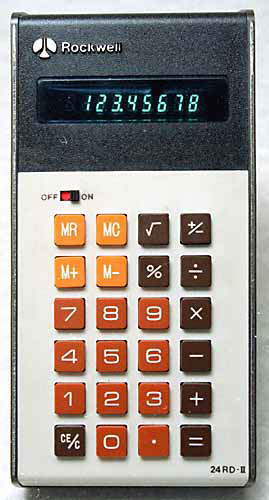
And while yes, they can go out it's kinda rare, although far more likely than leds. I have a old calculator with a flourescent display that's still nice a bright...it's from 1976 I belive.
Here's a picture from the vintage calculator site; (at the time, small leds were used, and were very hard to see, theflourescent didn't have this problem, I don't think Ti ever switched from led, but the flourescent was used commonly in rockwell calculators)
The more likely reason for some to dim and others not to would be the nature of use. I'd be happy to bet a not paltry sum of money that most units showing failure of the fluroscan would have been switched on and off a lot during their life time.
Filaments, from everything I've learnt, are perfectly happy once their temperature has increased and the initial rush of current and temperature has stopped. So on and off heating and cooling would cause problems with most things of that nature.
Filaments, from everything I've learnt, are perfectly happy once their temperature has increased and the initial rush of current and temperature has stopped. So on and off heating and cooling would cause problems with most things of that nature.

It's weird- some seem to last forever, and some get noticeably dimmer in just a few years, or get mottled-looking with some portions of the glow being brighter than others.
I would expect that raising filament voltage would work, but that's a difficult proposition in most cases- one would have to add a different transformer and connect it to the filament drive circuits.
In some models, there's a series power resistor (dropping) in the primary of the filament transformer that could be messed with....
The sx-3900 for example has a 220 ohm 1 watt resistor, but BOTH displays are run off of different windings of the same transformer. A series dropping resistor in the secondary??
SolderIron
Addicted Member
I have a receiver that some digits are dimmer than others. I thought about raising the anode volt but never follow through. Too much work and don't know about getting enough improvement for the pain.
>Thirty-three percent voltage boost can rectify moderate fade, and 66% boost severe fade.
Probably not good for the remianing life of the tube. But if it works long enough to serve the purpose....
>Thirty-three percent voltage boost can rectify moderate fade, and 66% boost severe fade.
Probably not good for the remianing life of the tube. But if it works long enough to serve the purpose....
Similar threads
- Replies
- 2
- Views
- 290


- Replies
- 1
- Views
- 552

