• The move to the new server is done. There are some software and database maintenance updates in process. This has us passing the hat around to help out. We appreciate any donations. Seriously, even a dollar helps. The payment page may be found here - https://www.audiokarma.org/support.html

DIY aperiodic enclosures for old Philips fullrange

audiozaz

rtfm!? - tl;dr
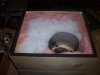
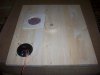
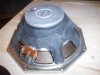
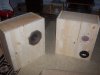
Here are some aperiodic boxes I finished building last weekend. In them are Philips AD7060 6" fullrange drivers I took out of Noresco cabs.
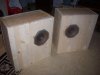
front.jpg

front+back.jpg

with gasket.jpg

vent front.jpg

back baffle vent.jpg

back driver.jpg

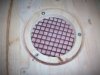
I made the enclosure to be ~28liters, unoptimally small, yielding a 0.84 Qtc, which I brought down to ~0.66 with the aperiodic vent. Fc is 71Hz. The vent is about ½" thick pink fiberglass insulation sandwiched between guttermesh. The tuning process was very educational and fun to me. I will have to re-tune my Dynaco A25 to see if I can make them sound better, as when I bought them, there was no more fiberglass in the slot and I pretty much winged it when putting some back. Now I'm better armed. :)

These boxes sound quite nice so far, with Jazz and even dance music, so long as I don't push too hard on the SPL. The whizzer seems rather well-behaved. There is none of that tin-can sound I've heard on other similar FR's. Will have to try other styles of music. Might do a couple of mods such as BSC, phase plug and whizzer damping. Oh, and I'll have to sand and finish the cabs before the cold sets in in these parts. :)

az
 
Register to hide this ad
Nice job, I like aperiodic loaded enclosures also. Good on ya Eh!

Shawnra

Thanks. Although they don't have low-bass, what they do put out is very tight and pleasing. Impulse response seems subjectively very good. I'll try to run them with my OB woofers when I can set-up a line crossover for them.

az
 
I built an aperiodic subwoofer based around a peerless woofer many years ago. The woofer was intended for sealed enclosure use and I feel it's roll off was alleviated a bit by adding 2 scanspeak aperiodic ports. Basically it made the internal volume behave like it was a bit larger without unloading the driver at the very bottom frequencies like a port would have. Worked very well, my friend called the sub the "Big Green Monster" because I painted it emerald green and it was quite huge. Around 4 cubic feet constructed with a layer of 3/4" mdf and a layer of 5/8' baltic birch on the outside.

Shawnra
 
I built an aperiodic subwoofer based around a peerless woofer many years ago. The woofer was intended for sealed enclosure use and I feel it's roll off was alleviated a bit by adding 2 scanspeak aperiodic ports. Basically it made the internal volume behave like it was a bit larger without unloading the driver at the very bottom frequencies like a port would have. Worked very well, my friend called the sub the "Big Green Monster" because I painted it emerald green and it was quite huge. Around 4 cubic feet constructed with a layer of 3/4" mdf and a layer of 5/8' baltic birch on the outside.

Shawnra

Sounds cool.

There is not much actual data on DIY'ing aperiodic boxes. All you can seem to find is "use this many Variovents per volume unit". Of course it's more of a trial and error process until you get it right. I started with 2" thick fiberglass in the sandwich, which was basically like a closed box and reduced the ammount 2-3 times until I had reached desired Qtc.

What I'd like to know is how much you can get away with. The main advantage of aperiodic "loading" is to run a driver in a box that is otherwise too small. In my case, half the size required for a 0.707 Qtc, for which it would need 56 liters. As mentionned earlier, my starting Qtc was ~0.84 simulated, but in fact around 0.79 because of the stuffing inside the box that made it look bigger. Simulation shows that my 28l volume + stuffing = ~36l, in order to have the 0.79 figure, which is in agreement with Fc, at ~71Hz. F3 is about 65Hz. I'd like to try pushing the design further to 1/3 or 1/4 of the 0.707 size. There will be a limit reached at some point though, where you might start to have a bass reflex behavior when not enough resistive material is present in the vent.

az
 
Last edited:
You know I can remember back to about 1990 when stuffing your port on a bass reflex box with small straws was all the rage. I wonder if this kinda combined the best of both worlds? Just a thought.

Shawnra
 
You know I can remember back to about 1990 when stuffing your port on a bass reflex box with small straws was all the rage. I wonder if this kinda combined the best of both worlds? Just a thought.

Shawnra

I've read about the straw trick you describe. I guess that they should be fairly compressed together to work toward making the enclosure aperiodic. Was that how it was done? Wait, or wasn't it with those brown coffee sticks that are already pretty slim inside?

az
 
Mmmmm...

And I just realized I could use the same procedure to make enclosures for the two Foster 12" woofers I have. Wether for BR or Acoustic Suspension, they model good in 230 liter and up cabs.

I figure I could get away with a 80l cab, which would seem to be something around 95l once stuffed and get f3 around 41Hz and an easily reached Qtc around .707, down from 0.85. I see a three-way in my future. Hey hey, I'm talking about a speaker build here! ;)

az
 
An article by George Short, North Creek Music on Aperiodic damping.
It has some math.
I've built a pair with his formula, using the CSS FR125s, a full range driver. It is a good technique for wringing the most controlled low end out of a FR driver but it won't get you much additional lower-end response.
 
An article by George Short, North Creek Music on Aperiodic damping.
It has some math.
I've built a pair with his formula, using the CSS FR125s, a full range driver. It is a good technique for wringing the most controlled low end out of a FR driver but it won't get you much additional lower-end response.

I've read this one before, good stuff. Isn't the Dynaco A35 or A50 of a similar design, i.e. with the aperiodic vent leading to a sealed chamber? I should try this multi-chamber approach sometimes. I do prefer to have a well-controlled/damped low-end on fullrangers as I feel that the less the cone moves, the better the midrange and highs are; lower "doppler distortion". This is why I went with a 0.66 Qtc. I'll have to play some more with placement in-room to get the best out of them. My next project(s) will be Karlson couplers; these are supposed to be good on minimizing cone excursion. :)

az
 
As I recall, the straw thing was all about reducing port turbulence by increasing surface area of the port. With the coffee stirrer thingies you might be getting into a resistive type setup. Never tried that.
 
As I recall, the straw thing was all about reducing port turbulence by increasing surface area of the port. With the coffee stirrer thingies you might be getting into a resistive type setup. Never tried that.

I could see drinking straws reducing port mach speed, somewhat altering the tuning (?), without getting into aperiodic territory, where the coffee sticks might lead to.

az
 
I've read this one before, good stuff. Isn't the Dynaco A35 or A50 of a similar design, i.e. with the aperiodic vent leading to a sealed chamber? I should try this multi-chamber approach sometimes. I do prefer to have a well-controlled/damped low-end on fullrangers as I feel that the less the cone moves, the better the midrange and highs are; lower "doppler distortion". This is why I went with a 0.66 Qtc. I'll have to play some more with placement in-room to get the best out of them. My next project(s) will be Karlson couplers; these are supposed to be good on minimizing cone excursion. :)

az
The Dynaco's are similar. From reading between the lines in Mr. Short's article I felt that he really liked the Scan-speak Revelator and was trying to get an alingment that worked with all the other factors that a speaker designer has to work with like size of enclosure, kit build or not, synergy with other drivers, etc..
The nice thing about aperiodic vents is that you can adjust them to get a system response to your liking. I really packed the aperiodic vent in the little bookshelves I built but my teenager manged to burn one up in short order. Some things never change.:D
 
I really packed the aperiodic vent in the little bookshelves I built but my teenager manged to burn one up in short order. Some things never change.:D

Burnt the voice coil or the whole thing?

I also was able to listen to them some more during the weekend. I mostly tried jazz-type stuff on them and they play that really well. I think on anything acoustic or more sparse, they should do very good. I simulated BSC with my EQ, but barely needed any with well-recorded/mastered program material. They have a very good realism with string instruments; I'm thinking of a specific Lorne Lofsky tune where there is one electric guitar, one acoustic guitar and a double-bass. They do drum quite well too, except for the low-reaching "thud" on kick drums, which could, even should, be more visceral. High-frequency extension is quite adequate, not as sparkly as a 1" soft dome, to which I am acustomed, but very easy and natural souding. I could easily add a rear-firing 3/8" mylar dome crossed-over very high, ~14kHz to see if it improves things, but I feel no immediate need for it. I set them up on ADS L500 cabs used as stands and listen to them with a slight toe-in, but still off-axis, which I feels sound much better.

az
 
Last edited:
Neat design. So, the wire bucket inside is to keep the stuffing away from the moving parts. What is the putty on the woofer for?
 
Neat design. So, the wire bucket inside is to keep the stuffing away from the moving parts. What is the putty on the woofer for?

I made it from guttermesh around the back of the driver mostly to keep any polyfill from getting in there. I remember reading something about keeping the aperiodic vent close to the driver and to have a "clear" path to it, so, if that means anything, I had it there. :)

The putty is ductseal, a pretty dense and malleable putty used by electricians around conduits and stuff to make them airtight. This stuff will never harden and is used to damp the stamped steel basket.

These cabinets have been taken appart, as it was mostly experimental. I might do a re-build of this one, but make the box even smaller to see how far I can push the idea. I'll probably design for Qtc~1.0 with stuffing and try to have the aperiodic vent take this figure down ~0.8. For Qtc=1.0, I simulate a Vb of 16 liters. Considering the stuffing, I think ~13 liter stuffed will equal around 16 liters. Predicted f3 is ~72Hz, but will more likely be closer to 80-85Hz once de-Q'ed (palindrome!) by the aperiodic vent.

Using golden ratio internal dimensions, external dimensions would be ~17cm*26cm*40.5cm, if using 1/2 BB ply. Might try the driver on the thinner side this time.

az
 
Last edited:
Back
Top Bottom