• The move to the new server is done. There are some software and database maintenance updates in process. This has us passing the hat around to help out. We appreciate any donations. Seriously, even a dollar helps. The payment page may be found here - https://www.audiokarma.org/support.html

An early 1060 is different

ChrisMarantz

Super Member
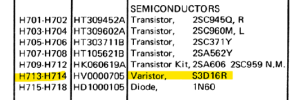
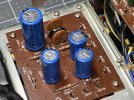
I am about to start on a 1060 rebuild and while I was looking it over I noticed that it's different from other 1060's I have worked on. This amplifier is serial number 25396 and it doesn't have the varistors (H713 & H714) which are typically glued to the heat sinks of transistors H705 & H706.

Instead there is a diode mounted on the circuit board. I haven't found this early variation in any service manual or schematic. I thought I would point it out for others who might run across it.
 

Attachments

  • 1060 Early Amp PC.jpg
    1060 Early Amp PC.jpg
    75.6 KB · Views: 324
  • 1060 Later Amp PC.jpg
    1060 Later Amp PC.jpg
    81.2 KB · Views: 308
Register to hide this ad
I'm gonna put a link to this in the Service Manual error sticky. Handy info.

That diode looks like one of those troublesome VD1212 or 1122.
 
That diode looks like one of those troublesome VD1212 or 1122.

When I work on the 1060 this weekend I'll remove and test them to make sure of what they are. While a pair of 1N4148's in series can be one solution, it may be possible to add a varistor and glue it to the heat sink like a later series.

I will be looking for an early schematic and visually comparing the early and later boards for other changes.
 
It looks like there is some glue on the board under that heat sink. The transistor is marked 2sc945 instead of c945. Could it be that someone did a repair on this unit and made the change?

Rob
 
It looks like there is some glue on the board under that heat sink. The transistor is marked 2sc945 instead of c945. Could it be that someone did a repair on this unit and made the change?

Rob

I'll be able to tell if its been worked on when I get it taken apart, however I don't think it has been repaired before. Everything looks very original.

This is one of those units that someone was stupid sloppy with the glue and it covers a lot more than is necessary.
 
After spending time this weekend recapping this 1060, I can report that it is all original. There wasn't any sign of previous work have been done, even the thread on the screws holding everything together was still intact.

I will assume that this is an early 1060 design which is actually the same as a really early 1030 I have.
 
Nakamichi CA-1DTS

I am about to start on a 1060 rebuild and while I was looking it over I noticed that it's different from other 1060's I have worked on. This amplifier is serial number 25396 and it doesn't have the varistors (H713 & H714) which are typically glued to the heat sinks of transistors H705 & H706.

Instead there is a diode mounted on the circuit board. I haven't found this early variation in any service manual or schematic. I thought I would point it out for others who might run across it.

How do you do
Search for the service an мануал on preamplifier Nakamichi CA-1DTS IF can help, give to know.
thank you beforehand
 
In my marantz 1060 I found R707-708 33Kohm (on the board) instead of 18K (in the service manual). Anyone have the same difference?
 
In my marantz 1060 I found R707-708 33Kohm (on the board) instead of 18K (in the service manual). Anyone have the same difference?
I don't remember all the differences between the two 1060's I had, but it was several. Mostly on the amplifier board. They made changes along the way as they were produced. I always go by whats on the board instead of the service manual unless you can see where someone was mucking about inside before you got it. They didn't update service manuals.
 
I am about to start on a 1060 rebuild and while I was looking it over I noticed that it's different from other 1060's I have worked on. This amplifier is serial number 25396 and it doesn't have the varistors (H713 & H714) which are typically glued to the heat sinks of transistors H705 & H706.

Instead there is a diode mounted on the circuit board. I haven't found this early variation in any service manual or schematic. I thought I would point it out for others who might run across it.
@ChrisMarantz:

I have restored three 1060's, and found both configurations:
  1. s/n 28420 - an epoxy "gob" (varistor or diode) at H713 & H714
  2. s/n 40093 - an epoxy "gob" (varistor or diode) at H713 & H714
  3. s/n 43259 - each H713/H714 position was fitted with a resistor in series with a thermistor glued to the snowflake heatsink for the respective NPN driver (H709/H710)
I've also found both configurations in multiple 2230's, and this is described in Service Bulletin M-2230-2. So it appears that Marantz made the identical change to the 1060 as they did to the 2230 - and as we know, the 1060 is nearly identical to the 2230, electronically speaking. I have not seen any Service Bulletins for the 1060, but it seems almost certain that Marantz would have published an equivalent Service Bulletin for the 1060. Anyone have a copy? Would love to see it!

In any case, based on prior posts from Catrafter I have simply replaced both configurations with a single 1N4448 diode and had no problems, in 1060's and in 2230's. My recollection is that in Tom's (catrafter's) opinion the whole change was an over-reaction by Marantz and that a single diode was perfectly sufficient. Just found the links:

Tom, from post #5 in Question regarding 1060 PA board:
I would just leave it alone if the resistor/thermistor mod (service bulletin) is already installed. If the service bulletin has NOT been done, you can replace H713 and H714 with ONE 1N4448 diode each.

Tom

and Tom again, from post #13 in Very Early 2230 different P550 board?:
...It is my opinion that the service bulletin for the 2230 M-2230-2) that calls for removing H757 ( a dreaded 'gob' diode) and replacing it with a resistor/thermistor in series was a knee jerk reaction that could have been solved by simply replacing H757 with a proper glass encapsulated diode such as a 1N4448.
...
Tom

I hope this is helpful - and it would be great to hear if anyone else has experienced otherwise.
Cheers! - Steve
 
I bought a couple hundred 1N4448 diodes on tape. They're dirt cheap and can be used as replacements in so many instances. They're kinda the cresent wrench of diodes. :biggrin: I've used two together to replace dodgy dual diodes too.
I've searched myself for service bulletins for the 1060 and 1030 with no luck.
 
Marantz 1060 Serial 33414

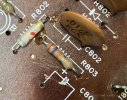
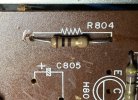
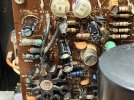
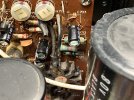
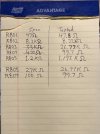
I'm currently rebuilding a 1060 and starting with P800. I've found 2 discrepancies in the Service Manual concerning R803 & R804.

Attached pictures of the factory installed resistors showing the color bands for
R803 / 27K ohms
R804 / 100 ohms

Aso pictures showing H713/H714 with wires running to the heatsinks for transistors H709/H710.
I thought this was hacked up by someone until now.

Edited

IMG_9754.jpeg

IMG_9753.jpeg

IMG_9749.jpeg

IMG_9751.jpeg

IMG_9750.jpeg
 
Last edited:
So, you didn't replace those electrolytic caps? I would leave those diodes alone unless bad.
 
You can't replace those with 1N4448 diodes! They are varistors that monitor the temperature of the transistor heatsink. (See PL) Just clean them up and they must be attached to the heatsinks.

View attachment 3337339
And be VERY careful with those varistors. The leads are fragile and can easily snap off right at the varistor itself.
 
So, you didn't replace those electrolytic caps? I would leave those diodes alone unless bad.
Started with P800 and finished it last night. Nothing else has been done. I'll treat them with great care. IMG_9778.jpeg
 
Last edited:
You can't replace those with 1N4448 diodes! They are varistors that monitor the temperature of the transistor heatsink. (See PL) Just clean them up and they must be attached to the heatsinks.

View attachment 3337339
I'm trying to figure all of this out plus I get easily confused deciphering explanations. Part of that is I get in a hurry reading. Thank for saving me trouble. I'll leave them be and treat them with great care.
 
So someone has been inside the amp before then. I saw caps and some resistors that had been replaced on the amp board.
One of the 1060's I had bought was a literal basket case I picked up cheap. It was all in pieces. Wires cut, PCB's removed from the chassis sitting in the box, resistors and caps missing or replaced with the wrong ones along with some other sketchy attempts at a repair. It was a fun project. :biggrin:
 
Yup. This thing has had technician Hackworth in it. The P700 board is a little rough. Cheapo power cans and poor soldering. The volume out of the right channel is about 1/2 that of the left. Pots are 95% clean and smooth as silk. All of the switches are dry as Bob Barker's back and starting to hang. The chassis has a slight "twist".... not sure why. A little corrosion and pitting in a few areas on the chassis. I overpaid substantially for this unit and did an emotional purchase. Mostly due to its exterior cosmetic appearance and of course the lies from the seller who sells lots of vintage gear from his garage. Claimed it was fully serviced by his guy and in excellent condition. When I got it home and plugged in I was like "What's wrong with the volume out of the right channel?" Popped the cover and saw the P700 board, cheapo power cans and soldering. That's when buyers remorse hit me hard, knowing I paid waaaaaaaaaaaaay to much. As in $200 to much! I'm embarrassed to say, but I paid $600. Well, I know how to rebuild it, so I feel I saved some random buyer that doesn't know a lot of grief. I guess I'll name this unit "Community Service" The upside.. When the cover is on its cosmetically a 9/10. Beautiful faceplate and knobs with next to no scratches. The rear panel is equally nice.
 
Yup. This thing has had technician Hackworth in it. The P700 board is a little rough. Cheapo power cans and poor soldering. The volume out of the right channel is about 1/2 that of the left. Pots are 95% clean and smooth as silk. All of the switches are dry as Bob Barker's back and starting to hang. The chassis has a slight "twist".... not sure why. A little corrosion and pitting in a few areas on the chassis. I overpaid substantially for this unit and did an emotional purchase. Mostly due to its exterior cosmetic appearance and of course the lies from the seller who sells lots of vintage gear from his garage. Claimed it was fully serviced by his guy and in excellent condition. When I got it home and plugged in I was like "What's wrong with the volume out of the right channel?" Popped the cover and saw the P700 board, cheapo power cans and soldering. That's when buyers remorse hit me hard, knowing I paid waaaaaaaaaaaaay to much. As in $200 to much! I'm embarrassed to say, but I paid $600. Well, I know how to rebuild it, so I feel I saved some random buyer that doesn't know a lot of grief. I guess I'll name this unit "Community Service" The upside.. When the cover is on its cosmetically a 9/10. Beautiful faceplate and knobs with next to no scratches. The rear panel is equally nice.
Ya, but you usually wind up learning a thing or two with pieces like this.
I have. And it's a good feeling when it's done and working right.
 
Back
Top Bottom