


pete_mac
Super Member
Something a little different from my usual Sansui and vintage amp restorations! 
After owning several audio-gd DACs, I bought this lovely audio-gd DAC 3SE when it popped up for sale, and I have been very impressed by its performance via the original DF1704 digital filter chip. I then bought a PMD100 chip to experiment with, but I got chatting with Kingwa (head honcho at audio-gd) regarding my options. He indicated that he could build me a full replacement digital board including the DSP1 V5 processor which would provide the tonal goodness of the PMD100, with the resolution of the DF1704. It also offers the option of selecting different oversampling settings and selectable phased lock loop jitter reduction. After experiencing the DSP1 V5 on my previous audio-gd Reference 5, the proposition was too good to refuse!
The DAC 3SE was in fact updated towards the end of its model run with a factory DSP1 V1 option (DAC 3DV). The version of the board that I have in mine has been built with WIMA capacitors rather than the white EVOX caps, so my board is a Reference 1 board, making this somewhat of a hybrid DAC.
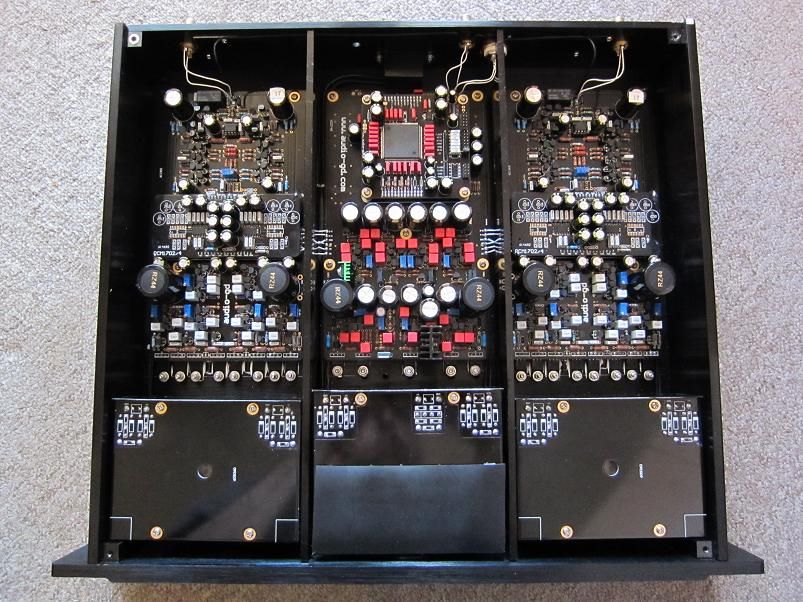
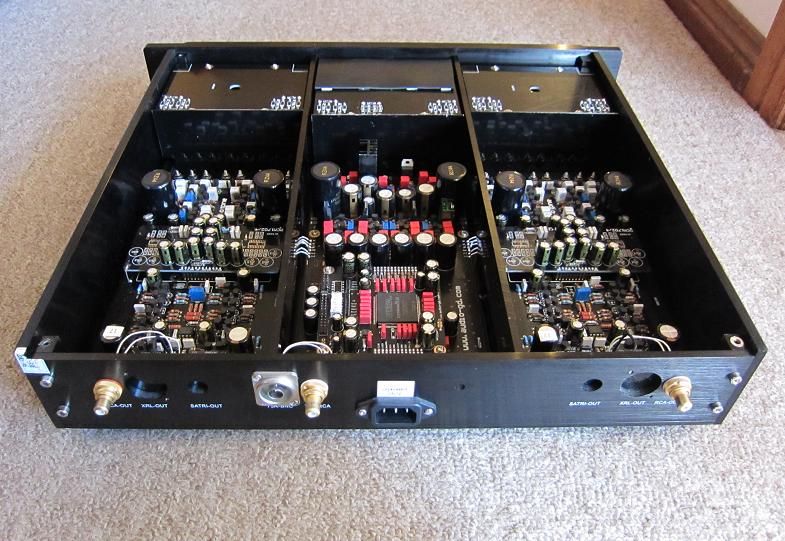
Even cooler is the fact that this DAC features three R-core transformers rather than the typical 1 x R-core and 2 x toroidal which were found in many early DAC 3SEs.
It’s a huge DAC at around 430mm x 430mm x 80mm, with a wider front face. It weighs around 13kg. It also runs quite warm after 1 hour of use. Kingwa designed his earlier DACs to run warm compared to the later stuff.
The new board arrived safe and sound and very well packed.
Original board removed:


The power wires were first unsoldered from the bridge rectifier PCB which is mounted directly above the centremost R-core transformer:

Here’s a comparison of the two boards. The FETs screw into the bottom panel of the DAC for heatsinking, and the new board featured slightly different spacing as you can see in the pic below. This required the drilling of five new holes which was easily done. Apart from this, the board was a direct fit once the necessary wires were desoldered and resoldered.

New board in position. One point to note is that the twelve bridging wires between the digital board and analogue boards (six wires per side) have a different order on the replacement board vs the original board. The first time I fired up the DAC, I hadn’t allowed for this change and there was no sound whatsoever (which is when panic set in!). I quickly retraced my steps and discovered my oversight.


The cream of the crop... a pair of PCM1704UK chips per channel (signified by the two white dots vs the normal PCM1704 chips):

Internal partitions re-fitted and ready to go!
The DAC is now singing sweetly and stood up to be counted in a recent comparison with some fairly pricey and highly fancied DACs. It doesn’t have the outright detail of some brand new DACs, but it isn’t all that far behind, and it makes up ground in terms of timbre, tone and realism. It’s the kind of DAC that you can listen to for hour upon hour without fatigue. To say that I'm happy would be a gross understatement
The black anodised aluminium enclosure also compliments my Sansui gear perfectly.
After owning several audio-gd DACs, I bought this lovely audio-gd DAC 3SE when it popped up for sale, and I have been very impressed by its performance via the original DF1704 digital filter chip. I then bought a PMD100 chip to experiment with, but I got chatting with Kingwa (head honcho at audio-gd) regarding my options. He indicated that he could build me a full replacement digital board including the DSP1 V5 processor which would provide the tonal goodness of the PMD100, with the resolution of the DF1704. It also offers the option of selecting different oversampling settings and selectable phased lock loop jitter reduction. After experiencing the DSP1 V5 on my previous audio-gd Reference 5, the proposition was too good to refuse!
The DAC 3SE was in fact updated towards the end of its model run with a factory DSP1 V1 option (DAC 3DV). The version of the board that I have in mine has been built with WIMA capacitors rather than the white EVOX caps, so my board is a Reference 1 board, making this somewhat of a hybrid DAC.
Even cooler is the fact that this DAC features three R-core transformers rather than the typical 1 x R-core and 2 x toroidal which were found in many early DAC 3SEs.
It’s a huge DAC at around 430mm x 430mm x 80mm, with a wider front face. It weighs around 13kg. It also runs quite warm after 1 hour of use. Kingwa designed his earlier DACs to run warm compared to the later stuff.
The new board arrived safe and sound and very well packed.
Original board removed:
The power wires were first unsoldered from the bridge rectifier PCB which is mounted directly above the centremost R-core transformer:
Here’s a comparison of the two boards. The FETs screw into the bottom panel of the DAC for heatsinking, and the new board featured slightly different spacing as you can see in the pic below. This required the drilling of five new holes which was easily done. Apart from this, the board was a direct fit once the necessary wires were desoldered and resoldered.
New board in position. One point to note is that the twelve bridging wires between the digital board and analogue boards (six wires per side) have a different order on the replacement board vs the original board. The first time I fired up the DAC, I hadn’t allowed for this change and there was no sound whatsoever (which is when panic set in!). I quickly retraced my steps and discovered my oversight.
The cream of the crop... a pair of PCM1704UK chips per channel (signified by the two white dots vs the normal PCM1704 chips):
Internal partitions re-fitted and ready to go!
The DAC is now singing sweetly and stood up to be counted in a recent comparison with some fairly pricey and highly fancied DACs. It doesn’t have the outright detail of some brand new DACs, but it isn’t all that far behind, and it makes up ground in terms of timbre, tone and realism. It’s the kind of DAC that you can listen to for hour upon hour without fatigue. To say that I'm happy would be a gross understatement
The black anodised aluminium enclosure also compliments my Sansui gear perfectly.
