• The move to the new server is done. There are some software and database maintenance updates in process. This has us passing the hat around to help out. We appreciate any donations. Seriously, even a dollar helps. The payment page may be found here - https://www.audiokarma.org/support.html

Thread About Unusual Musical Instruments

tybrad

Lunatic Member
Banned
So let's have a place here for showcasing one-of-a-kind, unusually designed musical instrumentation. It can be anything that qualifies as a playable instrument, but no fantasy or unreal instruments. Give us some history, context or other interesting info if you'd like- that makes it all the more interesting! Let's try to stay away from having things like, "Hey, this is Stevie Ray Vaughn's last played instrument" or something like that, while interesting, is not in the spirit of the thread. Just the very strange or unusual. Many of these will be thoroughly new to many of us. Should prove interesting.

-------------------------------------------------------------------------

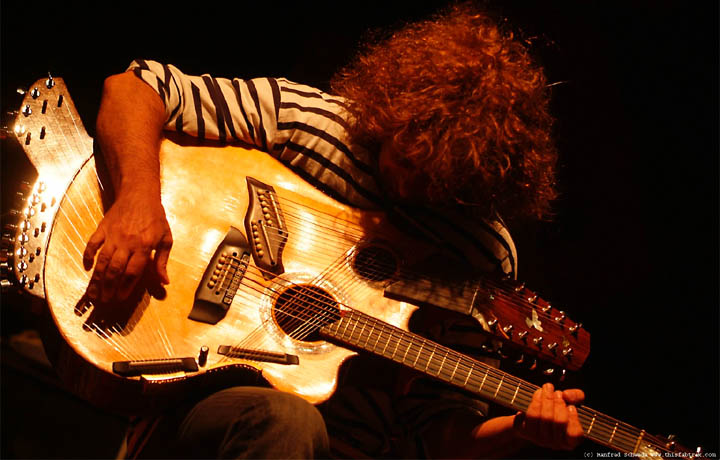
This is the Pikasso and it took two years to build, has four necks and 42 strings in total and you probably need more than two hands to play it. Some quick looking around reveals that it was designed and built by Manzer, its name ostensibly derived from its likeness in appearance to the cubist works of Pablo Picasso. The instrument is a harp guitar with four necks, two sound holes, and 42 strings, and it has a unique wedge-shaped body. The Pikasso took two years to build, has four necks and 42 strings in total and you probably need more than two hands to play it.

The original was built in 1984 for jazz guitarist Pat Metheny and it was used on a number of Pat Metheny's records. Another was later built for guitar collector Scott Chinery.
fwq3edfqwedqwdqwdqwd.jpg


200808_guitartech_1.jpg
 
Register to hide this ad
Yes the "synthaxe" was used by the great Allan Holdsworth on several of his records. Pretty odd instrument.
 

Attachments

  • al_synth.jpg
    al_synth.jpg
    9.7 KB · Views: 16
  • 103b5x900y900.jpg
    103b5x900y900.jpg
    146.1 KB · Views: 17
Let's not forget Junior Brown's Guit Steel. (That is country singer Johnny Bush standing in the background.)
 
Last edited:
Harry Manx (among others) uses a Mohan Veena. It's typically used in Indian classical music.

The instrument is actually a modified Archtop guitar and consists of 20 strings viz . three melody strings, five drone strings strung to the peghead, and twelve sympathetic strings strung to the tuners mounted on the side of the neck.[2] A gourd (or the tumba) is screwed into the back of the neck for improved sound quality and vibration. It is held in the lap like a slide guitar. The Mohan Veena is under tremendous tension; the total strings pull to be in excess of 500 pounds.[3]

1280px-Harry_manx_explaining_his_mohan_veena.jpg
 
Here's a great little boxset worth finding. It comes with a CD and a very informative booklet regarding many odd and interesting musical instruments. The forward by Tom Waits is worth the price alone.

regards,
 

Attachments

  • tumblr_mkytds54ue1sng3lro3_1280.jpg
    tumblr_mkytds54ue1sng3lro3_1280.jpg
    129.6 KB · Views: 12
I saw Einstürzende Neubauten on tour in May 2004, and they had the "air cake" from the front cover of the album along on tour to play as part of the show, as well as PVC pipes they were playing with an air pistol.

Perpetuum_mobile_cover.jpg


http://www.soundonsound.com/sos/nov04/articles/einsturzende.htm

Alexander Hacke explains that one way in which new Einstürzende Neubauten material comes into being is through a band member finding or inventing new sound sources. In the case of Perpetuum Mobile, a lot of inspiration was derived from plastic tubes, air pistols, and the gaffer-taped concoction made of tins and plastic and polystyrene and a record player that graces the front cover.
"The tubes inspired the album's pastoral aspect," Hacke explains. "Basically we reinvented the pipe organ. We cut the tubes to certain lengths to get them in tune, and then we played them with compressed air, using an air pistol, creating a giant pan flute or pipe organ. The interesting thing is that we figured out that it didn't matter how thick the tubes are or what material they're made of, you only play the air inside of the tube."
Hacke points out that the grey-blue plastic tubes seen on the album picture with a bird's-eye view of the band were purely meant to support the metal percussion lying on top and are not the tubes he's talking about here. "But on the back cover you can see the air pistol we used. They make a tremendous noise when loading up, and the piece 'Ozean Und Brandung' came out of that. The polystyrene flakes on that track were the work of Rudi Moser, and we treated them with a Pro Tools denoiser plug-in.
"On the front cover of the album you can see the so-called air cake, which is an instrument Andrew [Chudy] invented. He taped all sorts of stuff, like sawn-off plastic bottles, on a record player, so it can circle around, and using the air pistol you can get different resonances from the different objects on it. Because it turned we couldn't really attach a cable to the air cake, so we recorded it holding a condenser microphone in the same hand as the air pistol.

EN didn't bring their European voltage air compressors over to the States, but bought new ones once here to use for the US/Canada leg of their world tour. As the Asheville NC show I attended was the last show on that leg, between songs Blixa was working on selling the air compressors. Any reasonable offer, band will sign the tank, inquire at the merchandise booth.
 
Harry Partch (June 24, 1901 – September 3, 1974) was an American composer, music theorist, and creator of musical instruments. He was one of the first 20th-century composers in the West to work systematically with microtonal scales. He built custom-made instruments in these tunings on which to play his compositions, and described his theory and practice in his book Genesis of a Music (1947 and 1974).

Partch composed using scales of unequal intervals in just intonation, derived from the natural Harmonic series; these scales allowed for more tones of smaller intervals than in the standard Western tuning, which uses twelve equal intervals to the octave. Partch divided the octave into 43 unequal tones. To play this music, he built a large number of unique instruments, with names such as the Chromelodeon, the Quadrangularis Reversum, and the Zymo-Xyl. Partch described his own music as corporeal, and distinguished it from abstract music, which he perceived as the dominant trend in Western music since the time of Bach. His earliest compositions were small-scale pieces to be intoned to instrumental backing; his later works were large-scale, integrated theater productions in which he expected each of the performers to sing, dance, speak, and play instruments. Ancient Greek theatre and Japanese Noh and kabuki heavily influenced his music theatre.

Encouraged by his mother, Partch learned several instruments at a young age. By fourteen, he was composing, and in particular took to setting dramatic situations. He dropped out of the University of Southern California's School of Music in 1922 over dissatisfaction with the quality of his teachers. He took to self-study in San Francisco's libraries, where he discovered Hermann von Helmholtz's Sensations of Tone, which convinced him to devote himself to music based on scales tuned in just intonation. In 1930, he destroyed all his previous compositions in a rejection of the European concert tradition. Partch frequently moved around the US. Early in his career, he was a transient worker, and sometimes a hobo; later he depended on grants, university appointments, and record sales to support himself. In 1970, supporters created the Harry Partch Foundation to administer Partch's music and instruments.


The Zymo-Xyl, one of many musical instruments made by Harry Partch:

640px-Zymo-Xyl.jpg


The Zymo-Xyl is an oak-block xylophone augmented with tuned liquor and wine bottles, Ford hubcaps, and an aluminum ketchup bottle. The name is from the Greek zymo- for "fermentation", and xylo- or xyl- for "wood".First built in 1963.


http://en.wikipedia.org/wiki/Harry_Partch
 
Last edited:
Here's another: Gourd Tree and Cone Gongs

640px-Gourd_Tree_%26_Cone_Gongs.jpg


Twelve temple bells bolted to gourd resonators on a bar of eucalyptus, and two Douglas Aircraft bomber nosecones. First built in 1964
 
Might as well keep going.

The Spoils of War is a collection of several instruments, including more Cloud Chamber Bowls, artillery shell casings, metal "whang-guns", a Pernambuco wood block, and a gourd. First built in 1950

640px-Spoils_of_War.jpg
 
The Cloud-Chamber Bowls are a set of 12-US-gallon (45 L), 16-inch diameter Pyrex bowls cut from the carboys, suspended in a frame. The carboys were originally sourced from the Berkeley Radiation Laboratory, where they were used in the construction of cloud chambers. It was first built in 1950

640px-Cloud-Chamber_Bowls.jpg


http://www.corporeal.com/instbro/instintr.html
 
Back
Top Bottom