


We could also title this thread "The Lost ADC P-Mount".


For a few years now we've been seeing NOS ADC styli with the XT prefix. Until recently, you could even get an XT version of the famous ZLM stylus for far less money than a 'real' ZLM stylus.
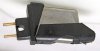
But where were the XT bodies? And what had ADC intended the XTs to be? In a casual conversation with one of our better-known online retailers, I was told the XTs were ADC's first p-mounts, and was shown a drawing of one taken from a 1980 Pfanstiehl catalog [center image above]. This immediately became a mystery, since I'd never seen such a thing.
Like many of you, I'd heard of and actually owned the ADC-branded Japanese-made p-mount cartridges, the PSXs and SERs...
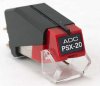
...and they have been indisputably good cartridges, but they were not designed by ADC and thus not physically compatible with any previous ADC models. I couldn't, for example, use them to play my QLM 36 Mk III Improved stylus in any of my p-mount tables. And I so desperately wanted to! Because geekiness, don't you know.
On eBay, faked versions of this alleged p-mount showed up, making me think the XT cartridges were vaporware, or worse, rumorware. I'd begun to believe that ADC had intended to make this line, but, since time was running out, abandoned the idea at the last minute and went with the PSX/SER lines. But then..
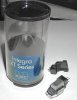
This all changed when a bunch of XT-II cartridges in legit-looking packaging showed up on eBay. There was an additional shock: the packaging said Integra XT. We know the ADC Integras to be well-designed integrated headshell-cartridge combos with slightly eccentric electrical specs. There are even Integra pre-mounts. But what was "integrated" about a p-mount cartridge?
I still don't know the precise answer to that question, but I finally know that the Integra XTs are both indisputably real p-mounts (mine weigh 5.95g) and real Integras, at least electrically, namely wrt inductance and resistance-- 480mH and 760 ohms. Checking the US audio magazines, they emerged from the void in the fall of 1982 without fanfare and were gone only a year later, replaced by the PSX/SER line.
The XT Integra bodies and styli are close enough electrically and VTFwise to the final-generation XLM/VLM/ZLM/QLM36 (including the XLM Mk II Improved) for their styli to be interchangeable. They're also close enough to be interchangeable with the better previous-gen (Mk II, not-Improved) styli, not to mention the better regular Integra styli (RXM-II and III) and Series styli (RS-III and IV). The VLM Mk II is the only exception, and it's a near miss, so stick a ~0.25g weight to the top of the cartridge and you're good.
Now, finally, I can use any of those styli in my p-mount tables, where the lower-mass arms, especially in the close-n-plays, are friendly to high compliance.
Styli: XT-I is a bushed 0.7 mil conical; XT-II is a nude round-spike 3x7 elliptical on a straight canti; XT-III is a nude 2x7 'tombstone' on a tapered canti, and XT-IV is an "Aliptic" version of the XT-III. Since these are T4P styli, VTF is nominally 1.25g. Makes stylus-swapping a snap.
For a few years now we've been seeing NOS ADC styli with the XT prefix. Until recently, you could even get an XT version of the famous ZLM stylus for far less money than a 'real' ZLM stylus.
But where were the XT bodies? And what had ADC intended the XTs to be? In a casual conversation with one of our better-known online retailers, I was told the XTs were ADC's first p-mounts, and was shown a drawing of one taken from a 1980 Pfanstiehl catalog [center image above]. This immediately became a mystery, since I'd never seen such a thing.
Like many of you, I'd heard of and actually owned the ADC-branded Japanese-made p-mount cartridges, the PSXs and SERs...
...and they have been indisputably good cartridges, but they were not designed by ADC and thus not physically compatible with any previous ADC models. I couldn't, for example, use them to play my QLM 36 Mk III Improved stylus in any of my p-mount tables. And I so desperately wanted to! Because geekiness, don't you know.
On eBay, faked versions of this alleged p-mount showed up, making me think the XT cartridges were vaporware, or worse, rumorware. I'd begun to believe that ADC had intended to make this line, but, since time was running out, abandoned the idea at the last minute and went with the PSX/SER lines. But then..
This all changed when a bunch of XT-II cartridges in legit-looking packaging showed up on eBay. There was an additional shock: the packaging said Integra XT. We know the ADC Integras to be well-designed integrated headshell-cartridge combos with slightly eccentric electrical specs. There are even Integra pre-mounts. But what was "integrated" about a p-mount cartridge?
I still don't know the precise answer to that question, but I finally know that the Integra XTs are both indisputably real p-mounts (mine weigh 5.95g) and real Integras, at least electrically, namely wrt inductance and resistance-- 480mH and 760 ohms. Checking the US audio magazines, they emerged from the void in the fall of 1982 without fanfare and were gone only a year later, replaced by the PSX/SER line.
The XT Integra bodies and styli are close enough electrically and VTFwise to the final-generation XLM/VLM/ZLM/QLM36 (including the XLM Mk II Improved) for their styli to be interchangeable. They're also close enough to be interchangeable with the better previous-gen (Mk II, not-Improved) styli, not to mention the better regular Integra styli (RXM-II and III) and Series styli (RS-III and IV). The VLM Mk II is the only exception, and it's a near miss, so stick a ~0.25g weight to the top of the cartridge and you're good.
Now, finally, I can use any of those styli in my p-mount tables, where the lower-mass arms, especially in the close-n-plays, are friendly to high compliance.
Styli: XT-I is a bushed 0.7 mil conical; XT-II is a nude round-spike 3x7 elliptical on a straight canti; XT-III is a nude 2x7 'tombstone' on a tapered canti, and XT-IV is an "Aliptic" version of the XT-III. Since these are T4P styli, VTF is nominally 1.25g. Makes stylus-swapping a snap.
Last edited:


