• The move to the new server is done. There are some software and database maintenance updates in process. This has us passing the hat around to help out. We appreciate any donations. Seriously, even a dollar helps. The payment page may be found here - https://www.audiokarma.org/support.html

NAD 3020 Stereo Amp - no sound

fmueller

Super Member
I have an NAD 3020 Stereo Amp that I'd like to bring back to life. It powers up , meaning the single power LED comes on, but none of the LEDs above the volume control ever come on, and there is no sound through either the speakers or the phones. Is there any chance that somebody with no previous audio equipment repair experience and a phobia of soldering could fix this thing?

Background, I bought this amp used about 4 years ago when moving into a new home. Initially it worked fine, but then one channel gave up service after a few months of light use. I found some NAD repair guru via an audio forum - might have been this site - and send it in for service. It came back fine, but after another few months it died completely. I didn't have the time to worry about it until now, and it has been collecting dust in the basement. I'd love to use it again with my Paradigm 11se MkII.

Is it possible and worth fixing, or should I sell the thing for parts?
 
Register to hide this ad
Check for voltage I could do, but if I don't know how to check for failed capacitors, that would mean sell it for parts, right? :sigh:
 
In the interest of safety if you are uncomfortable even taking the cover off and probing with a multimeter. I would not recommend trying to fix this yourself. However here are some things to look at. You should have preamp out jacks on the back. Try it with another amp if you have one (most people on this site probably have many) ,by removing the jumper, to narrow it down to the amp or preamp. If the preamp works you still have a very nice preamp. If you want to look further read on. Not intimately familiar with model (I have other nads) but usually amps have protection relays or fuses. When it worked did you here a click after you turned it on? If you did then it has output relays. If you no longer hear a click your relay is bad (which happens over time) or worse you may have a shorted output transistor (other thing can be wrong, but these are most common). Sometimes you have one relay for both channels and sometimes seperate. Relay issues and other problems definately require some soldering skills. If you don't remember hearing a click when it was working it may have output fuses that you will have to check by taking cover off and looking near speaker outputs (MAKE SURE YOU ARE UNPLUGGED). If you want to try to check some of these things and post I could guide you further (as would many other members on this board).

PS: Yes, a voltage check of the supply rails of the amp would be next, but by then you are into issues that would require some troubleshooting skills and possibly soldering.
 
First of all, many thanks for looking into this! I am comfortable working with electrics - I had a model train set of about 16'x4' when I was a teen, and used to string miles and miles of wire for all the signals and switches ;-)

I also own a multimeter. I've done the electrics in part of my house, and everything works! I also recently replaced a thermal fuse in my stove, and that works too. I even built my computer from parts. As long as there are screw connections and plugs, I am fine, but I never had much luck with a soldering iron. For some reason I've never managed to hold even two simple wires together. Maybe I am dyssolderic - sort of like dyslexic, but it effects soldering instead of reading :D I'd be willing to learn though!

The preamp jacks are both where they should be - between 'preamp out' and 'normal in'. The 3020 is notorious for making a huge click when being switched on, so I guess that means output relay. Hold on - you hear the click in the speakers. Is that what you mean, or just a click inside the amp? Relay would seem to suggest the latter. I don't remember if it ever clicked inside the machine, but it doesn't now. All that happens when I switch it on is for the power LED to light up - and that switch makes and impressive click, but I think that's just the switch.

Alright, off to take the cover off, do voltage check, and look for fuses.

Many thanks!

Frank
 
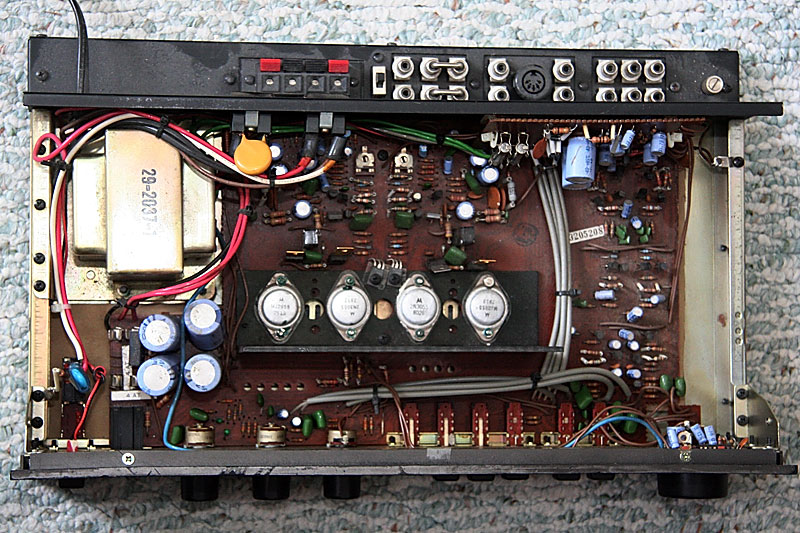
For those who are curious, this is what a NAD 3020 looks like inside:


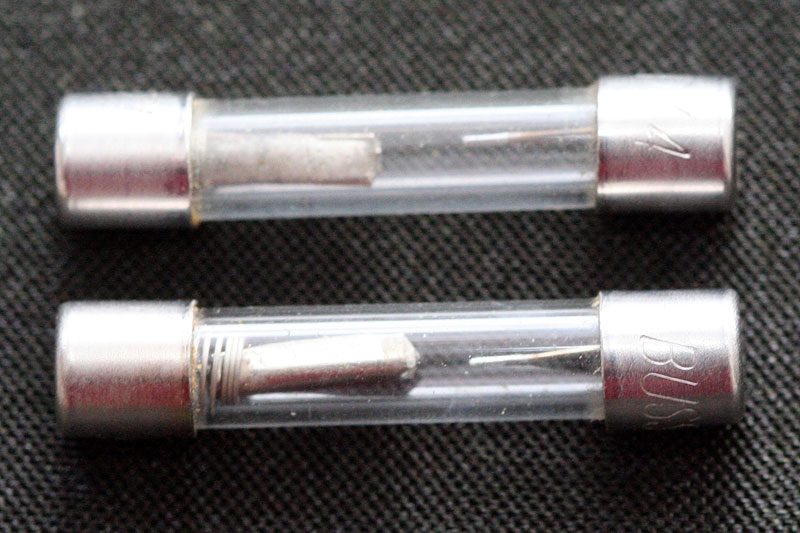
And - low and behold - below the power supply in the picture, just left to the big blue thingys are two of those old fashioned fuses like there used to be in 1970s cars:


They sure look dead to me. That would be so awesome if that was all that's wrong with the thing - well kinda stupid too, because I had that thing sitting in the basement for years not being able to use it, but I would get it back :music:

Now where does a man get replacement fuses for these dinosaurs? It says on them:

BUSS MDX4
125 VOLT

Both seem identical.

Many thanks

Frank
 
They are 4 Amp slow blow fuses. You can try RadioShack. Chances are if both fuses blew something is really wrong, like blown output transistors. If that's the case, they will blow immediately when you turn it back on. I am on the East Side if you want to get it serviced.
 
Nice.. Cross your fingers they don't blow again when you put new ones in. Otherwise I would tend to agree with "dr audio's" diagnosis of blown, well technically shorted transistors. My comment about pre out was to verify the functionality of the preamp with another amp (if you had one). Although I have had many people tell me the amp they got has no output and it has just been missing the jumpers. So it was a good thing to verify. However if you could verify the preamp that would tell you the extend of the damage if any and tell you if it is worth trying to fix. If it is just in the amp section that is better than amp and preamp sections. Those TO3s look pretty easy to change, might be a good first attempt on replacing. However you can take your meter and measure ohms (amp not powered up) across the Collector (also the case of transistor) and Emitter of each output transistor if you see a few hundred ohms or less you have got problems (shorted outputs). You will have to pull (well unsolder the emitter) to confirm that the transistor is actually shorted and not something else in the circuit. You can look up pinouts on the web for the particular transistor from a datasheet. Good luck and take some measurements on those transistors and let us know.
 
I've seen that particular type of fuse fail like that frequently and nothing be wrong with the unit. If you look close the fuse wire has pulled out of the solder. What happens is the spring is constantly pulling on the solder connection which is weak and eventually just pulls apart. It's definately worth trying new fuses.
 
Ooops forgot about your relay question

You clearly don't have relays. The click I am talking about for equipment with relays would be a click inside the unit a few seconds after the power led comes on. The relays provide the same protection as your fuses but are resettable and if you get abnormal current draw condition on your output the relay would open preventing further damage and/or fire.
 
Other amps I have are a Nakamichi AV-500 and a Nakamichi Receiver 3. To verify the preamp, would I just connect pre-amp out of the NAD 3020 with one of the inputs of the Naks, ie where you usually connect the CD player?

I assume the 'TO3s' are the type of transistor I have? Are those the 4 big upright standing blue things?

Of course I'll try to get the fuses first from Radio Shack and see how I go with that. If all else fails, employing dr*audio's services would be pretty tempting!

Frank
 
You'll need an amp with main in jacks on the back. You can run the pre-out of the NAD into the main in's of a known good amp, and see if the preamp section of the NAD is at fault.

The transistors (Indeed TO3 type: http://en.wikipedia.org/wiki/TO3) are the 4 metal circles with "wings' mounted to the black L-bracket (I'm assuming is being used as a heatsink) in the front-middle of the amp. The blue things are electrolytic capacitors, the main power supply filtering caps from the look of it. If you plan on poking around inside of this thing I highly recommend you find a guide on what basic electronic components look like, and their functions.

Good luck. I hope the old fuses are the culprit of your amplifier woes. :)
 
Hi,
A 3020 has FOUR fuses. The voltage regulator/power supply for the preamp, and the input stage for the power amp is attached to the back wall of the chassis. If those fuses are blown, it could take a long time to trace down the exact cause. If those fuses are fine, and the preamp is still functional, then you have eliminated 3/4 of the circuitry that needs to be checked.

If you are unsure of ohm meter readings on the power transistors, I suggest this: Unsolder and remove the output transistors from just ONE channel. Put two good main fuses back in. If you leave the bottom cover off, stand the amp on its side (the transformer side balances easier). Power the amp on. If the fuses don't blow, you are already holding the bad outputs in your hand. No matter what, replace BOTH. If the fuses still blow, remove the other pair of outputs, put fuses in, and power it up. If it STILL blows a fuse, get help! If the fuses hold, replace all the outputs (may as well since they are all already out, and old age tends to be the leading cause of death in those particular transistors).

If you do have to replace outputs, do yourself a BIG favor and order them from a well-established parts source. Motorola transistors, especially the 2N3055, have been a very popular item among counterfeiters to make.

All that said, it is extremely rare for an NAD 3020 to blow output transistors. One of the "burn-in" tests at the factory was that it had to survive a certain amount of time with the speaker connectors shorted without destroying itself. There are two, tall, black rectangular objects, one on each channel, that visually form the peak of a triangle with the driver transistors. These are self-resetting thermal breakers that are supposed to protect the amp in the event of a heavy-duty short.

Oh yeah, one more thing, almost forgot. The voltage regulator board I mentioned earlier (on the back wall of the amp), if the fuses on it have blown, check the two bigger transistors on that board. One will be a BD139, and the other a BD140. On the rare occasion that one of those fails, it'll most likely be obvious, as there won't be much left of it . . .

Good luck!
 
Many thanks for all of your input!

I highly recommend you find a guide on what basic electronic components look like, and their functions.

order them from a well-established parts source.

Any specific recommendations for these things?

A 3020 has FOUR fuses.

Found the other two, and they seem to be ok. They are 1 amp, right? It says 1A om there anyhow. Might as well get two of those as well while I head to Radio Shack.

The rest of what you wrote I will have to digest slowly!

Again, many thanks

Frank
 
Just in case you need them, here are the NAD 3020 Schematics.

Those are for the 3020B, it'll be quite a bit different on the inside, and some part values in the power amp section will be quite a bit different. fmueller, I'll try to scan my service manual tomorrow, I actually have the correct one for the very first version of the 3020, which is what you have.

As for output transistors, I'd highly recommend ON Semi (spun off from Motorola), and get them from either Mouser, Newark, or Digi-Key.

Yes, the fuses on the voltage regulator are 1A. If those stay intact when you test the preamp section, and the preamp sounds fine, then you can ignore the preamp, the voltage regulator board, and the input section of the power amp, and the soft-clipping circuit. Your problem will most likely lie somewhere in the last gain stage, the driver stage, the outputs, or a bad main power supply cap or rectifier. That looks like a lot when you type it, but we're talking about a sparsely-populated area of the board less than the size of a 4x6 index card.
 
Back
Top Bottom