• The move to the new server is done. There are some software and database maintenance updates in process. This has us passing the hat around to help out. We appreciate any donations. Seriously, even a dollar helps. The payment page may be found here - https://www.audiokarma.org/support.html

Dandy Dim-Bulb Tester

inkboy1

Bob's my uncle
Anyone buying untested vintage equipment should use either a variac machine or a dim-bulb tester before firing it up and possibly causing some damage. just google dim-bulb tester to read about it. meanwhile, here's a simple, compact design:

it looks like this:
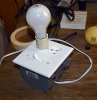
mydimbulb.JPG

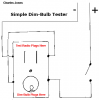
here's the schemo:

Dimbulb_TJ.png

plug the new device in the top outlet and flip the switch. if the light burns bright, flip off the switch, 'cause you've got a short somewhere. if it goes dim or off, you're good to go -- power up that new toy.

i got all the parts at wallyworld for a few bucks: power cord, switch, switchbox, outlet, cover plate, plug-in lightbulb socket, bulb. that's it. it's a much more compact design than i've generally seen online. make sure the tab connecting the two outlets is broken off so the two outlets are separate.

current passes thru the bulb before it gets to the second outlet. if there's a short at the other end of the second outlet, it'll let the bulb burn bright. if current flows through to the tested device, it'll drain power away from the bulb. it's effective, and a lot cheaper than a variac.
 
Register to hide this ad
That's really nice and clean. Mine uses the same box, switch, and outlet but I wired in a separate light socket. Off to Home Depot to find a plug in light socket.

Thanks.
 
Nice clean design. Not to nitpick, but the "+" and "-" labels probably should read "hot" and "neutral".
 
It was stumbling upon a thread similar to this that introduced me to AK.

http://www.audiokarma.org/forums/showthread.php?t=41523&highlight=poor+variac

Of course I had to build one. Turns out to be quite handy.

yeah, but who's gonna test six items at once? the idea was to shrink it down in size and portability -- light and tight. i've seen 'em with outlets and several ceramic light sockets, all attached to a 2-3-foot board, with wires running around and exposed wire-connects. that'll work, but i'll take a single buttoned-down box that takes up very little space. to each his own...
 
I wasn't going to nitpick, but since the ball is rolling... The original drawing can be further simplified.

1. Remove the wire that connects the left side bulb terminal to the right side outlet.

2. Move the wire marked "-" to the right side outlet terminal.

3. do not cut the metal jumper on the left side of the duplex outlet.

Go to post #10 at the link below for more details.

http://www.audiokarma.org/forums/showthread.php?t=187673
 
This may be a silly question but...I have a variac(TENMA 72-1095) and a dim bulb tester and an old tube amp to fire up. Should I use both at once or start with one or the other first?
 
Option 1. Use the variac and an ammeter in series.

Check the VA or Watt rating of the DUT.

If it is below the Ampèrage drawn slowly ramp up the voltage with the variac.
of course watch for obvious signs as well, smoke etc.


Option 2. Or for the dim lamp tester.

I have 2 lamp sockets parralleled up - then in series with the test socket.
when all works fine i can bypass the lamps to have full power applied.

It gives me options of between 25 and 300 Watts of lamp in series with the DUT

DUT = device under test
 
Thanks, that's what I was thinking but wasn't quite sure. Any idea what kind of numbers should I expect to see. The meter on my Tenma Isolation Transformer can be switched between volts and amps and I will be firing up a Leak Stereo 50 (see avitar) without the tubes (as per earlier instructions I have read here at AK) for the first time.
 
Thanks again for the idea/plans! This thing works slick as snot! Here's mine:

IMG_0594.jpg


Wasn't able to find an outlet-to-bulb-socket adapter so just used some lamp parts to stick a bulb on the side of the box.

Michael
 
Bulb Safety

Bulb Safety

The construction of a Series Lamp unit is quite simple but Please, Please put a protective shield around your bulb on your “Series Test Lamp” / “Dim Bulb Tester” / “Poor Man’s Variac.”

I'm an electrician & I have been involved with the tragic consequences of bulbs without shields.

My father (also an electrician) wired an Earth Leakage Circuit Breaker / Safety Switch / Ground Fault Interrupter (same thing different names around the world) at a residence. The resident also wanted to fit one on the shed but wouldn't until he got permission from the trust fund that ran the farm side of the property.

An hour or so after my father left the gentleman climbed onto a truck with a lead light that was missing the shield. He bumped the bulb against the metal back, shattered the glass & the live filament holder sticking out touched the truck back & he was killed.

His wife was almost shocked when she came to check on him. He probably would be alive today if he had plugged the light into his house power. Instead a simple, cheap light bulb left his wife to raise several small children on her own.

A broken bulb will have the metal arms that hold the filament sticking out ready to fry you. One will be Live / Hot / Active & the other Neutral / Cold. Please fit either a metal cage from a lead light or a PVC pipe collar with a few holes drilled in it for visibility & cooling.

A little mechanical protection could save a fatality or serious shock. This is especially important on lamps that are portable or easily knocked over.

Regards,
Brian.
 
A co-worker (an electrical engineer) died from electrical shock in his basement about a year ago. I don't know the details, but a GFI might have prevented it. If your shop outlets aren't protected by a GFI (Ground Fault Interrupter), they definitely SHOULD be. Your kitchen and bathroom outlets probably have them, but you probably don't do your DIY work there...

We're working with vintage equipment with possible hidden problems - that NEVER met the current safety standards, and could have leaky capacitors, shorted transformers, wiring errors... How many of us have a "suicide cord" (AC cord with alligator clips) hanging next to the bench?

For $10 and an hour of time, at least one electrical hazard can be greatly reduced. If you're not qualified to do it yourself, the cost of hiring an electrician is a small price compared to a human life...

(stepping down from soapbox...)
 
Back
Top Bottom