• The move to the new server is done. There are some software and database maintenance updates in process. This has us passing the hat around to help out. We appreciate any donations. Seriously, even a dollar helps. The payment page may be found here - https://www.audiokarma.org/support.html

So what about the plinth?

tromba

Super Member
I've got a Thorens TD-124 and the plinth it came with (original I assume) is a simple box with holes in the top to drop the table in. Not much weight. I also have a Sota and the plinth is VERY heavy.

So I started reading plinths, and like all other audio topics found those that said it doesn't matter at all and others who swear by monster heavy. I'm not really looking for discussion like that.

I'd like to assume here that the plinth DOES make a difference. I found one maker (can't recall which one now) that showed their replacement plinth and how it was good at limiting resonance "unlike most others on the market"

There's a seller on a big auction site who sells them both finished and unfinished. They weigh 8-9 lbs but can have holes drilled for lead shot going up to 20 or so lbs.

So assuming there IS a difference in plinths:

1. what IS this difference? Less resonance or something? Isolation of motor noises?

2. what is it that causes the difference? Weight? shape? materials?
 
Register to hide this ad
This should prompt some lively discussion.

Here's my opinion, based on on what I've read and some common sense reasoning:
Material is more important than weight. Granite and some other hard materials weigh a lot but ring like a bell. Because of this, some recommend cheap material, even chipboard because it does not resonate.

I've seen some very expensive plinths advertised. If they are aesthetically appealing, go for it, but don't expect a correlation between expense and performance.
 
Lots of reading to be done about plinths. Big monster plinths are basically what brought about the resurgence of idler drive tables. Art Dudley in Stereophile has written of his experiences, and it is a good read.
 
Granite is viable, and has been proven out by Big Bill, here at AK; find his plinth, An Empire of Granite (paraphrased).
Another granite plinth that comes to mind is by a gent called Slawts at lencoheaven.net.
To my way of thinking, the toughest thing about granite is its near diamond hardness, and difficulty in DIY building.

I have two plinths of soapstone that I really like. Heavy barely begins to describe them though.
I also have another that is stacked leaves of .70"/18mm birch plywood, at about 5"+ in thickness, with minimal material removed.

The most crucial thing is to build a plinth with the Massive Theory in mind. Massive does not necessarily correlate with great weight; rather it is referring to a plinth with minimal material removed, cut-away, leaving maximum mass. This minimal removal reduces the open air area within the plinth, eliminating room for reverberation to occur. It also keeps the most mass, which acts as a damping for motor vibration; more mass to absorb and damp out that influence.

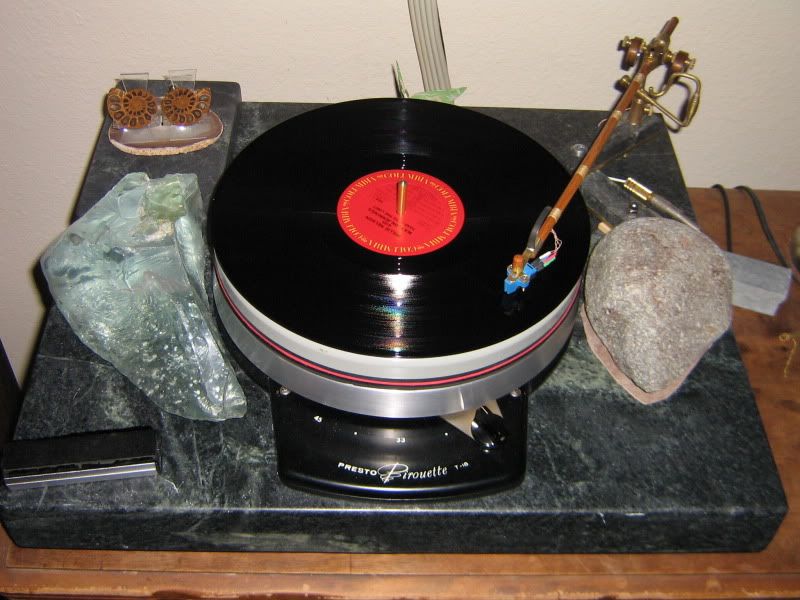
Presto Recording Corp, T-18 Pirouette, on soapstone (apprx. 185lbs, complete):
IMG_1080JPG.jpg

http://www.audiokarma.org/forums/showthread.php?t=380100

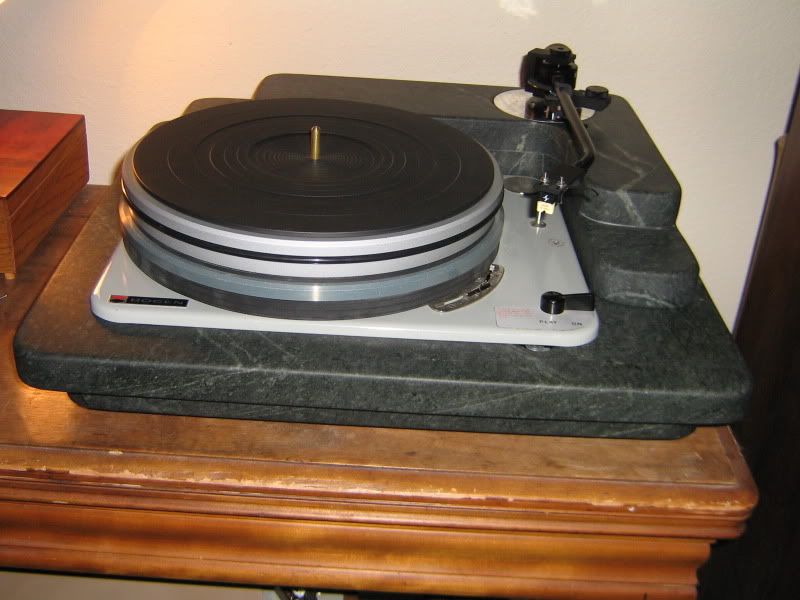
Bogen-Presto B51_HP mod, on soapstone (apprx. 185lbs, complete):
IMG_1162JPG.jpg

http://www.audiokarma.org/forums/showthread.php?t=377588

Lenco L75 top plate cut-away build, on birch ply (apprx. 50lbs, complete):
IMG_6030JPG.jpg

http://www.lencoheaven.net/forum/index.php?topic=1196.0
 
Last edited:
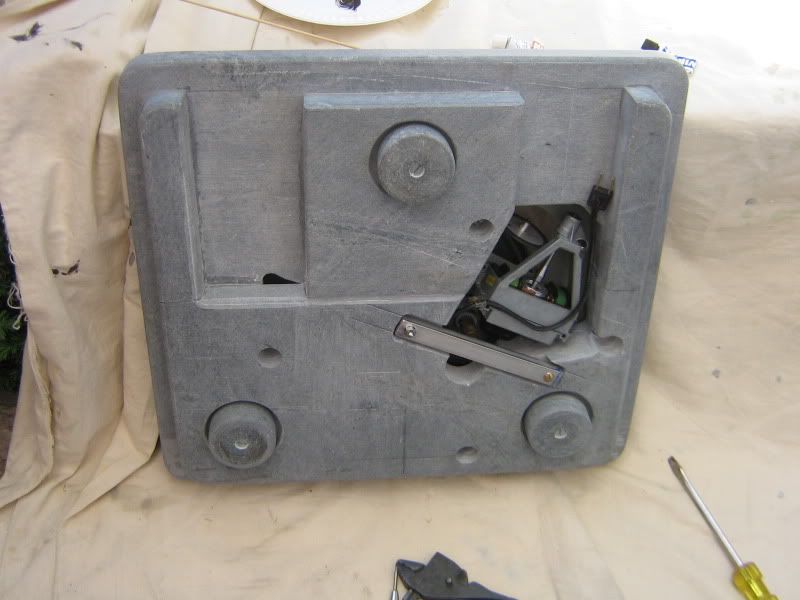
Massive theory - minimal cut-away design:

Bogen-Presto B51_HP mod, soapstone:
top:
IMG_0381JPG.jpg

bottom:
IMG_1127.jpg

In the area that states Mechanical Reduce, I used a router and carbide bit to reduce the thickness in this area, to maintain total mass; this is for the connecting rods, speed controls, and other mechanical connections. The cut out is for the motor, and allowing ventilation.

Presto T-18 Pirouette, soapstone plinth:
IMG_0159.jpg

IMG_0161.jpg


Lenco L75 top plate cut-away, on birch ply:
top:
IMG_5590JPG.jpg

bottom:
IMG_5606.jpg
 
Lots of reading to be done about plinths. Big monster plinths are basically what brought about the resurgence of idler drive tables. Art Dudley in Stereophile has written of his experiences, and it is a good read.

Yep, tons of resources out there on this subject. A lot of interest having been sparked by Jean Nantais using them with Lenco turntables, but applicable to all idler TTs. Slate is one approach, CLD (constrained layer damping) is another.

Google lenco plinth and you can read for a while on the subject.
 
Last edited:
Lots of reading to be done about plinths.
That's the truth!! Before I joined AK last spring I'd never even heard the word plinth. I just always used the table the way it came out of the box.
Art Dudley in Stereophile has written of his experiences, and it is a good read.
Thanks for mentioning that. The three pages of that article were great.
Massive does not necessarily correlate with great weight; rather it is referring to a plinth with minimal material removed, cut-away, leaving maximum mass.
that makes sense. Once you've done that, does adding weight (like lead or something) contribute anything?
This minimal removal reduces the open air area within the plinth,
is airflow and heat anything to worry about. The current plinth on my TD-124 now sits flush to the shelf with only the "mushrooms" to allow some air in. Yours seem the opposite -- flush to the plinth but with legs. AND THANKS FOR THOSE PICTURES!!!!! Those plus the links with give lots more reading.
 
IMHO the plinth is just a part of a system, in the same way the tonearm and the cart are a system by themselves. I understand that everything is part of the same system: The cart, the tonearm, the tonearm base, the subchasis (if there), the plinth, the suspension, the feet.

The basic theory here is that changes in density and compliance is what makes vibrations reflect back instead of proceed to the next element in the array reaching the tonearm and cartridge.

There are two paths to the pickup stylus, one being from the plinth to the platter and from there to the stylus and the second being from the plinth to the tonearm and the cart.

There are two types of designs (in broad terms), the suspended and the rigid. There were more suspended designs in the past, with the various Dual 1xxx designs being the more representative from what I recall. A typical more modern suspended design I know of would be the Technics SL-1600/1700/1800MkII with the same age Technics SL-1300/1400/1500 MkII being suspended while the earlier (MkI?) versions being rigid.

When there is a spring between the plinth and a sub-chasis, the spring's compliance is what tunes the system to eliminate resonances. With a rigid design, it's the mass and the difference in density that achieves the same thing.

The school of thought that promotes the idea of the massive plinth argue that the high mass of the plinth is what "contains" vibrations and doesn't allow them to proceed to the "higher" parts of the turntable.

And then we have the element of inadequate placement (e.g. a flimsy desk on a crackling wooden floor) that causes not only vibration but also jumps when walking close to the TT. I've had this years ago with a Dual 1009 and thought of the suspended design to be stupid (I didn't have this when I removed the springs and had the TT rest directly on the plinth). But then, all was corrected when I followed advice I read in magazines back then, to mount the TT on a wall shelf, preferably a heavy one. So I used a piece of marble as a wall shelf and mounted the TT on there. Problems solved. And high mass comes up again.

I consider the Technics SL-1300 MkI a good example of a good TT with a lacking plinth. If you tap on the plinth you can hear the thump amplified. If you tap on the (heavy) table where the TT sits (close to the TT) you can hear the thump again. It's a rigid plinth and if I use a set of AT rubber feet I bought years ago the problem is reduced (tapping the desk). If I apply generous amounts of modeling clay inside the plinth then the plinth tapping problem is seriously reduced. Again we have isolation and mass coming into play.

As a bottom line, as the stylus picks up miniscule amounts of vibration (that's what it's there to do) one must reduce any external vibrations to the maximum extent. Just like microphones, a good heavy stand and well thought suspension (perhaps threads around a frame) is what the experts reached as a solution. Same with TTs, I believe one needs a well designed combination of suspension and mass. As an extreme, I wouldn't expect decent performance from a 3kg TT.
 
IMHO the plinth is just a part of a system, in the same way the tonearm and the cart are a system by themselves. I understand that everything is part of the same system: The cart, the tonearm, the tonearm base, the subchasis (if there), the plinth, the suspension, the feet. . . . I believe one needs a well designed combination of suspension and mass.
When I think about that, it's completely logical. For the entire system it's a matter of getting speakers that sound good in MY acoustical setting, played with MY amp, etc. Making changes in the room acoustics can make the speakers "better".

Much of this (speakers, amps) can be done with trial and error. I can hear the speakers in a store and like them right away and know that probably I can make them work. If I buy or make a plinth, how can I tell ahead of time if I have "a well designed combination of suspension and mass"?

This is probably what that one plinth maker that I mentioned earlier when speaking about his plinths (how it was good at limiting resonance "unlike most others on the market") meaning that they are a good design
 
I don't see how there can be any question that the plinth resonant properties can affect the SQ. However, there are many overkill... and by that I mean truly overkill examples, that go well beyond any audible benefit. With smart design, a completely inaudible table total mass design should be able to fit within 25-30lbs easily(of course, weight alone is not a reliable measure of resonant behaviour). I base this on my experience with accelerometer analysis of various structures. Much lower mass may be possible transparently, but prefer to error on the side of safety but yet remain in a practical weight class.

I bought my main TT based on the fact I could easily (relatively speaking) modify the plinth to be inert for all intents and purposes, and that it's platter was already sufficiently inert, as is it's excellent tonearm. It would have cost much more to get a TT in all other ways equal to mine but with an already totally inert plinth and I had the subject of this thread in mind when I was shopping.
 
I believe that all else being equal, a heavy plinth will be better at dissipating vibrations, the way i see it, this is not Formula one racing, if light and stiff was the way to go, all high end TTs would be made of carbon fiber or some other exotic material, and weight next to nothing,

Now, i do think that when it gets to a certain point, the benefits you get from a super heavy plinth might not even be audible, that being said, i don't buy into that light is better promoted by Rega and the likes. as far as i'm concerned, the use of particle board, is simply a cost cutting measure, it's cheaper to buy and cheaper to ship.

Take VPI for example, from what i've read, they seem to have a very good reputation with AK members, and the more expensive models tend to be heavyer that the cheaper ones, that doesn't mean that light weight TTs can't sound good, it just means what i said at the beginning of this post, all else being equal...
 
I believe that all else being equal, a heavy plinth will be better at dissipating vibrations, the way i see it, this is not Formula one racing, if light and stiff was the way to go, all high end TTs would be made of carbon fiber or some other exotic material, and weight next to nothing,

Now, i do think that when it gets to a certain point, the benefits you get from a super heavy plinth might not even be audible, that being said, i don't buy into that light is better promoted by Rega and the likes. as far as i'm concerned, the use of particle board, is simply a cost cutting measure, it's cheaper to buy and cheaper to ship.

Take VPI for example, from what i've read, they seem to have a very good reputation with AK members, and the more expensive models tend to be heavyer that the cheaper ones, that doesn't mean that light weight TTs can't sound good, it just means what i said at the beginning of this post, all else being equal...

Spot on. Heavier is better when it comes to the platter of matter.
 
Combining materials with very different loss factor, and the right mass where it´s needed is the way I would do it. I think a modern approach like this is used in some modern TTs, but it will develop more in the future. A high weight per se puts the key points of the design differently, but is it better, not IMO. If a high mass generally is used, one has to deal with energy reflexions that might not be easier than working with structure losses. For a good plinth a lot of measuring is needed, by accelerometer, but also many others IMO.
gusten
 
Last edited:
Spot on. Heavier is better when it comes to the platter of matter.

There are examples of lightweight designs that perform just as good. There are several different ways to skin a cat.

I will give an example: The Technics SL-10 turntable. Full die-cast aluminum chasis. Suspension is in the form of rubber feet loaded with springs. They give when pressed but are stiff. The platter is thin, medium weight and the underside is covered with a rubber compound, much like the material covering the inside of loudspeaker enclosures.

This is one of the most insensitive TTs I've listened and owned to external vibrations and taps. It's not lightweight and plastic by no means. Perhaps it's small size combined with the relative high weight make it equivalent to heavyweight more substantial devices.

But I'm sure it's not just trial and error. It used to be trial, error and magic in loudspeaker design in the early sixties. Science and modeling took most of the error and magic out in the following few decades.
 
Combining materials with very different loss factor, and the right mass where it´s needed is the way I would do it.
Can you elaborate on that? What is the loss factor of various materials? How does one determine where mass is needed? There seems to be far more involved here than I thought!!
The most crucial thing is to build a plinth with the Massive Theory in mind. Massive does not necessarily correlate with great weight; rather it is referring to a plinth with minimal material removed, cut-away, leaving maximum mass. This minimal removal reduces the open air area within the plinth, eliminating room for reverberation to occur. It also keeps the most mass, which acts as a damping for motor vibration; more mass to absorb and damp out that influence.
I've thought some more about this. If I bought a commercial plinth I could probably add something like modeling clay if there was extra mass cut out (perhaps compensating for getting an inexpensive inexact fitting plinth vs a very expensive custom one). Would this amount to approximately the same thing as a different design that cuts away less wood?
But I'm sure it's not just trial and error. It used to be trial, error and magic in loudspeaker design in the early sixties. Science and modeling took most of the error and magic out in the following few decades.
I'm sure that's right, but doesn't help with selecting plinths. With loudspeakers, I'm not trying to put any of my drivers in an existing system. I listen to a complete speaker and decide if I like it or not. Adding a plinth to my table, arm, and cartridge makes auditions pretty much impossible
 
Having spent the better part of a decade of my engineering career as a vibration analyst, I find this type of discussion truly amusing.

You guys are so far off-base that it's like you're trying to play the Red Sox from Mexico City, thinking you're at Fenway.

Before holding forth on a subject based on science, it might be a good idea to learn what the terms mean, at least. (And that doesn't mean reading what some other audio fan/guru "thinks" about the subject)

Such as resonance. That gets thrown around a lot, but it's clear form the way it is used that none of you actually understands the concept.

Now I know how the EE guys feel when the subject turns to cables....
 
Having spent the better part of a decade of my engineering career as a vibration analyst, I find this type of discussion truly amusing.

You guys are so far off-base that it's like you're trying to play the Red Sox from Mexico City, thinking you're at Fenway.

Before holding forth on a subject based on science, it might be a good idea to learn what the terms mean, at least. (And that doesn't mean reading what some other audio fan/guru "thinks" about the subject)

Such as resonance. That gets thrown around a lot, but it's clear form the way it is used that none of you actually understands the concept.

Now I know how the EE guys feel when the subject turns to cables....

Please! Tell us more!
 
Back
Top Bottom