Help with indoor power supply for car sub

~Maxx

I AM the Dark Side...
Hopefully this is simple. I'm putting together a simple system in my workshop, and need a slim sub to go beneath or behind my bench. I happened to have an under-seat 8" powered sub from my previous vehicle - so I thought I'd just use it instead of buying something new.

The remote power feature can be disabled, so I assume that a 12v DC benchtop power supply with an on/off switch would be the thing to get. I'm just not sure about the amperage. The manual for the sub gives me peak and rms ratings (600w & 150w respectively), and there's a 20 amp fuse built in. But I can't seem to find any info on how much actual power it draws.

A quick search brought up several DC power supplies for work bench use that seem to range from 2.5 - 30 amps. If I'm going to have to go top of the line with one of these I'm looking at the $140-$150 neighborhood. I only paid $100 for this sub, and I can buy a new slim profile model for in home use for $100-$150. Just trying to be reasonable about the math.

Any advice from the local engineers? Can I get away with one of these 5 amp power supplies for $50?
 
Register to hide this ad
Ya, that's a tough one. I do see the higher amperage bench supplies on Craig's List from time to time. Usually some old HAM operator passes and all the test equipment and radios get sold off. I saw one for sale just a few days ago near me. It's gone now though.
 
Some are pretty spendy but you could build or buy a 20 amp 12 volt power supply.

I just recently built a power supply for my Sony car stereo amplifier to run in the house. It is from an old tube television power transformer. Works perfectly and has plenty of amperage to push a pair of 12 inch woofers to awesome power levels.

Some computer switch mode power supplies can also be used as 12 volt power supplies but may not have the amps available for sub amps. You could always experiment.

Or......just get a 20 amp battery charger and put some capacitors across the connections to knock out the hum.
 
Last edited:
A used battery charger might be cheapest path.
But if you wanted to make one:
Antek has 400VA and 500VA transformers for in the $50 range. A couple of dollars for the rectifier and 12v, 16v Caps are cheap. 10000uf for under $2.
Under $70, w/o case.
 
Thanks for the feedback. I hadn't thought of building one. Then again - while it would be fun and educational - I'm not sure I want to do the work in this case. I need to slap this up and move one with other projects.

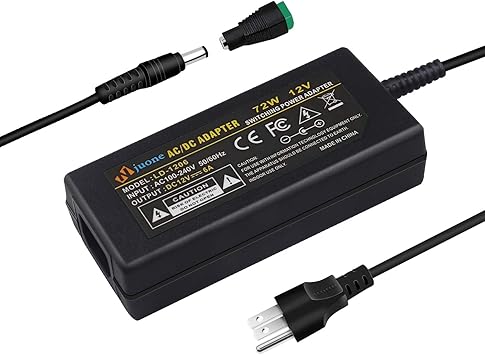
I found sort of a beefed up 12v laptop adapter that was 20 amps for $40something. But that leaves me with no power switch. Pretty sure those ac switches that plug straight into the outlet tend to max out at 15 amps, which means I'd have to install a heavy duty inline switch. Simple job - but worth the effort? I'm undecided.

I did find one 13.8v 30 amp model with a power switch for $70. I'm thinking it might be worth it to just go that route and be done with it.
 
I use a 12v computer monitor brick to power an HDFM auto head here. Just had to modify the plug. Mine is rated for 6 amps DC, so check the requirements on your sub first. Cost you maybe $15. Whether it'd work for you or not depends on how hard you're planning to push it.

61JDCU6DrWL._AC_SY355_.jpg
 
Can I get away with one of these 5 amp power supplies for $50?

Get away with? Hmmm...it will play, sure, but you won't be able to get anywhere near the sub's capability with only 5A supply. So, sorta depends on your use case. Low levels may be fine, crank it up, twist off the knob... nope.

150W implies something greater than 12.5A when you consider amplification inefficiency and power supply inefficiency. 600W implies something greater than 50A with the same considerations for inefficiency.

What you might look into is grabbing a used ATX-type of PC power supply. Some can have a pretty robust +12V rail, and you can put a switch on the power up signal wire to turn it on or off. Since the power on signal is very low current it doesn't take much of anything for a switch. There is much info on the Internet about using a ATX-type PC supply to get 12V power.
 
I'm just pairing this sub with some bookshelf speakers, and I'm definitely not what you'd call a "bass-head". Just enough to fill out the bottom. So I'll certainly not be pushing this to its upper limits. When I think about it though - it only makes sense to get the component that's most appropriate for the equipment. So the power supply should push at least 20 amps (just based on fuse in the subs power amp). Who knows what else I may want to use it for down the road anyway.

The more feedback I get here the more I'd love to tinker with something diy. The PC psu is a really interesting idea. But I've got a lot on my plate right now, and need something "plug-and-play" so to speak. $70 is a tad more than I wanted to spend, but it sounds like the most reasonable, hassle-free option at this point.
 
Wondering if a "smart" PCU power supply might get a bit confused with the varying load of a sub? They're built more for steady state ... Might rule out anything that's considered "eco friendly"?
 
It's a regulated output. I believe it will respond to do what it must to maintain 12V under any load within its rated capacity.
 
Yeah, assuming the workshop isn't in the house I agree with the car battery idea. A used 12V car battery (ie. one no longer good enough to start a car but still provides well over 12V when charged) can be had for close to nothing. Permanently connect a low current, low cost 'maintenance charger' to it and it should serve you well for at least a couple of years. Also, depending on what else you'll be doing in the workshop it can be really convenient having a high current 12V power source at the ready for other things but always best to connect a breaker or fuse direct to a terminal to prevent a disaster.

As others have said above, this would also be OK inside a house but best to get a sealed, dry or gel type battery if that's the intention.
 
I'd also steer away from a car battery - the outgassing can be explosive. If you don't mind spending a couple hundred bux, you could use a battery with a vapor recovery system. Mine is under the rear seat on my Aurora. You'd still want to vent that outdoors though.
 
Thanks for the feedback. I hadn't thought of building one. Then again - while it would be fun and educational - I'm not sure I want to do the work in this case. I need to slap this up and move one with other projects.

I found sort of a beefed up 12v laptop adapter that was 20 amps for $40something. But that leaves me with no power switch. Pretty sure those ac switches that plug straight into the outlet tend to max out at 15 amps, which means I'd have to install a heavy duty inline switch. Simple job - but worth the effort? I'm undecided.

I did find one 13.8v 30 amp model with a power switch for $70. I'm thinking it might be worth it to just go that route and be done with it.
For under $20 you could buy a Bluetooth remote controlled power outlet. I use them on tube power amps with the switch on the back of the chassis. Just plug them into the wall, and the computer power supply into the remote outlet.
They work from across the room just fine with the remote.
 
Well I've run into another issue. This was supposed to be a simple project to get me up and running, but it's sure starting to spiral...

Apparently this sub is stuck in "auto-on" mode. The unit was not powering up when I hooked it up to my new 12v converter. So I took it out to my truck and wired up the + & - from one of the amps under my seat. Still nothing. As a last effort I plugged in the remote wire, and (after turning the key) it finally powered on. Then shut off after taking the key out.

So it seems that I need to figure out how to send "at least 3v" (according to the manual) to the center connection between + $ -. Anyone have any ideas as to how I might best accomplish that? The fact that the manual specifies "at least 3v" makes me wonder how much leeway I have. Could I get away with just a jumper wire from the +12v terminal? Or do I need to rig up a 3v connection from a seperate adapter on its own outlet.

Sorry... this is a bit out of my wheel house. I appreciate the advice.
 
Back
Top Bottom