How “necessary” is anti-skate on a TT?

rotobadger

Suffering AZ Cardinals Fan
Subscriber
The reason I ask this question is this:

I have a Kenwood KP-990 (awesome table) which has an anti-skate weight. I’ve always left it in the up position (disengaged) as it causes the arm to drift a tiny bit when lifted in cueing mode. Not a big deal.

But, in the roughly two years I’ve used this table I’ve never once had a skating issue.

Am I just lucky? I know some tables don’t even have this feature, like my Pioneer PL-41.

Just an idle thought that’s rattled around in my brain so I thought I’d ask the pros here on AK.

I guess, another way of putting it, is why does my table have this feature if it doesn’t really seem to need it?

Could very well be my ignorance that is causing the answer to elude me!
 
Register to hide this ad
The reason I ask this question is this:

I have a Kenwood KP-990 (awesome table) which has an anti-skate weight. I’ve always left it in the up position (disengaged) as it causes the arm to drift a tiny bit when lifted in cueing mode. Not a big deal.

But, in the roughly two years I’ve used this table I’ve never once had a skating issue.

Am I just lucky? I know some tables don’t even have this feature, like my Pioneer PL-41.

Just an idle thought that’s rattled around in my brain so I thought I’d ask the pros here on AK.

I guess, another way of putting it, is why does my table have this feature if it doesn’t really seem to need it?

Could very well be my ignorance that is causing the answer to elude me!

could be causing extra wear on one side of the stylus

that said, I usually have the anti-skate on my Kenwood KD770D at its lowest setting, same with my Kenwood KD500

my Well Tempered Lab is a bit above it's lowest setting

not having the ability to watch the output on a scope during adjustment I usually just set it by ear, a record with a great soundstage helps here

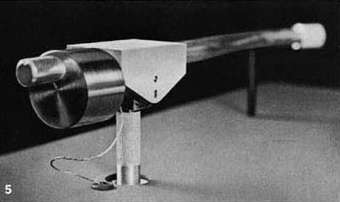
all this said, the AR XA has no anti-skate and is one of my favorite tables
 
could be causing extra wear on one side of the stylus

that said, I usually have the anti-skate on my Kenwood KD770D at its lowest setting, same with my Kenwood KD500

my Well Tempered Lab is a bit above it's lowest setting

not having the ability to watch the output on a scope during adjustment I usually just set it by ear, a record with a great soundstage helps here

all this said, the AR XA has no anti-skate and is one of my favorite tables
Thanks for the quick reply. So, if I’m understanding you correctly, the anti-skate weight may be designed to help preserve your stylus as well as keeping the needle from “skating”?

If so, maybe it couldn’t hurt to start using it.

On my 990 it’s called “insideforce canceller”. I’ve had it sitting at 1.5, second to lowest setting.

I use an Ortofon 2M Black on this table so preserving it would certainly be something I’d like to do considering the cost of replacing or retipping.

Also, I think we’ve had this conversation before, but which table do you prefer. What’s your daily driver? I mentioned in another thread that my 990 is a superior table to the PL-41 but the PL is just more fun, for some reason.
 
Last edited:
Thanks for the quick reply. So, if I’m understanding you correctly, the anti-skate weight may be designed to help preserve your stylus as well as keeping the needle from “skating”?

If so, maybe it couldn’t hurt to start using it.

On my 990 it’s called “insideforce canceller”. I’ve had it sitting at 1.5, second to lowest setting.

"inside force" is a more accurate term than skating. It's really rare to actually experience a stylus literally skating across a record. The inside force does push the stylus to one side of the groove, which may cause uneven wear or an imbalanced sound level but the amount of either is subtle.
 
"inside force" is a more accurate term than skating. It's really rare to actually experience a stylus literally skating across a record. The inside force does push the stylus to one side of the groove, which may cause uneven wear or an imbalanced sound level but the amount of either is subtle.
Ah, ok. This actually clears it up for me a bit. I genuinely though that the main function of anti-skate was to keep the needle from slipping out of the groove as it gets closer to the center of the record.

Good info, thanks much.
 
The reason I ask this question is this:

I have a Kenwood KP-990 (awesome table) which has an anti-skate weight. I’ve always left it in the up position (disengaged) as it causes the arm to drift a tiny bit when lifted in cueing mode. Not a big deal.

But, in the roughly two years I’ve used this table I’ve never once had a skating issue.

Am I just lucky? I know some tables don’t even have this feature, like my Pioneer PL-41.

Just an idle thought that’s rattled around in my brain so I thought I’d ask the pros here on AK.

I guess, another way of putting it, is why does my table have this feature if it doesn’t really seem to need it?

Could very well be my ignorance that is causing the answer to elude me!

I could be mistaken but I believe the string / lever setup on your Kenwood also increases the anti-skate as the arm swings inward, and I believe most magnet and spring setups do also.
 
Harry Weisfeld of VPI has suggested that the best sound comes from simply not using anti-skate and tracking near the cartridge's upper VTF limit. My nephew does this with a Thorens TD146 for which the anti-skate string and weights got lost, and it plays great. One disadvantage to this method is uneven force on the groove walls and therefore uneven wear on the stylus. Weisfeld acknowledged this and suggested 500-hour stylus change intervals.

I kept the anti-skate at its minimum setting on my Rega RP3 (on that 'table you can never really turn it off) until trying the method suggested at Soundsmith:

". . . set the A-S so that the arm VERY SLOWLY drifts inwards when placed on the SURFACE (NOT IN A GROOVE) at the end of a record. You will have a moment to do this until the stylus “pops” into the run-out groove. This works for ANY amount of VTF required, for ANY cartridge. It will set the A-S for EQUAL force per groove wall for 30-40% groove modulation levels, at ANY VTF, for ANY cartridge." https://www.sound-smith.com/faq/how-do-i-adjust-anti-skating-my-cartridge

I went back and forth on this but eventually concluded that the performance was at least as good as the HW method with the potential benefits of slightly lower tracking forces and more even wear on the stylus. On my particular sample of the RB303 arm and with my M97xE tracking at 1.35 grams (brush up), the Soundsmith-derived anti skate setting was just shy of the 1 gram notch. This setting also coincides well with advice I read in the manufacturer's comments of a 2001 Sumiko cartridge review. John Hunter opined that setting tracking force and anti-skate via test records results in optimizing both for worst-case scenarios, with deleterious results on sound quality for more normal conditions:

"Tracking force was inevitably a little too heavy and anti-skate was generally far too strong for the cartridge to sound its best. . . I came to understand that I was performing the equivalent of walking around 365 days a year wearing overshoes on the offhand chance it might snow. To be sure, I was prepared for those snowy days, but I missed out on a lot of fun. These days, I usually set anti-skate to about two-thirds of the recommended tracking force, and if I have a known difficult tracker, then I’ll dial it up to compensate for that." https://www.sumikoaudio.net/ContentsFiles/SumikoCelebration_TAS.pdf
 
If you have it, but don't use it, or don't set it properly, it will wear the left channel (inside of the groove), and that side of the stylus more. See Stereo Review https://worldradiohistory.com/Archive-All-Audio/HiFI-Stereo-Review.htm , July 1976, pages 56-60, for an article about record and stylus wear by a Shure engineer, complete with photos of a 0.7mil conical styli tracking at 1.5g, with and without anti-skating.

However, you'll always have people try and convince you that it's not necessary, or that you should set it to something other than what the tonearm or turntable manufacturer suggested - they have yet to convince me, after reading plenty of articles about it by people who know a lot more than they do, including cartridge design engineers.:crazy:
 
Most styli I have looked at with a fair bit of wear are worn more on one side than the other. This is an indication of too much or too little a/s.

There are 35 different ways to evaluate proper antiskate and none of them give you the right answer. Since you read the wiki you know things change across the record and do with different music, too. Some use a blank uncut record to set the a/s so the nail stays where put instead of glide inward or outward. Wrong because that only offers one unmodulated contact point, the tip of the stylus. Some use the manual and set it and forget it. Wrong for too many reasons. Some use a test record with equal modulation in both channels and at high modulation (loud sections) there will be a buzzing mistracking in the channel that is not firmly in contact with the groove, adjust the a/s to eliminate or balance the mistracking, wrong because the amount of modulation affects the pull on the nail and hence the a/s required. And on and on.

I use an arm with BBs in a bucket, actually lead birdshot. It came with a few slugs that duplicate a round number of shot, 10 or 20, IDR. Properly set up without the test record there should be 35-60 BBs in the bucket to match the tracking force, so you see why there are slugs included. When I started using the test record it was obvious the standard method was way too much a/s and I have since sort of settled on using the bucket and a single slug and call it good enough. I have not done long term stylus evaluation from new to see if the wear is even side to side but the test record tracks just fine in both channels and at the highest modulation the mistracking is even side to side. This was an upgrade in the method from the manufacturer of the arm.

All this talk to the need for and amount of antiskate to use but you said you arm swings out when you use the cuing. There should be an easy fix to that, clean the armlift platform and the arm where it contacts that platform so that the dust dirt old dry rubber and such are not there anymore and there is more friction between the arm and platform and this should allow you to raise and lower cuing without moving a groove either way. Most arms have a rubber on either the lift or the arm or both for this reason.
 
Last edited:
all this said, the AR XA has no anti-skate and is one of my favorite tables
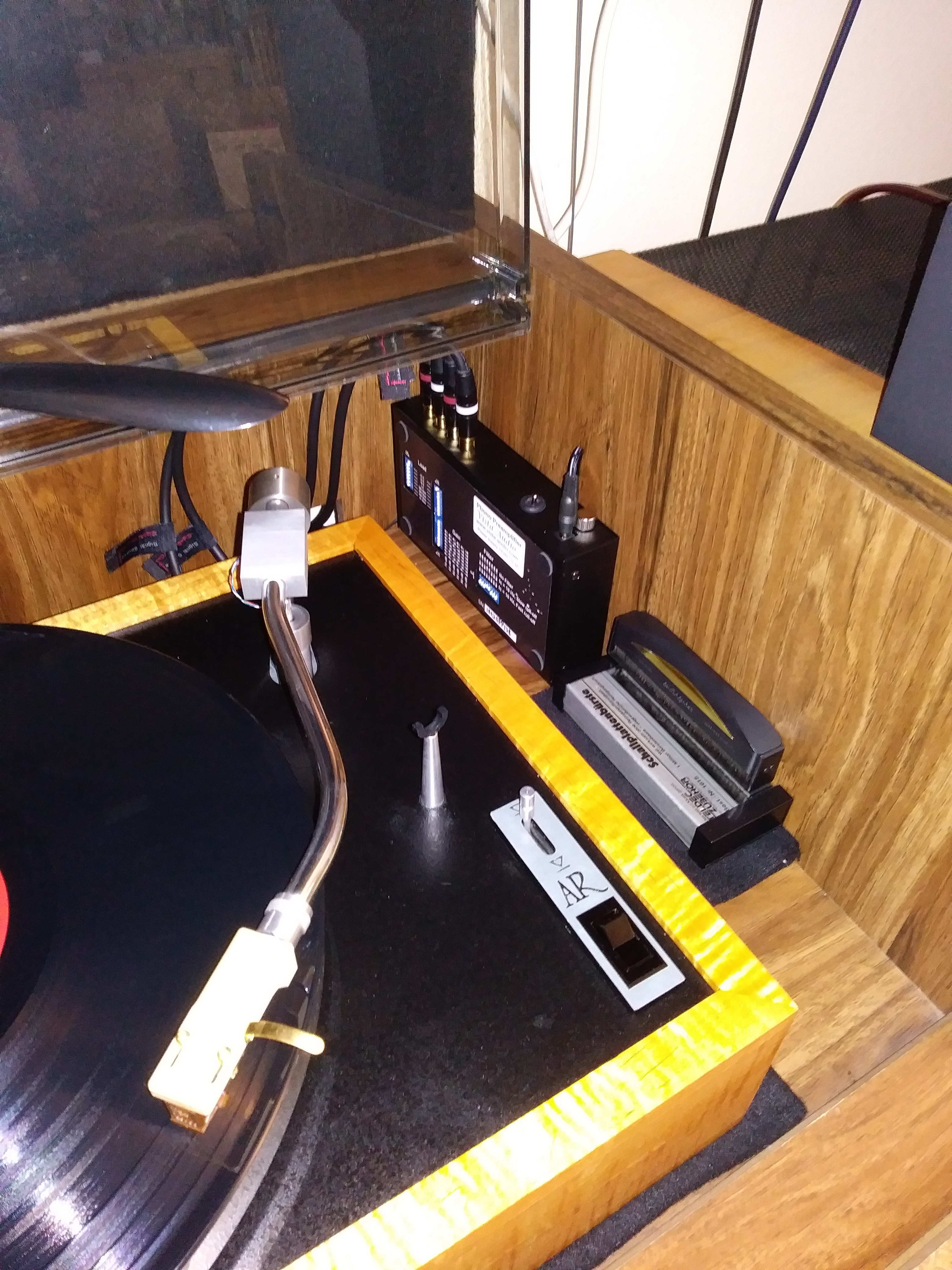
The AR's have a mild form of antiskate manifested by the way the tonearm wires are dressed. When properly dressed as shown in the photo there is a low level antiskate force imparted to the tonearm. I can actually feel the resistance in tonearm movement when moving the tonearm by the finger lift.

AR-wire-braid-loop.jpg
0302191317.jpg
 
I don't think anyone should rely your arm moving away from perpendicular via the cueing as a method of determining if your anti-skate is correct... In my experience, 90% of that is actually caused by the lifter "bar" not being parallel with the travel of the tone arm and as such the arc of the album. One end is slightly higher (or lower) the the other so when it contacts the underside of the arm that off-set moves the stylus. It seems to me; at the point the lifter bar actually puts enough upward pressure on the arm tube to lift the stylus and arm mass on the far end, because of where it is so close to the arm pivot point, that force is many multiples of the 2 gram average VTF, so you would be saying that the anti-skate is so strong it is dragging the tonearm while hanging on the lifter bar? As soon as the stylus clears the groove by .01mm the full weight of cartridge, arm mass and such is suspended by the lifter bar and it moves-so why does it stop and not go all the way back to the arm rest? I've killed to many necessary brain cells (or just failed to show up) that day in trigonometry class to remember how to calculate that actual mass but it seems to support my theory.

While I've got my Big Brain hat on...I would think the Kenwood-type of Anti-skate (fishing line with a levered dead-weight) would be one of the most accurate, using a lot of the same missed Trig class theory above. If in fact you need less "pull" the closer you get to the center of the album, once the dead weight of the Kenwood-type system passes the halfway point of it's arc the actual load (pull) would decrease since you're no longer deadlifting it. Kind of like raising a side of a barn-once you get it more than halfway up gravity (and the weight) become less of a factor. But what do I know-other than having Uncle Nearest 1856 being delivered up to midnight from my local liquor store is the best Covid perk ever! :-)
 
Is anti-skating necessary?

Probably. Most especially if you're using one of todays very popular low to medium tracking weight cartridges (maybe .75g up to 2.0g) with an advanced design stylus shape and a low to medium mass tonearm. For example a typical setup that uses a high compliance cartridge that tracks at 1.5g, and a low mass 9" tonearm will likely benefit from the proper use of anti-skating.

Possibly not so much if you're using a heavy cartridge (think SPU, EMT for example), with a conical stylus (perhaps also a basic elliptical) on a long (12"+) medium to heavy weight tonearm at a heavy tracking force (think 4.0g). Many users forgo anti-skating (even if their tonearms are so equipped) when running a combo such as this.

It very much depends on usage. Remember the old adage - "Horses for courses".
 
Skating force is a fact. Hence the need for anti-skating.
I set my antiskating using a rotating groove less blank. The arm is placed in the middle of the blank. I set the AS so that the arm very slowly moves to the outside of the disk.
 
Skating force is a fact. Hence the need for anti-skating.
I set my antiskating using a rotating groove less blank. The arm is placed in the middle of the blank. I set the AS so that the arm very slowly moves to the outside of the disk.

I think the arm should very slowly move to the inside of the disc. So do Peter Ledermann and Frank Schroeder.
 
Back
Top Bottom