• Please note that there are a few updates and clarifications made in the Audiokarma Rules, mostly relating to advertising and the addition of the new "Paying it Forward" & "Giving back" forums in the AudioKarma Audio Marketplace section.

Marantz Model 1060 Amp - main 3 amp fuse blows - help pls

Homer4beer

Well-Known Member
Hi guys,

I was given a Marantz 1060 stereo amplifier and when I turned it on it was dead. I opened the cover and noticed the 3 amp fuse was blown. I replaced it, powered it on, and had the exact same thing happen.

What could the cause be? Any service manuals around here? I'm not that experienced in electronics but happy to try and fix it with some guidance.


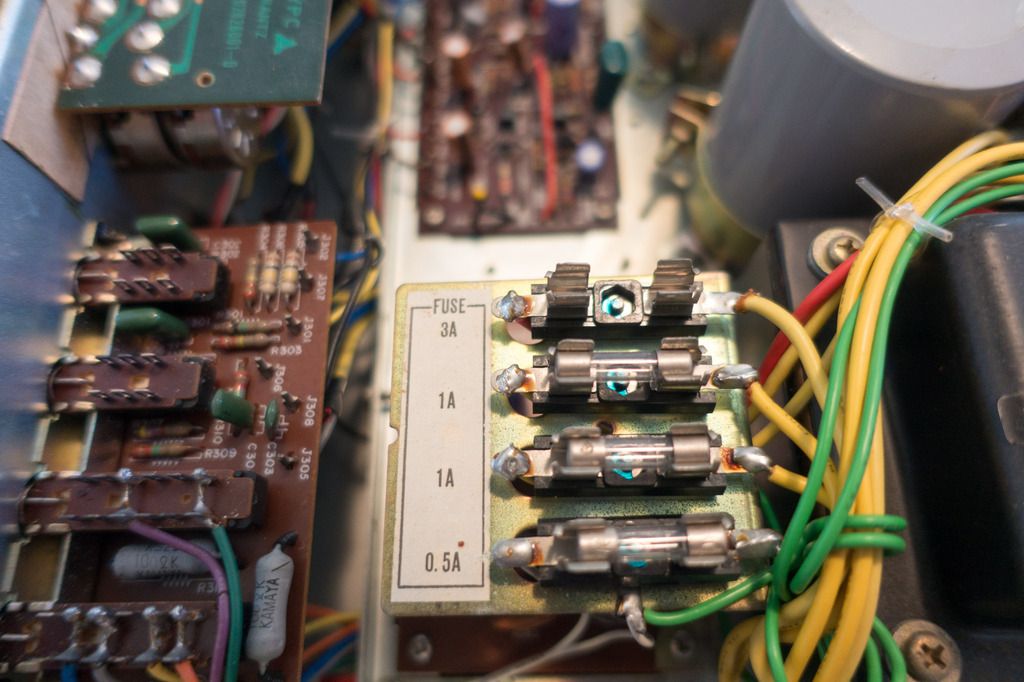


Cheers guys!
Homer
 
Last edited:
Register to hide this ad
You likely have a short somewhere. A common place to look first is output transistors. If you are blowing fuses, don't fire it up again until you build a Dim Bulb Tester. It will indicate a short by staying bright when you turn it on, and it will lend some protection for other components if there is a short. But there are several possibilities for your short, and it's just going to require some investigation to figure out where it is. Join hifiengine.com (free) . They have most service manuals for download. When you sign in, go to Library --->Marantz--->integrated Amplifiers--->1060 to see service manual and user manual for download.
Steve
 
You likely have a short somewhere. A common place to look first is output transistors. If you are blowing fuses, don't fire it up again until you build a Dim Bulb Tester. It will indicate a short by staying bright when you turn it on, and it will lend some protection for other components if there is a short. But there are several possibilities for your short, and it's just going to require some investigation to figure out where it is. Join hifiengine.com (free) . They have most service manuals for download. When you sign in, go to Library --->Marantz--->integrated Amplifiers--->1060 to see service manual and user manual for download.
Steve


Thanks.

How do I build a "Dim Bulb Tester?"
 
Any idea what area of the amp the output transformers are
You won't find output transformers in a 1060. But you'll find output transistors :D. They are the 4 TO-3 mounted on the main heatsink.

If you unscrew them they will just pull out of the connector. Don't forget about the mica insulator, there has to be NO electrical contact between the transistor body and the heatsink.
And when remounting them you need some thermal compound / grease (NON conductive)

But of course your problem might very well be somewhere else...

Beware : on the same heatsink there are also two diodes mounted. Their leads are FRAGILE and tend to break off the body of the diode if bent. And there are no modern replacements, so be very careful with them

IMG_1567.jpg

Good luck !
 
Last edited:
You could do the following to see if the problem is in the amp board before trying to pull out the output transistors, it's quicker and easy :

1) disconnect the main supply to the amp board (red wire to J709 I think) it's the red wire going from the big cap to the outermost connector of the amp board - from underneath of course
2) insulate that disconnected wire
3) disconnect pre-outs to main in
4) power up with DBT
5) if bulb dims chances are the fault is in the amp board
6) try out the pre-outs to another working power amp or amp.

BEWARE OF LIVE VOLTAGES WHEN WORKING ON THE POWERED AMP !
 
You won't find output transformers in a 1060. But you'll find output transistors :D. They are the 4 TO-3 mounted on the main heatsink.

If you unscrew them they will just pull out of the connector. Don't forget about the mica insulator, there has to be NO electrical contact between the transistor body and the heatsink.
And when remounting them you need some thermal compound / grease (NON conductive)

But of course your problem might very well be somewhere else...

Good luck !

Ah yes I have seen these! So do I replace them or simply remove them and reapply with thermal insulating grease?
 
You could do the following to see if the problem is in the amp board before trying to pull out the output transistors, it's quicker and easy :

1) disconnect the main supply to the amp board (red wire to J709 I think) it's the red wire going from the big cap to the outermost connector of the amp board - from underneath of course
2) insulate that disconnected wire
3) disconnect pre-outs to main in
4) power up with DBT
5) if bulb dims chances are the fault is in the amp board
6) try out the pre-outs to another working power amp or amp.

BEWARE OF LIVE VOLTAGES WHEN WORKING ON THE POWERED AMP !

Yep I think I understand. I need to build a DBT ASAP. Can I do it with Australian power sockets and parts?
 
Yep I think I understand. I need to build a DBT ASAP. Can I do it with Australian power sockets and parts?

Absolutely. You can get all the bits you need from your local Bunnings. About $12 cost for a DBT. If you can get hold of a few old lightbulbs- you are in business.

PM me if you need details on what to get.

John
 
So do I replace them or simply remove them and reapply with thermal insulating grease?

First you need to find out if they are good or not. No need to replace them if they are fine. And since it's quite a bit of work to get them out (access !) you can try removing the power to the amp board like I suggested.
IF you find that with the power removed, the preamp part works, then on to find out what is wrong in the amp board.
Or is it dismantled already ?

The grease needs to be THERMALLY conductive but ELECTRICALLY insulating. and don't forget the mica pads...
 
Just a silly question.....Is the voltage selection set correctly????? Just saying.........Did you get the amp from out of your country????? Possible wrong voltage for what you have. My 1060 has different voltages for different countries although I never changed it. It was set for 120V AC for the U.S. Mine has an option of different voltages but not necessarily a switch. It requires a rewire of incoming wires. My manual says any voltage from 100, 120, 200, 220, and 240 V AC 50 HZ to 60 HZ. I can't find diagram #4 that lays out the terminal selection per voltage.
 
Back
Top Bottom