Pioneer SX-770 : No Sound ( Troubleshooting / Repair ) Help.

QUiKSR20

AK Subscriber
Subscriber
Recently picked up this beautiful SX-770 for $50 in not working condition, Always thought these looked awesome "My Hopes / Goals were that it was something minor, burnt fuse, dirty pots etc.".

sx770.jpg


Unfortunately when I met the seller he tells me " My tech looked at it and found the following wrong ", Not sure why he didnt fix it. Maybe he wanted to much to repair it or just didnt know enough.

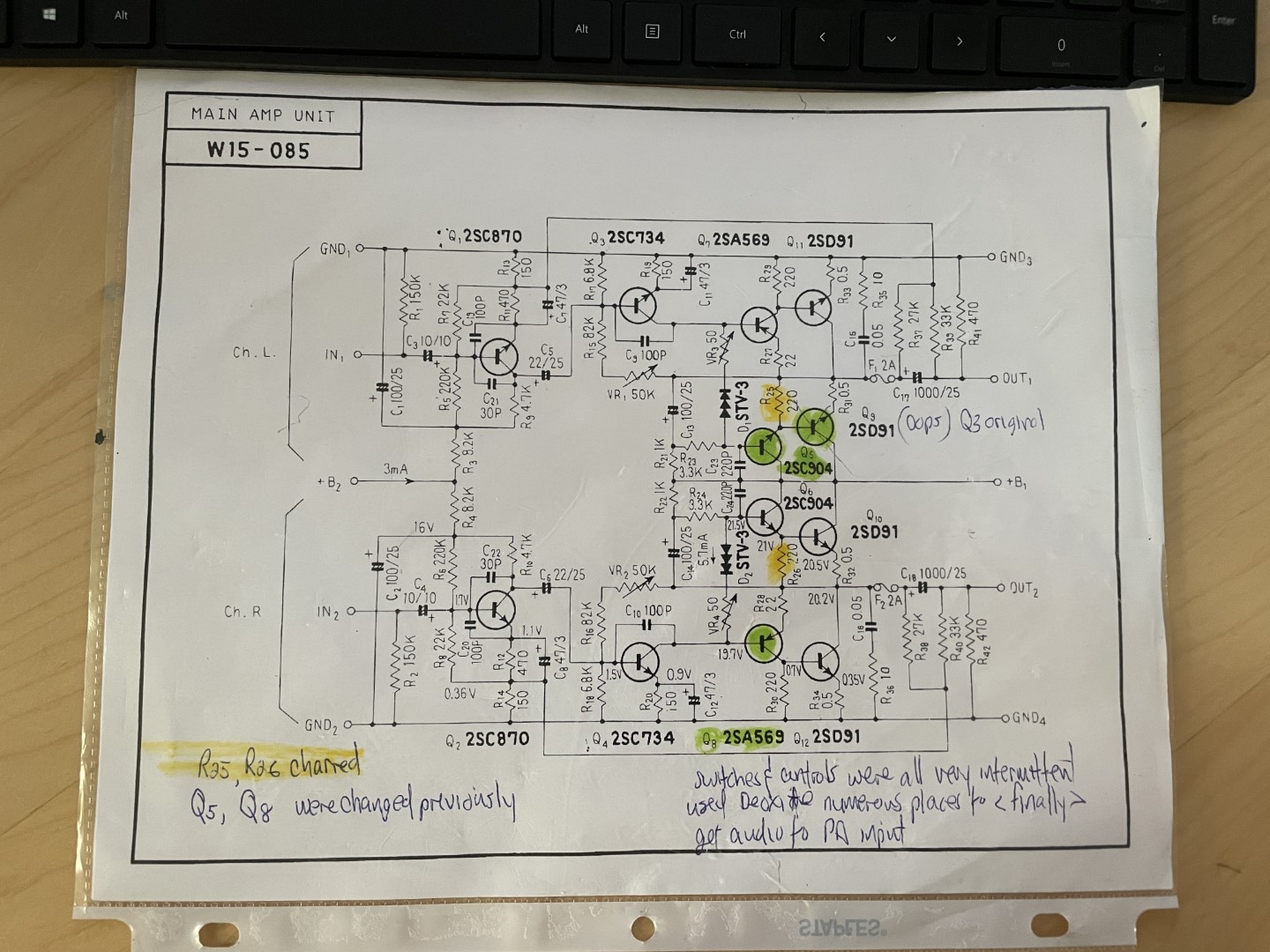
Schematic / Notes I was given with the receiver :
previous_tech.jpg


I hooked it up to the dimbulb ( no issues ) and get no sound at all as expected, The only way I get a little bit of extremely faint sound is running the pre-amp outputs to an external amp and even then its almost barely audible.


- Found Schematics / Service Manual
- Researched the crap outta the model on here

I have read all the SX-770 posts on here for info and it appears the pre-amp outputs on this unit are a little different then normal pre-amp outputs and depend on a functioning amp ( atleast thats how I interpreted it ).

What can you guys make out of the techs notes? Surprised he didnt just fix it, I should of asked why he didnt but didnt cross my mind.
Would the first step for troubleshooting this be to remove the amp board and check stuff out of the unit?

Theres no room inside and I have seen people remove the board and then re-connect it with alligator clips like so :

index.php


Credit to this thread - Pioneer SX 770 Powers On, No Sound

Full Restore - Pioneer SX-770 Receiver Restoration

Does this sound like an issue in the amp board ( W15-085 )? Its the same on all inputs and even with external amp leveraged. The only diff is with an external amp I get a very faint bit of sound randomly.

If this sounds like an amp board issue ill remove like the pics above and start checking transistors etc or whatever you guy suggest as next steps. Im an amateur tech learning as I go and trying to build the correct habits.

My first repair was a Realistic STA-100 and with the help of this board I repaired it successful and learned a ton in the process.

Thanks in advance!
 
Last edited:
Register to hide this ad
Nice receiver! And for a price like that.
I would not start with taken boards out yet and for me, the picture you showed, would be for really specific measurements where you would need that acces to be able to do it.
I can see (read) you are well prepared but just to share information, this has been really useful and I repeatedly read it to remind myself.

http://conradhoffman.com/troubleshoottut.htm
Most points brought up you do already, most important one he mentioned to me: "troubleshooting is done with the mind not with the soldergun"
 
First, know what you work on: capacitor coupled output.
DC measurements with speakers ( load attached ) and is not adjustable.
I would check the output fuses for sure, although you would think the previous tech did, you never know. And of course switches and potentiometers. They had a deoxit treatment, this can also make it worse, all the dust inside collecting in one spot.
After that, you always start with powersupply. Verify voltages, connections.
Then, why not, the components identified by previous tech. R25,26, how they measure, Q5, Q8, they measure good, correct substitutes, how measure there complementaries.
 
Nice receiver! And for a price like that.
I would not start with taken boards out yet and for me, the picture you showed, would be for really specific measurements where you would need that acces to be able to do it.
I can see (read) you are well prepared but just to share information, this has been really useful and I repeatedly read it to remind myself.

http://conradhoffman.com/troubleshoottut.htm
Most points brought up you do already, most important one he mentioned to me: "troubleshooting is done with the mind not with the soldergun"

Ill check out that post thank you very much for sharing, Yeah before I post I try to research the best I can, We have some great minds here and the last thing I want to do is ask
questions or post for help when its already been answered :) Thanks again and ill check that link. I hope i get this receiver working , its so good looking.

First, know what you work on: capacitor coupled output.
DC measurements with speakers ( load attached ) and is not adjustable.
I would check the output fuses for sure, although you would think the previous tech did, you never know. And of course switches and potentiometers. They had a deoxit treatment, this can also make it worse, all the dust inside collecting in one spot.
After that, you always start with powersupply. Verify voltages, connections.
Then, why not, the components identified by previous tech. R25,26, how they measure, Q5, Q8, they measure good, correct substitutes, how measure there complementaries.

Ill check all of that, thank you.. That amp board is hard to view without removal as its vertical. I may remove like the pic to troubleshoot after I verify powersupply voltages.
 
Last edited:
Always great help available on here!
The link is more about mind set than anything else.
For sure someone with more knowledge will come along. I have never seen or worked on a Pioneer receiver before. But I have a Sansui AU-777 I will have to start on this spring which is comparable for amplifier design.
Like the line level outputs, taken from the power amp instead of the control amp and ofcourse the quasi complementary outputs and capacitor coupled.
So I will keep an eye on your progress mostly also for my own preparation/ education.
 
Always great help available on here!
The link is more about mind set than anything else.
For sure someone with more knowledge will come along. I have never seen or worked on a Pioneer receiver before. But I have a Sansui AU-777 I will have to start on this spring which is comparable for amplifier design.
Like the line level outputs, taken from the power amp instead of the control amp and ofcourse the quasi complementary outputs and capacitor coupled.
So I will keep an eye on your progress mostly also for my own preparation/ education.

Not to get too off-topic but im a huge Sansui fan, I have a 7070 and currently looking for a Sansui 8 & AU717 :)
 
Me too, Sansui all the way!
Just kidding, they have a beautiful lineup, although I am mostly in to the DC coupled amplifiers.
No fanatic here, just don't like silverfaced amplifiers but that is just about looks.
 
Does the above sound like an issue with the amp board? If so ill look to remove it and look it over top to bottom for issues ( besides whats already noted ), Still not sure why the other tech
went as far to point out what he saw but not fix it.
 
I realize I never closed the loop on that other thread on my SX 770 rehab (now updated). I was very new to the hobby (I think it was my 2nd or 3rd receiver to work on). It was quite the adventure as the thread shows - learned a ton thanks to Zeb. It helped me on several SX 990s that I subsequently repaired.

The 770 is still my baby and it's in the regular rotation in my basement (home gym). It's sound is fantastic.

Anyway, I'm not real clear on the tech notes. I see R25/R26 were 'charred' (I think that's what it says) - were they replaced?.

My troubleshooting now involves basic service (cleaning pots as mentioned before), attempting any service manual amp adjustments, verifying voltages on the PS board, then I'll move to check voltages on boards that make sense given the issues.

I would probably focus on the amp board given my experience and your symptoms, but I'm still a novice at the hobby and tend to take the 'long way' on my repairs.
 
I realize I never closed the loop on that other thread on my SX 770 rehab (now updated).
I was very new to the hobby (I think it was my 2nd or 3rd receiver to work on). It was quite the adventure as the thread shows - learned a ton thanks to Zeb.
It helped me on several SX 990s that I subsequently repaired.

The 770 is still my baby and it's in the regular rotation in my basement (home gym). It's sound is fantastic.

Hey Mikie,

I really appreciate you taking the time to chime in, your thread was very helpful and Its also comforting to read that you were able to fix it being an amateur hobbyist.
I am also just a starting as a hobbyist ( I have a long history of troubleshooting / working on cars / computers / audio ) but never dabbled in this level of electronic repair.

Bult a dim bulb, acquired some good must have tools and also fixed my first receiver ( thread - https://bit.ly/3Eg2Jy6 )

Anyway, I'm not real clear on the tech notes. I see R25/R26 were 'charred' (I think that's what it says) - were they replaced?.

Thats what it says, I cannot tell if it was fixed or just noted. It seems ill have to remove the board and dig in and see what I find.

My troubleshooting now involves basic service (cleaning pots as mentioned before), attempting any service manual amp adjustments, verifying voltages on the PS board,
then I'll move to check voltages on boards that make sense given the issues.

I would probably focus on the amp board given my experience and your symptoms, but I'm still a novice at the hobby and tend to take the 'long way' on my repairs.

Same - Every receiver I get I follow the same ritual :
  • Power it on with a dim-bulb first time
  • Set Idle Current / DC Offset
  • Clean it inside and out
  • Deox / Faderlub where needed
If it then works replace any missing bulbs / worn parts and enjoy!

I really love the look of this receiver and hope I get it working, So it sounds like as a first step I should de-solder a few of the wires and remove the amp board for a closer look.

Does that sound like the next logical step to you?

She powers on fine and doesn't trip the dim bulb at all ( just no sound ). With the pre-amp outputs I was able to get an extremely super low bit of sound ( you could barely make it out ).

I figure atleast with the board out I can start testing transistor and looking for known issues like the mentioned charred parts.

Thanks in advance!
 
Last edited:
Hey Mikie,

I really appreciate you taking the time to chime in, your thread was very helpful and Its also comforting to read that you were able to fix it being an amateur hobbyist.
I am also just a starting as a hobbyist ( I have a long history of troubleshooting / working on cars / computers / audio ) but never dabbled in this level of electronic repair.

Bult a dim bulb, acquired some good must have tools and also fixed my first receiver ( thread - https://bit.ly/3Eg2Jy6 )


Thats what it says, I cannot tell if it was fixed or just noted. It seems ill have to remove the board and dig in and see what I find.


Same - Every receiver I get I follow the same ritual :
  • Power it on with a dim-bulb first time
  • Set Idle Current / DC Offset
  • Clean it inside and out
  • Deox / Faderlub where needed
If it then works replace any missing bulbs / worn parts and enjoy!

I really love the look of this receiver and hope I get it working, So it sounds like as a first step I should de-solder a few of the wires and remove the amp board for a closer look.

Does that sound like the next logical step to you?

She powers on fine and doesn't trip the dim bulb at all ( just no sound ). With the pre-amp outputs I was able to get an extremely super low bit of sound ( you could barely make it out ).

I figure atleast with the board out I can start testing transistor and looking for known issues like the mentioned charred parts.

Thanks in advance!
Just curious, have you tried headphones to see if you get anything?

I would pull the board out and get some jumpers to test it outside of the chassis. Makes replacing/testing easier.
 
Just curious, have you tried headphones to see if you get anything?

I would pull the board out and get some jumpers to test it outside of the chassis. Makes replacing/testing easier.

Damn didnt think to check with headphones, Pulled the board though and ordered jumpers to connect outside the chassis.
 
So I pulled the amp board to see what im working with and right off the bat I can see someone has done repairs before and not the greatest work.
Testing a few spots and observing visually I see a few issues which I have listed and labeled below ( Picture + Schematic ) :

Green Arrows - Resisters R25/R26 - Labeled as "220" assuming 220ohm, hard to decode since they are burnt visually.

- Lifted one leg, tested ( DEAD, No Reading )

Pink Arrow - Trimmer VR3 - Labeled as 50 hard to read

- This trimmer gets no reading from the meter [ ohms setting ] ) Shouldnt the outer pins read max setting? The other 3 trimmers give readings.

Orange Arrows - Q6/Q8

- Were replaced and look like ECG/Equivalent ( not original ) parts. I would look replace exact parts.

Red Arrow - R35 / R31 / R32 / R34 - Labeled 0.5 ( 4 Ceramic cylinders )
- Are these resistors? Might be fine but the outer shell is falling apart and cracked, Just noting it.

W15-085 Board -
w15-085p.jpg


W15-085 Schematic - ( image is flipped, You can see IN1 vs IN2 )
w15-085e.jpg


- No Blown Fuses / Doesnt Trip Dim Bulb
- No Sound / Pots cleaned

Judging by the above findings what do you guys suggest as the next course of action? Something caused these two resistors to die and im wondering if its a bad transistor or trimmer.
Looking for any suggestions on next steps as I am an amateur and still learning, Trying to do as much homework as I can before I ask the pro's for help.

Would you look to remove and test each transistor one by one? All suggestions & tips are welcome and as always thanks in advance!
 
Last edited:
That looks kind of sloppy.

Was VR4 (50 ohm) tested out of circuit? I'd pull it and test...in fact, I'd pull VR1/2 (50k ohm) and VR3 (50 ohm) just to be sure. Looks like you are familiar with testing the trimmers - make sure you test end to end (total resistance) and end to middle (wiper) in each direction. IIRC, these trimmers are known to get sketchy and cause all sorts of issues on SX 770s and SX 990s.

In case you need a reference for testing: https://www.wikihow.com/Test-a-Potentiometer

R31,32,34,35 are .5 ohm resistors. Q5/Q6 originals were 2SC904s (NPN), Q7Q8 were 2SA569s (PNP).

That board is small enough that I would test anything the previous tech did at a minimum. In fact, you could quickly test everything without too much effort. I'd also look for broken traces/bad solder joints on the back and re-flow solder to anything you're not going to replace.

Here's another thread for you to reference (in case you didn't come across it):

https://audiokarma.org/forums/index.php?threads/smoking-resistors-on-a-pioneer-sx-770.959334/
 
That looks kind of sloppy.

Was VR4 (50 ohm) tested out of circuit? I'd pull it and test...in fact, I'd pull VR1/2 (50k ohm) and VR3 (50 ohm) just to be sure. Looks like you are familiar with testing the trimmers - make sure you test end to end (total resistance) and end to middle (wiper) in each direction. IIRC, these trimmers are known to get sketchy and cause all sorts of issues on SX 770s and SX 990s.

In case you need a reference for testing: https://www.wikihow.com/Test-a-Potentiometer

I didnt test VR4 out of circuit, Just on board.. You think remove it and re-test? Strange the other 3 trimmers get a reading and this one gets nothing
( I know out of circuit is the proper test, the no reading just threw me for a loop on something being dead ).

I dont know a ton about testing trimmers but read up a little to find out the outer legs should read its max reading and one of the outers to middle should show the adjustments ( think thats correct ).

Thanks for the test link, Ill check that out.

R31,32,34,35 are .5 ohm resistors. Q5/Q6 originals were 2SC904s (NPN), Q7Q8 were 2SA569s (PNP).

Cool thanks for confirming, I am going to replace those sloppy universal parts and grab the right ones, Any suggestions on
where to get? I searched mouser and digikey for 2SC904 / 2SA569 but come up blank unless im searching wrong..

That board is small enough that I would test anything the previous tech did at a minimum. In fact, you could quickly test everything without too much effort. I'd also look for broken traces/bad solder joints on the back and re-flow solder to anything you're not going to replace.

Im going to test every transistor out of circuit, Theres only 8 and I have a DCA55 tester I can quickly throw each one on and if its bad ill replace.

Here's another thread for you to reference (in case you didn't come across it):

https://audiokarma.org/forums/index.php?threads/smoking-resistors-on-a-pioneer-sx-770.959334/

Got that one saved as well, I literally searched SX-770 in the titles search and went to town reading.

Sounds like I got some next steps, Test Every transistor and maybe pull that potentiometer... Reading nothing even in circuit seems suspect.

Something clearly caused these resistors to die, Really appreciate the response!
 
I would remove VR4 and test it off the board.

I’ll have to see what I replaced Q5/6 and Q7/8 with. I think I know, but I don’t want to lead you astray :)
 
I would remove VR4 and test it off the board.

I’ll have to see what I replaced Q5/6 and Q7/8 with. I think I know, but I don’t want to lead you astray :)

Awesome thank you, im off today so ill start testing everything and update this thread later... Cant wait to get this thing working, Too damn good looking to not use.
 
Here is what Zebulon1 recommended I use on the amp board:

Q1, Q2 KSC1845's
Q3, Q4 KSC1815's
Q5, Q6 KSC2690's
Q7, Q8 KSA1220's

Looks like mouser/digikey are out of stock on all but the 2690s. There are some listed on the bay, but sources can be questionable and there's the outside chance you get fakes. I've purchased from the seller peace.love.and.music several times in the past without issue.
 
Here is what Zebulon1 recommended I use on the amp board:

Q1, Q2 KSC1845's
Q3, Q4 KSC1815's
Q5, Q6 KSC2690's
Q7, Q8 KSA1220's

Looks like mouser/digikey are out of stock on all but the 2690s. There are some listed on the bay, but sources can be questionable and there's the outside chance you get fakes. I've purchased from the seller peace.love.and.music several times in the past without issue.

Awesome, Just the info I need.. Im pulling all the transistors and testing now, ill post my findings. You happen to know if those two burnt resisters labeled 200 are 200 ohms 1/2 watt?
 
I’d have to check the service manual. You can download it for free from hifiengine after you create a free account.
 
Back
Top Bottom