speaker cone doping...

You did too many things at once - unplug the port and listen to the speakers. You usually only change one thing at a time then test - that is the scientific way. I bet the cone treatment did nothing at all.....

I kinda paraphrased. I plugged the ports after realizing how much of a difference the original doping job made to the soundstage.

I guess you guys are the experts...but I know what I'm hearing. And I know my wife isn't crazy and she agrees with me all the way about the difference it made. I just know I was a/b'ing between a $1000 pair of Polk LS50's and my $20 modded technics and I couldn't help but laugh at how evenly matched they are now. Giving the benefit of the doubt to speaker manufacturers about every "decision" they may or may not make is ignoring the fact that speaker companies are still run by people with varying levels of competency and know-how.

If anyone lives near Reno (NV) I will bet $20 to every person that listens that you will be blown away listening to these things. That's all I can say. You're more than welcome to stop by and prove me wrong...
 
Giving the benefit of the doubt to speaker manufacturers about every "decision" they may or may not make is ignoring the fact that speaker companies are still run by people with varying levels of competency and know-how.

Usually more important these days is budget. A great designer with a ridiculously low budget has his hands tied. There's only so much you can do with a sow's ear.

I'm all for experimentation, and the OP might have made a good choice for his test subjects.

I think bowtie nailed it. Some speakers are screaming for some help. Looks like you found one. Others are the right speaker for the job and probably shouldn't be molested.
 
So, I heard from a few people/places online about speaker cone doping and I figured well, the whole concept makes a lot of sense, an exchange of a small amount more cone mass for a ton more rigidity in the driver and thought I'd try it.

I have these crappy technics floorstanders that I replaced the tweeter on with a big ole' peerless' and they sounded tons better so I thought they would make a good test subject. I know a lot of people use "Damar varnish" which seems popular but I didn't know where to get it exactly (except online) so I just dabbed a whole mess of wood glue on the all the cones of my technics and coated it with a q-tip to even it out. I plugged up the bass ports with some cloth as well (the bass was too boomy) and then let them set for a bit. Afterwards I hooked up a generic 80's integrated to power them and holy crap!!

They sound amazing!! The little ugly looking speaker mod make a huge difference!! The biggest change (and this seems awfully weird) was in the imaging believe it or not. Somehow speaker cone doping gave instruments, singers this incredible pin-point location and tangibility in the sound-field that definitely wasn't there before.

Has anyone tried this??? I was blown away with my meager 1 minute job on the technics that I thought would make a them somewhat better at best. The change is phenomenal for the test speakers I used...my wife was astounded as well which is a good sign.
Depends on what you wish to accomplish with the doping. There is two basic reasons and types of doping. One would be a coating to reduce transients and possibly help with mid frequency detail and the other would be to add mass near the voice coil to improve linear movement or on the entire woofer to dampen it. Doping of any kind to tune a woofer/mid is definitely not for amateurs. The thinner and stiffer the cone without adding a lot of mass is generally a good thing. If it is a large pulp cone you will need to know the crossover point to determine if doping will even help. If it is a pulp woofer two way system that crosses over above 1000 hz some light coating especially on the out edge of the cone may reduce transients and help a bit with the higher range of the woofer. If it is a 12 or 15" pulp on a three way crossing over very low (say below 3-400 hz) the the effect of coating would be minimal. If you were coating a smaller pulp mid range the results could be very good. Doping on the other hand can help the overall LF response. JBL (aquaplas), Infinity (a hard tar-like substance) and SAE (aquaplas Guass woofers) did it successfully. Applying Aquaplas is a skill better left to pros. I used to have an excellent formula for coating woofers (much like the KEF coating) but not sure if I still have it. Its not something you can find at your local hardware store.
 
I would, like the OP, dope woofer cones from cheap, little value speakers.
Technics, in some case, is a good choice.
Let us experiment, life is short.
 
It's difficult for me to understand how doping a bass driver can make imaging better, especially since low frequencies are non-directional. How do non-directional frequencies make instrument and singers placement within the sound-field better, more precise? I'm not saying that doping isn't beneficial and I feel it can minimize cone breakup and may lower distortion, but not so sure about imaging. I have a pair of T&A Stratus P-30s with a doped mid-range and could see where it may affect imaging. I just can't see imaging affected by doping the bass speakers which normally carry a mono signal.
 
Just say no......
biggrin5.gif


One day a small rabbit was taking a run through the forest. As he was running he came upon a giraffe. This giraffe was about to shoot up some heroin. The rabbit looked at he giraffe for a moment and then said, "Giraffe, don't do heroin. Heroin is a drug, and drugs are bad for you. Come running with me through the forest."

The giraffe looked at the rabbit, then at the heroin, then back at the Rabbit, and then threw the needle away. The two then proceeded to run though the forest.

While running through the forest they came upon a sheep. This sheep was about to smoke a joint. The rabbit looked at he sheep for a moment and then said, "Sheep, don't smoke pot. Pot is a drug, and drugs are bad for you. Come running with us through the forest.

The sheep looked at the rabbit, then at the joint, then back at the rabbit, and then threw the joint away. The three then proceeded to run through the forest.

The three then stumbled upon a tiger. This tiger was about to crack open a cold beer. The rabbit looked at the tiger for a second and then said, "Tiger, don't drink alcohol. Alcohol is a drug, and drugs are bad for you. Come running with us through the forest!"

The Tiger then looked at the rabbit, then at the beer, then back at the rabbit, and then cracked open the beer and carefully placed it on the ground next to him. He then proceeded to slowly walk over to the rabbit, lifted his paw up, and then mauled the sh-t out of the rabbit. After he was done he slowly walked back to the beer, picked it up and started drinking it.

The giraffe and the sheep were shocked. The giraffe looked at the tiger and said, "Dude!!! What the fu-k? He was just trying to help you!!! Why did you hurt him?"

The tiger slowly looked at the giraffe and then said, "Because every time that rabbit does "speaker dope" I end up running through the fu-king forest!!!"
 
So, I heard from a few people/places online about speaker cone doping and I figured well, the whole concept makes a lot of sense, an exchange of a small amount more cone mass for a ton more rigidity in the driver and thought I'd try it.

I have these crappy technics floorstanders that I replaced the tweeter on with a big ole' peerless' and they sounded tons better so I thought they would make a good test subject. I know a lot of people use "Damar varnish" which seems popular but I didn't know where to get it exactly (except online) so I just dabbed a whole mess of wood glue on the all the cones of my technics and coated it with a q-tip to even it out. I plugged up the bass ports with some cloth as well (the bass was too boomy) and then let them set for a bit. Afterwards I hooked up a generic 80's integrated to power them and holy crap!!

They sound amazing!! The little ugly looking speaker mod make a huge difference!! The biggest change (and this seems awfully weird) was in the imaging believe it or not. Somehow speaker cone doping gave instruments, singers this incredible pin-point location and tangibility in the sound-field that definitely wasn't there before.

Has anyone tried this??? I was blown away with my meager 1 minute job on the technics that I thought would make a them somewhat better at best. The change is phenomenal for the test speakers I used...my wife was astounded as well which is a good sign.
I use liquid electrical tape on some large pulp woofers. I lowers FS with zero effect on sensitivity
 
I use liquid electrical tape on some large pulp woofers. I lowers FS with zero effect on sensitivity
If you add mass which lowers the Fs then you have a lower sensititivity. Probably lowers the power handling as well. It's physics not opinion. You might not hear much change but it can be measured.

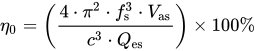
The formula for power efficiency says that efficiency is increased with increasing Fs. It's generally why high sensitivity woofers also have a higher Fs. This is from the wikipedia article linked below.

A version that is more easily calculated with typical published parameters is:η0=(4⋅π2⋅fs3⋅Vasc3⋅Qes)×100%
{\displaystyle \eta _{0}=\left({\frac {4\cdot \pi ^{2}\cdot f_{\rm {s}}^{3}\cdot V_{\rm {as}}}{c^{3}\cdot Q_{\rm {es}}}}\right)\times 100\%}


SPL or sensitivity is related to power efficiency.

 
Last edited:
Back
Top Bottom