• The move to the new server is done. There are some software and database maintenance updates in process. This has us passing the hat around to help out. We appreciate any donations. Seriously, even a dollar helps. The payment page may be found here - https://www.audiokarma.org/support.html

Variable resistor potentiometers for AR, Infinity, etc - replacements?

avguytx

Lunatic Member
Ok....I have spent literally hours researching online and the daunting task of searching within AK for information before deciding to post this. I have a few pairs of speakers that use these good 'ol variable resistor potentiometers....my AR-11's, AR-2ax's and Infinity Quantum 3's. Yes, I know these can be cleaned and gotten "close" but I have some in my Quantum's (at least 3 out of 6) that are rough feeling and still have drop outs. Plus, they were rusted and corroded beyond belief and the dremmel starts taking more off than you want. So, the question is...has anyone found suitable, reasonably economical, replacements for these? To my understanding, they can range in their impedance. I think some are 5-ohm 25 watt that I've read but I'm sure they could be different on all of them no matter how much the same they look.

Wouldn't it be nice for all of us to know what replacements could be used versus trying to clean pots that are beyond help or solder replacement resistors in? Just curious.... Maybe it's just me. I like the controls personally because you can tailor them for a given room instead of the tone controls. Especially when you have (3) pots per cabinet like the Infinity Quantum 3's or the other QLS models (or AR, Dahlquist, etc, etc)

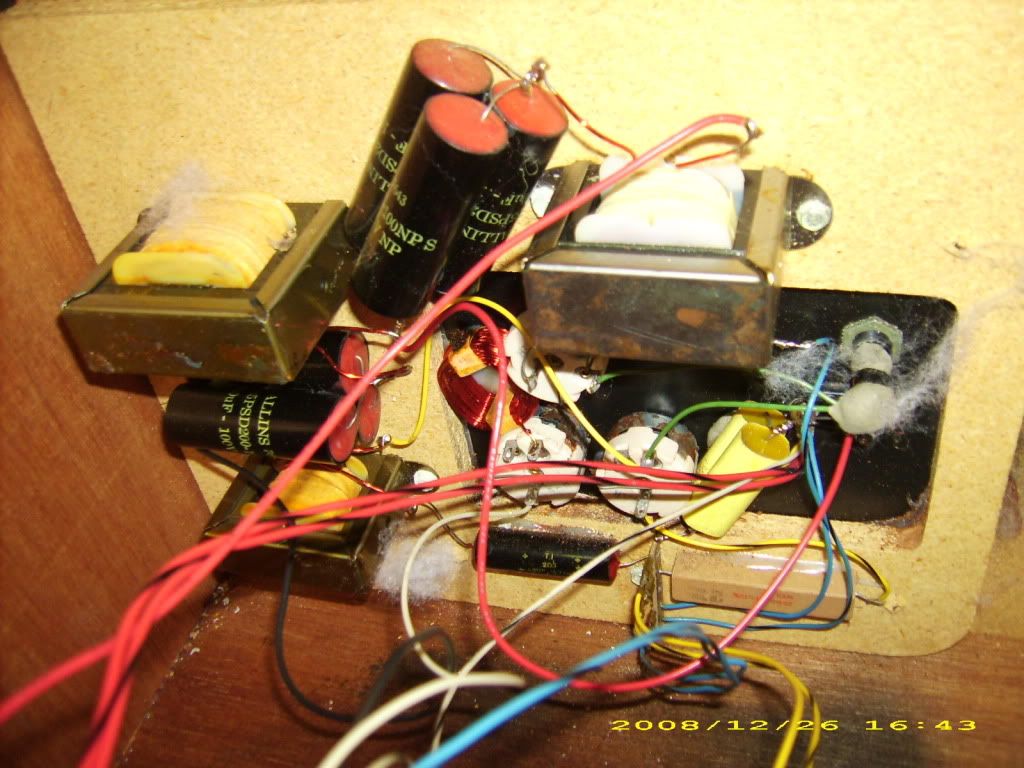
Here's a picture of the culprits in the Quantum 3's.
019.jpg


018.jpg


In my Infinity RS-IIIa's, which are about to get recapped this coming weekend, they use what I would assume to be L-pads which were cleaned and work almost perfect. It's too bad they can't be used since they are reasonably priced in comparison.

001.jpg
 
Register to hide this ad
The closest thing that is reasonably available is a 15 ohm ohmite rheostat/pot with an open back. It needs to have a back shield of some sort added to keep stuffing out of the windings and it's probably too big to fit into tight spaces like the three-pot in your photo.

It is possible to combine L-Pads with resistors to simulate the performance of the originals, but the exact values will vary with the specific crossover design.
 
These won't be for the AR-11's as their controls are 3 position toggle switches which work great. These would be for my Infinity Quantum 3's. I guess what I could do is see what pots are in the AR-2ax's I have here (one pair of newer versions and an orphan older one) and maybe rob those out of there if they are in decent shape since I haven't listened to them in over 3 years. Newark seems to have the best price ($26.75 ea) on the Ohmite RHS-15R which the Classic Speaker pages says is the best "replacement" for the original one. I guess it depends on just how well I want them to work. :D I think I'll pull out some of the ones out the AR-2ax first and meter them...then compare to the Quantum 3's.

Thanks for the link!
 
Last edited:
Apparently, I had taken pictures of the AR-2ax crossovers and all 4 of their pots appear to be in outstanding shape. If I remember right, I did clean these up and they turned out good. These may end up being the "sacrificial lambs" since I don't listen to them anyway. If they control the right range, that is.

002.jpg


004.jpg
 
the AR's are just 0-16 ohm pots....

measure your infinity's pots with an ohm meter to find out what they are...a 5 or 8 ohm pot won't give you the attenuation that a 16 ohm one will.
 
Last edited:
Would these work?
http://www.tedss.com/H95-C26/
(for the quantums)

They very well might! Thanks for that link and any research you did!

the AR's are just 0-16 ohm pots....

measure your infinity's pots with an ohm meter to find out what they are...a 5 or 8 ohm pot won't give you the attenuation that a 16 ohm one will.

I should have done that when they were all apart last weekend. I really don't know why we didn't do that to test the range and accuracy of the existing pots. That will have to be a this weekend project before classes start back on Monday.
 
The nominal rating of the Aetna-Pollak control was 15 ohms, but their extremes vary greatly. Measured examples may have a max as high as 17 ohms with a min anywhere from 0.25 to a full ohm.
 
Electrolytic acid from caps

They very well might! Thanks for that link and any research you did!


I should have done that when they were all apart last weekend. I really don't know why we didn't do that to test the range and accuracy of the existing pots. That will have to be a this weekend project before classes start back on Monday.


I have a set of QLS-1's and Quantum 3's as well. I recently took out (from QLS-1) one of the pots to inspect and clean up to see how it did. While it was out, I measured it as a scratchy 0 - 5 ohms. It actually went about 5.3 or 5.4 ohms but close enough. I have uploaded macro pics of the pots as apart. I hope this helps some to understand a bit better what we are dealing with. I wasn't too sure and hadn't found any pics myself in my searches, so I'm offering up these. Note the blue stuff, which I somewhat expected to find. I was surprised though to see so much white corrosion with absolutely no evidence of moisture damage or water getting in. This white corrosion completely coats my HUGE cap holders in the bottom of the cabinet. My conclusion is that the large electrolytic caps contain an electrolyte (http://en.wikipedia.org/wiki/Electrolytic_capacitor) and this electrolyte liquid (think car battery here...) has evaporated and settled into the bottom of the cabinet. What I find noteworthy is that the lower two pots are severely corroded and the upper single one is far less this way, leading me to believe the gases settled just below the upper pot and from there down got a light acid bath. No wonder the copper voice coil wires sometimes go bad at connections. I've been told not to use electrolytics if at all possible. This could be a good reason to avoid them:yes:, not to mention that mylar probably sound better anyway. Haven't got that far myself to compare as I've only been a converted audiophile for about 6 months after a major find at a yard sale. :music:
 

Attachments

  • IMG_1825.jpg
    IMG_1825.jpg
    52.8 KB · Views: 83
  • IMG_1826.jpg
    IMG_1826.jpg
    51.1 KB · Views: 78
  • IMG_1828.jpg
    IMG_1828.jpg
    53 KB · Views: 93
  • IMG_1836.jpg
    IMG_1836.jpg
    98.4 KB · Views: 85
  • IMG_1833.jpg
    IMG_1833.jpg
    103 KB · Views: 86
Here's a pic of the cap holders I mentioned, as well as a pic of the acid bath. Note only two pots shown. The missing one was on my desk at the time and appeared fairly clean, which is why I started with that one. I can't wait to rebuild all of this.
 

Attachments

  • IMG_1822.jpg
    IMG_1822.jpg
    80.3 KB · Views: 66
  • IMG_1818.JPG
    IMG_1818.JPG
    130 KB · Views: 69
Great pics ghuntley!

Mine had water damage so the corrosion seemed logical at the time.

JT, sorry I missed your post. I got refurbed pots from cdfac so I never have tried the pots I posted.
 
I have a set of QLS-1's and Quantum 3's as well. I recently took out (from QLS-1) one of the pots to inspect and clean up to see how it did. While it was out, I measured it as a scratchy 0 - 5 ohms. It actually went about 5.3 or 5.4 ohms but close enough. I have uploaded macro pics of the pots as apart. I hope this helps some to understand a bit better what we are dealing with. I wasn't too sure and hadn't found any pics myself in my searches, so I'm offering up these. Note the blue stuff, which I somewhat expected to find. I was surprised though to see so much white corrosion with absolutely no evidence of moisture damage or water getting in. This white corrosion completely coats my HUGE cap holders in the bottom of the cabinet. My conclusion is that the large electrolytic caps contain an electrolyte (http://en.wikipedia.org/wiki/Electrolytic_capacitor) and this electrolyte liquid (think car battery here...) has evaporated and settled into the bottom of the cabinet. What I find noteworthy is that the lower two pots are severely corroded and the upper single one is far less this way, leading me to believe the gases settled just below the upper pot and from there down got a light acid bath. No wonder the copper voice coil wires sometimes go bad at connections. I've been told not to use electrolytics if at all possible. This could be a good reason to avoid them:yes:, not to mention that mylar probably sound better anyway. Haven't got that far myself to compare as I've only been a converted audiophile for about 6 months after a major find at a yard sale. :music:

Well I do not think this corrosion is caused by the electrolytics, IMHO it is
caused by the heat that is generated look closely these look like heater coils.
Well when they cool down moisture is formed and leads to the corrosion.

As far as not using electrolytics in a Xover I agree with you but in this case these caps are used by the Watkins woofers.
Two LCR circuits which establish the resonance frequency of the woofer.
In the Infinity forum you can find a white paper on this subject.

I am sure cost was the reason for using them.

It is quite spendy to replace 1600 or 1300 uf caps with film.

EW thoughts on the matter was using two electros in parallel to make a NP cap this would also be acceptable I think.

Anyway get them back together and enjoy them. :music:
 
Well I do not think this corrosion is caused by the electrolytics, IMHO it is
caused by the heat that is generated look closely these look like heater coils.
Well when they cool down moisture is formed and leads to the corrosion.

As far as not using electrolytics in a Xover I agree with you but in this case these caps are used by the Watkins woofers.
Two LCR circuits which establish the resonance frequency of the woofer.
In the Infinity forum you can find a white paper on this subject.

I am sure cost was the reason for using them.

It is quite spendy to replace 1600 or 1300 uf caps with film.

EW thoughts on the matter was using two electros in parallel to make a NP cap this would also be acceptable I think.

Anyway get them back together and enjoy them. :music:

I would agree that you could be right about the condensation build up contributing to the corrosion. I now tend to think that perhaps we both might be right to some extent. Electrolytics do in fact contain electrolyte and they are known to lose it or gas it off. It's gotta go somewhere and is perhaps evidenced by the blue build up on the pots that resembles that on car batteries. Perhaps the added condensation you describe is precipitating electrolytic moisture trapped? hmmm... Well at any rate, I'm hoping to have time tonight to de-solder the caps and test the capacitance. I'll post later what I found.

So, just how much might one expect to pay for film replacements for these caps? I do know it is expensive but haven't found prices yet for the biggies. Any recommendations or directions to threads are welcome.
 
I'd like to believe that you'd gain little by replacing the watkins electolytics with polys. That's what I've been told in past threads...
http://www.audiokarma.org/forums/showthread.php?t=71339
http://www.audiokarma.org/forums/showthread.php?t=215773
http://www.audiokarma.org/forums/showthread.php?t=166374
...though I can't recall who said so. There may be some advantage to using small poly bypass caps in parallel with electrolytics for that circuit, some swear by it, I've never tried. Someone stated that replacing the iron core inductors in the watkins circuit with custom wound air cores reduces distortion, costs lots.

Regardless, it's good reading for anyone doing a Quantum refurb.
 
Two more things to mention:
I never checked whether the cap holders are ferrous metal, could the corrosion possibly be electrolysis from two dissimilar metals?

Paralleled poly caps of the values you're talking about (1100mfd, 1400mfd) will take up ALOT of space regardless of cost, might require a separate box for the watkins circuit. Someone has already gone this route with a RSIIB refurb here at AK.
 
I'm seeing the same white material, but it's on my screw heads also. I'm wondering if it's the zinc or whatever they coat the metal with to protect against rusting. I took a wire brush and screwdriver to remove it. The surface coating of the metal parts is now mostly missing.

upload_2023-5-6_19-14-58.png
 
It's oxidation that occurs when bare metals are exposed to air. IOW, it's corrosion.

Oxides on metals do form a sort of protective film, because they reduce bare metal exposure. Now that you have removed the oxide, the metal will start to corrode again until enough oxide forms to replace the film.
 
Back
Top Bottom