• The move to the new server is done. There are some software and database maintenance updates in process. This has us passing the hat around to help out. We appreciate any donations. Seriously, even a dollar helps. The payment page may be found here - https://www.audiokarma.org/support.html

Saving Unican Eric's Philips AG9016 From the Dumpster

Leestereo

Super Member
Part I: The Repair Disaster

Unican Eric asked me to complete the restoration/upgrade of his Philips AG9016, a small single-ended integrated tube amplifier, which he acquired last year. Here is his original post: http://www.audiokarma.org/forums/showthread.php?t=510489

His local tech had "...been modified [it] to allow hookups without damaging the back end of the unit for speakers and cd player." And now Unican Eric wanted me to install proper RCA jacks and speaker connectors and to see if I could improve the sound since it is "dull and has no treble."

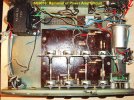
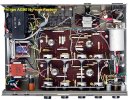
I read over Unican Eric's original AK post, and I downloaded the service manual (in Dutch!) and did some on-line research into possible circuit mods. It looked like a fairly straight forward project, then...I opened up Unican Eric's actual unit and was dismayed to see that the Philips was now is quite different from what he had originally posted. It became obvious that the previous tech did a less than stellar job:
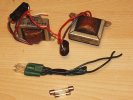
-the original small output transformers replaced with even smaller ones
-original pilot lamp was replaced with 3 Christmas tree lights
-wrong sized fuse soldered onto the smaller blown original fuse
-original EL95 output tubes replaced by 6AQ5 tubes (not a suitable replacement since it draws almost twice the plate and heater current).

When I informed Unican Eric of what I had found under the hood, he was less than happy: "I am very upset at my tech, all he was supposed to do was replace the power cord and hook it up so I could play my cd player etc: Why he would replace what he did?" I told him that it would be difficult, if not impossible, to find the original parts to restore the Philips to its original state. Upon hearing this last bit, Unican Eric decided to "scrap the restoration on the Philips. Let me know what I owe you and if you want you can keep the Philips as well for parts or whatever or toss it." What a shame, I thought; the Philips AG90106 metal work is quite good with heavy gauge steel which is tapped for threaded machine screws, decent sized power transformer, and the pcb is sandwiched between rubber washers to absorb vibrations. Wanting to preserve the Philips case, asked Unican Eric if he wanted a tube preamplifier. I thought that it would be nice to have the Philips redone as a stand alone preamplifier with full use of the tone and balance controls. So instead of a very low powered tube integrated amp with limited bandwidth, he would have a full bandwidth tube preamplifier that would be more useful.
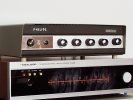
AG9016 Factory.jpg

AG9016 Hacked AK.jpg

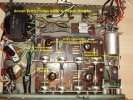
AG9016 Repair Parts AK.jpg
 
Last edited:
Register to hide this ad
Hiya,

Christmas Lights as a pilot light .. never thought of that one even in my most stoned state.

Looking forward to this rebuild and your impressions :)

Frannie
 
Part II: The AG9016 Cathode Follower Preamplifier

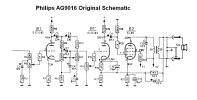
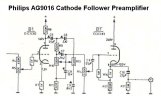
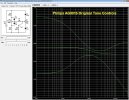
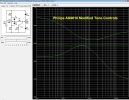
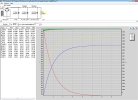
The initial plan for the new preamp circuit was to convert the existing single 12AX7 per channel to a gain stage with a cathode follower. The decision to keep the passive tone controls was expected to drop the signal by about 20dB, but the high gain of the 12AX7 should more than enough to compensate. The original tone circuit was evaluated with Tone Stack Calc 1.3 and modified to give a flat response with the controls at mid-point.

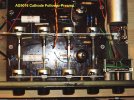
The first implementation of the cathode follower circuit with the existing power supply was completed as a proof-of-concept build. This initial build revealed a problem with the cathode follower which was solved with the help of AK members (see http://www.audiokarma.org/forums/showthread.php?t=573959 for details). With the mains AC at 121V, all of the voltages measured higher than indicated in the original schematic. In particular the AC heaters were at 7.4V, which may shorten the life of the tubes. Sonically, the preamp sounded very nice, but there was a low level buzz.hum audible in the background (heard on headphones or if within a foot of a speaker). The buzz was suspected to be from the AC heaters.

AG9016 Schematic Original CleanAK.jpg

AG9016 Schematic mod.jpg

AG9016 tone original AK.jpg

AG9016 tone mod AK.jpg

AG9016 Stripped AK.jpg

AG9016 Cathode Follower AK.jpg
 
Last edited:
Part III: New Power Supply & DC Elevated AC Heaters

The first power supply issue which had to be resolved was the high heater voltage, which varied between 7.2V -7.5V (depending on the mains AC voltage). The AG9016 power transformer is a multi-voltage type and according to the service manual, it appears to have been set to "110V". Interestingly, the next higher voltage configuration was labelled as "127V"; nevertheless, with this wiring change, the heater voltage dropped to 6.2V-6.4V.

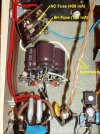
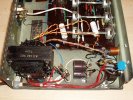
The new power supply was designed with the help of PSU Designer II; the final value of the dropping resistors were determined empirically to obtain a B+ of 295V. With a bank of three 470µ/350V capacitors and two 8.2kohm dropping resistors, the power supply ripple would theoretically be attenuated by about 100dB. These power supply components were installed in the space previously occupied by the output transformers rather than near the inputs as the in original power supply. This location should minimize noise and hum being pick up by the circuit.

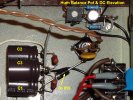
To eliminate the heater low level buzz/hum noise, a small 500ohm potentiometer was wired to the AC heater filament secondaries and the center tap was disconnected from the chassis ground. Further, the wiper of the hum pot was connected to a 55V DC source (voltage divider on the B+) to provide a DC elevation of the AC heater circuit. With these changes, the low level buzz/hum was completely eliminated; no noise can be heard even through headphones.

AG9016 PS Original.jpg

AG9016 PS New AK.jpg

AG9016 Power Supply 1 AK.jpg

AG9016 Power Supply 2 AK.jpg
 
Last edited:
Part IV: Replacement of DIN connectors with RCA Jacks

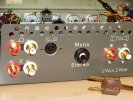
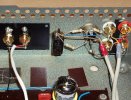
The AG9016 uses obsolete 5-pin DIN connectors for source input and these were replaced with nice Rean/Neutrik RCA jacks. Similarly, the Bakelite DIN speaker connectors were replaced with the same type of RCA jacks. The input RCAs are mounted directly onto the chassis (but are electrically isolated). The output RCAs had to be mounted on a blank board of black phenolic which in turn was attached to the chassis.

AG9016 RCAs 2AK.jpg

AG9016 RCAs Inside AK.jpg
 
Last edited:
Looks good. Shame that someone did it no favors in the past. Sadly, cleaning up prior bad work is usually more time consuming than just fixing broken stuff.
 
Part V: From Cathode Follower to Mu Follower

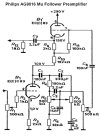
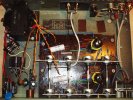
One of the challenges of this project was to adapt the original pcb to the new preamplifier circuit in order to have functional tone and balance controls. From the original layout, it seemed that a cathode follower topology would be relatively easy to implement and in fact all of the new components were installed using the original traces. I had intitially wanted to try a mu follower circuit since I consider this to be a superior topology to the cathode follower, but the pcb layout didn't seem to be compatible. However, as I was removing the last of the superfluous original components (the permanent "loudness" contour) I noticed a way of implementing a mu follower by running two additional jumpers from traces that the "loudness" circuit had used. For the mu follower, I also removed the cathode bypass capacitor which lowered the gain a bit and as a result of the cathode degeneration feedback.

ag9016 mu follower schematic.jpg

AG9016 Top Final AK.jpg

AG9016 PS final AK.jpg
 
Last edited:
Part VI: How Does It Sound?

I had the opportunity to listen to the AG9016 mu follower preamplifier for 4 days before Unican Eric came by to pick it up. The Philips has a pair of 1965 Mullard (branded Rogers) 12AX7s installed and IMO, its an amazing, wonderful sounding preamp. Its extremely quiet (solid state quiet) and very clean and neutral sounding; there is a slight warmness to its sound as compared to a solid state preamplifier, probably due to the dominant second harmonic distortion; but one would not automatically think it was a tube unit from its sound. For example, compared to my Conrad Johnson PV-8, the Philips isn't anywhere as tubey or euphonic sounding. Nevertheless, this Philips AG9016 is without doubt an excellent line stage preamplifier.

ag9016 playing2 AK.jpg
 
Last edited:
Hiya,

Christmas Lights as a pilot light .. never thought of that one even in my most stoned state.

Looking forward to this rebuild and your impressions :)

Frannie

And how stoned was your most stoned state? Snozzberries tasting like snozzberries? :scratch2:

2511433328_e0d5a6bd54.jpg


-D
 
I must say after reading the posts by Ben I really didn't realize the work he put into this Philips. He did send me e-mail with pictures and progress but because of the time between these e-mails you kinda forget the whole story of what was being done.

I am very happy to have this project now sitting in my computer room hooked up with a set of Energy 5.1e and a Kenwood M1 power amp.
The hardest part of this is remembering the order to turn on all the components..lol.

The sound is just unreal, so very clear and the bass is all there with very smooth vocal and highs. This preamp makes my C1 pale in comparison.

I tested it with Linda Ronstadt and the Nelson Riddle Orchestra and the sound made the hair on my neck stand up it was that good. I said in an e-mail to Ben that I kept waiting for my tweeters to give out but they held on for the full ride. I then played Days Of Future Passed by the Moody Blues and just let myself enjoy the music.

Ben did a fantastic job of fixing up this mess and has allowed me to hold on to this little gem of history. He truly is amazing in this field of electronics.

To my other tech guy, well your fired. :twak:
 

Attachments

  • 20140309_204830.jpg
    20140309_204830.jpg
    53.4 KB · Views: 55
Hiya,

Excellent analysis and write up :)

To my other tech guy, well your fired.

Instead of the holiday card how about a Bouquet made of those Xmas lights.

And how stoned was your most stoned state? Snozzberries tasting like snozzberries

I lost the whole decade of the 1980's .. that stoned enough ?? .. although my mom say's blonde runs in the family and we miss place things.

Frannie
 
Hiya,

Well I think I posted that before I was actually MOTY .. :)

But I meant that and even more as this is an example of a useful , coherent thread that should stand as a model for how things are done in this joint.

Frannie
 
I thought I might revive this interesting thread. I have one of these that I'm presently refreshing, and converting to modern style connectors, and have a couple questions. First off, I can't seem to find a schematic that includes the power supply. Like the amp that started this thread, mine has been "worked on", especially in the power supply area. I'll probably just get the meter and load simulator out and do a design build, but it would be nice to see what they originally used. There seems to be some sort of either overload, or soft start electro-mechanical bimetal switch on the side of the power TX. I would also be curious about getting one of these as flat as possible. The loudness and treble set up seem curious to me, as the treble control, (if I'm seeing things right) can only cut, and not boost the higher frequencies. These seem to be either loved or hated as integrateds, and like the HF81, the specs would leave one wondering why the love, which is proven by the prices they command. I think it's more the EL95 tube that has my interest peaked
 
Hiya,

Excellent analysis and write up :)


Instead of the holiday card how about a Bouquet made of those Xmas lights.


I lost the whole decade of the 1980's .. that stoned enough ?? .. although my mom say's blonde runs in the family and we miss place things.

Frannie

Ha, just caught this post. I haven't smoked a doob in a long long time, but I think I could enjoy sitting down in front of a good rig with some good tunes, and burning one with you.
 
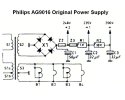
...but it would be nice to see what they originally used. There seems to be some sort of either overload, or soft start electro-mechanical bimetal switch on the side of the power TX.

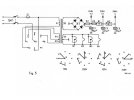
Here is a schematic of the complete power supply as it appears in the Philips service manual:

AG9016 PS complete.jpg

I would also be curious about getting one of these as flat as possible. The loudness and treble set up seem curious to me, as the treble control, (if I'm seeing things right) can only cut, and not boost the higher frequencies.
The treble control does give a small boost (~3 dB) at its maximum setting. To "flatten" the frequency response (as shown in post no. 3), the loudness components (C4/C34 and R3/R33) should be removed and in the tone control circuit, R11/R41 should be changed to 33kohm (from the original 10kohm) and R12/R42 (12kohm) should be removed.

Let me know if you need a copy of the service manual (in Dutch).
 
Last edited:
Back
Top Bottom