Olden Multi-way speakers .VS. Modern Multi-way speakers

Ron_j

Active Member
Let me start with an apology if this topic has been discussed here before. It’s about differences in Multi-way Vintage speakers and modern Multi-way speakers.


I understand that these days the low to mid price-range multi-way speakers are maximum 3-ways with 3 or max 4 drivers. While in the olden times, speakers had 6,7 or even 8 drivers and were 5-way, 6-way etc. What exactly caused this paradigm shift? Better technology? Or better understanding of the basic science behind the speaker design? Like use of T/S parameters in speaker design?


I understand all that talk about separation issues, phase issues, coherency etc (esp. when musical instrument having its output frequencies broken into so many pieces that the output does not sound at all like the actual instrument). But strangely some hi-efficiency speakers I listened to; that are 5-ways or more but still sounded very musical and coherent to me…
Some such speakers are McIntosh ML-2C, Sansui SP-Z9 etc.


Another thing is their crossover frequency selection. For eg. For McIntosh ML-2C the Crossover frequencies are: 250 Hz, 1.5kHz, 3kHz and 7kHz. So there is no 10:3.4Octave or 8:3 Octave consideration here. Why and how? Those days what was the basic consideration for crossover design? Since there were no T/S Parameters etc… What’s the basis of choosing those Xover points? I am intrigued…
 
Last edited:
Register to hide this ad
I honestly suspect some of those many-multi way speakers were marketing gimmicks. There are lots of vintage fullrange, 2 way and 3 way configurations right along with those 6 ways. Often, the 2 and 3 ways sound better than the ones with a half dozen drivers. They don't look as cool, and "3 way speaker" doesn't sound as cool as "6-way speaker" in marketing terms.
 
I'm with Gadget, if you look at the timeline history of what was in the market, you'll see that 4 or> way speakers started to appear at the same time. I would date the move to more complex alignments to somewhere in the late 70's, early 80's. At this time, JBL was one of the major players and their larger Monitors incorporated more than three drivers. There was a lot of mimicry of the JBL designs, including slant lenses, bullet tweeters, etc..
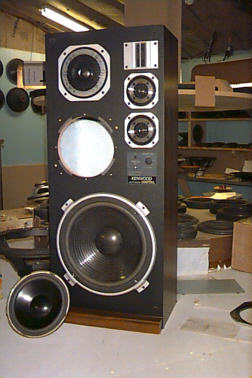
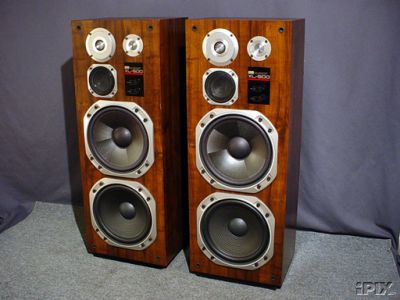
The early 80's produced a lot of what is referred to as Kabuki systems, multiples of the same sized drivers, maybe even a horn. Look at the Pioneer CS-xx series for an example. Sansui was a big proponent of this design, too, as were most of the Japanese brands.

Crossover networks were dependent on the frequency response of the drivers, nothing old or new there. A better network or best alignment of drivers will try to keep the pass bands out of the range of voice and more common instruments, where a large part of our listening discernment is centered.
 
I have tried to figure out the older "Kabuki" and +4 driver multiway designs. I can only attribure this to marketing for the most part. The more drivers the better the sound- damn the actual results. Back then driver technology at best was limited, stuff enough of them into a box and create a xover to work, doll it up and sell them. Did not matter the grill covers killed half the music and rattled, or the driverd were shrill and bottomless.

Macintosch was one of the very few who took the time to get it right with multiway components along with JBL. They understood true component integration! The only mass produced model I recall getting half praise were the Pioneer DX 63's. Established people like ElectroVoice, Altec, JBL Macintosch, Utah and a couple others were off and running early, the Japanese were trying to create their own sound.....and did!
DC
 
One of the primary considerations with the McIntosh speakers was power handling. IIRC, Gordon Gow was concerned that the company's speakers couldn't take the power of its own amplifiers, so one of the engineer's design goals was to achieve this with acceptable distortion. When the spectrum is divided more often, the overall max power vs. frequency curve is much smoother and the area under the curve much greater, all other things equal. Total power response/directivity should be smoother/better managed with more "-ways."

With the Sansui, I expect the same applied with maybe a bit more influence from the marketing/styling departments.
 
So all those more than 3-way systems really didn't sound all that great? Is that the general consensus here? And most of those systems didnt give a rat's a** to coherency or transparency?


So they were like the "Digital Speakers" from Kenwood, Cerwin Vega, Technics etc from late 80s to mid 90s? A mere marketing gimmick?

Another question I had was; which way did they design crossovers beyond 3-ways... a set of many narrow band pass filters?

To be frank I haven't seen any crossovers with 5-way or more up close... Anyone here got an example schematic to upload?
 
Last edited:
Seems as though Dahlquist got it right with their 4 way DQ10's back in the day. And the drivers weren't anything special either. Makes you wonder why the Japanese couldn't do it with their multi driver speakers. Almost like they didn't really care how bad they sounded.
 
Basically speaking once you understand how capacitance, resistance and inductance applies to filtering frequency you can built any multi driver network you want. Generally speaking certain value capacitors will filter/pass certain frequency, as does various value inductors. Combined they would effectively create a given "slope" or steepness between the given frequencies.
Find a good crossover programs and it will allow you to plug in given frequencies and driver impedances to obtain certain frequency divides and slopes. Bad news is that many crossover programs only go as far as 3 way designs. If ou do find a schematic for a 4+ driver setup ( see DQ10) it will be partially based around those particular drivers being used. ALL drivers have unique impedance curves, power handling and sonic signatures that make them viable for a given design. Trying to copy a x-over design and inserting your own drivers is an act of pure folly!
DC
 
I suspect that they were inspired as gimmicks and had the same chance of sounding good as a 3 way. I also wonder if they died out because the trend to surround sound which already has more gimmicks than you need. We do have plenty of excursions into unusual tech today though. I believe it is my NHT's that have 2 identical drivers that are crossed over differently to yield one mid and one mid woofer in addition to a sub-woofer and a dome tweeter. Is that a 3 way 4 driver or is that a 4 way?
 
So all those more than 3-way systems really didn't sound all that great? Is that the general consensus here? And most of those systems didnt give a rat's a** to coherency or transparency?


So they were like the "Digital Speakers" from Kenwood, Cerwin Vega, Technics etc from late 80s to mid 90s? A mere marketing gimmick?

Another question I had was; which way did they design crossovers beyond 3-ways... a set of many narrow band pass filters?

To be frank I haven't seen any crossovers with 5-way or more up close... Anyone here got an example schematic to upload?

It depends on the design. I mean, I have a cheap, $250 JVC MXGB5 compact system (Nicer than Bose for the money though) that came with 4-way speakers (They actually sound quite-good for what they are... Nice bass... It's been several years since I've heard it though... Things have changed A LOT since then). But then I also have my big W90's, which are a 6-driver, 3-way system. And the W90 from a few years later is a 4-way design that gets excellent reviews. You have 3-ways and 4-ways at both ends of the budget spectrum.

The McIntosh ML2C actually needs the McIntosh MQ101 or MQ102 equalizer in order to sound right, so that's a rather-unique example (Sort of a 5-way system with baggage, I guess). Sansui got a lot right back in the day. They made many speakers that are very-smooth and musical, just like their early solid-state amps and receivers. They put out some fine products under Kikuchi's direction, and even after he retired. Basically, there's just a lot of different viewpoints out there about how to get good sound.
 
Last edited:
Basically speaking once you understand how capacitance, resistance and inductance applies to filtering frequency you can built any multi driver network you want. Generally speaking certain value capacitors will filter/pass certain frequency, as does various value inductors. Combined they would effectively create a given "slope" or steepness between the given frequencies.
Find a good crossover programs and it will allow you to plug in given frequencies and driver impedances to obtain certain frequency divides and slopes. Bad news is that many crossover programs only go as far as 3 way designs. If ou do find a schematic for a 4+ driver setup ( see DQ10) it will be partially based around those particular drivers being used. ALL drivers have unique impedance curves, power handling and sonic signatures that make them viable for a given design. Trying to copy a x-over design and inserting your own drivers is an act of pure folly!
DC


I understand this perfectly. In fact I have been doing DIY speakers for sometime and I use tools like Dayton Audio's WT3 for driver impedance graph and design crossovers based on that. So do I use the WT3 for enclosure design(by measuring T/S)

by saying
To be frank I haven't seen any crossovers with 5-way or more up close... Anyone here got an example schematic to upload?
what I meant was I would like see how and what arrangement the crossover of these more than 4way speakers looked like. Because if the crossovers are designed badly there will be unpredictable gains in the pass-band frequencies. Also then there are considerations for 8:3 or 10:3.41 Octave considerations between the upper and lower crossover points in a 3-way system unless you want to use Very Narrow Band Filters/Notch Filters for specific response characteristics.

So yeah my curiosity to see a schematic is purely academic in nature... Not to sacrilegiously copy a crossover and plonk some drivers in it. Don't worry!:D
 
Gimmick:
kenwood.jpg


Gimmick:
XL500_1.jpg


Engineering:
product_119427.jpg


Engineering:
refstan1.jpg
 
I understand this perfectly. In fact I have been doing DIY speakers for sometime and I use tools like Dayton Audio's WT3 for driver impedance graph and design crossovers based on that. So do I use the WT3 for enclosure design(by measuring T/S) D

In part yes, you take the measurements derived from that and plug them into another suitable design program like Bass Bx Pro 6, WinPro, etc. I do not think that the WT programs have box design incorperated into them.
DC
 
In part yes, you take the measurements derived from that and plug them into another suitable design program like Bass Bx Pro 6, WinPro, etc. I do not think that the WT programs have box design incorperated into them.
DC

I had written "WT3 for enclosure design(by measuring T/S)" means to measure Thiele/Small parameters(Vas, Driver Fs, Qts etc) that will be used for enclosure design. Not that WT3 used for Enclosure design. :no:
 
Last edited:
I suspect that they were inspired as gimmicks and had the same chance of sounding good as a 3 way. I also wonder if they died out because the trend to surround sound which already has more gimmicks than you need. We do have plenty of excursions into unusual tech today though. I believe it is my NHT's that have 2 identical drivers that are crossed over differently to yield one mid and one mid woofer in addition to a sub-woofer and a dome tweeter. Is that a 3 way 4 driver or is that a 4 way?
Those would be 3.5. The ".5" designation refers to two identical drivers with different frequency handling.

I understand this perfectly. In fact I have been doing DIY speakers for sometime and I use tools like Dayton Audio's WT3 for driver impedance graph and design crossovers based on that. So do I use the WT3 for enclosure design(by measuring T/S)

by saying
what I meant was I would like see how and what arrangement the crossover of these more than 4way speakers looked like. Because if the crossovers are designed badly there will be unpredictable gains in the pass-band frequencies. Also then there are considerations for 8:3 or 10:3.41 Octave considerations between the upper and lower crossover points in a 3-way system unless you want to use Very Narrow Band Filters/Notch Filters for specific response characteristics.

So yeah my curiosity to see a schematic is purely academic in nature... Not to sacrilegiously copy a crossover and plonk some drivers in it. Don't worry!:D
Unpredictable gains, sure there were. Phase shifting, you can bet on it. Notch filtering and Zobel, hardly present. The speaker builders of the Kabuki era used the cheapest stuff to get by. They were not designing the speaker system nor the crossover network to be the best possible combination but trying to incorporate as many drivers as was economically feasible into a box.
From what I remember from looking at the few 4 way (or greater) that I've had, is the network filtered the drivers on one end of the frequency and they were allowed to naturally roll off on the other end.

Not WT3 used for speaker design. :no:
It might be easier to follow if you transpose "speaker" to "enclosure".
 
I had a pair of Sansui SP-3000 and SP-2500 speakers with a Sansui 4000 receiver. Sounded ok, but the speakers still had the original capacitors. I suspect that had I recapped them the sound might have been much better.
 
So all those more than 3-way systems really didn't sound all that great? Is that the general consensus here? And most of those systems didnt give a rat's a** to coherency or transparency?
There are way more done wrong than right. The people that got it right may only amount to a handful. There is a misconception that all is sacrificed if you have xyz amount of crossover points. I can loosely agree that certain frequency ranges shouldn't be interrupted. What if the gains outweighed the losses?

So they were like the "Digital Speakers" from Kenwood, Cerwin Vega, Technics etc from late 80s to mid 90s? A mere marketing gimmick?
For the people that got it right it was not a gimmick.

Another question I had was; which way did they design crossovers beyond 3-ways... a set of many narrow band pass filters?
The only instance that is an absolute is a high pass to the highest freq. tweeter. I have never seen a HF cutoff. The remainder of the drivers should have a band pass filter. The only other item to cover is the subwoofer. It can have a LF cutoff filter for the protection of the driver making it a band pass.
To be frank I haven't seen any crossovers with 5-way or more up close... Anyone here got an example schematic to upload?
Realistically you need to give attention to active crossovers at this point. The complexity and losses of a passive crossover will quickly add up. These two schematics combined will go something like this
passive>pllxo HP>active LP to give you a 5 way. These items were marketed and sold this way.

http://www.jbl.com/resources/Brands...Documents/en-US/technicalsheet/250tiBQ ts.pdf

http://www.jblproservice.com/pdf/Vintage JBL-UREI Electronics/UREI- BX63A ts.pdf
 
It might be easier to follow if you transpose "speaker" to "enclosure".
I agree... In fact that's what I meant(enclosure) when I wrote "Speaker" it was like a typo. Anyway I was trying to clarify to the other comment that, WT3 was used for aiding the enclosure design not "for" enclosure design :)
 
Back
Top Bottom